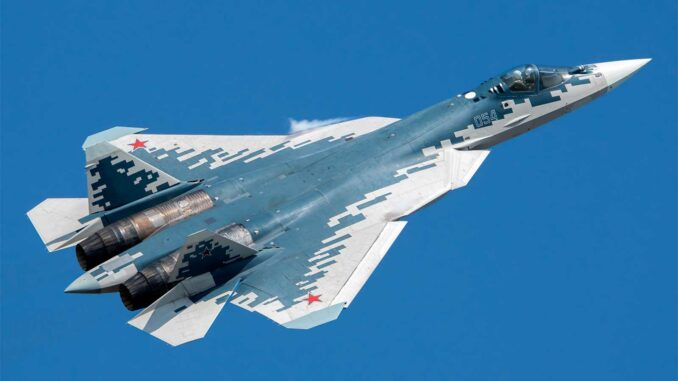
The Su-57 finally receives its definitive engine. What the Izdeliye 30 really changes in terms of performance and balance compared to Western fighters.
In summary
On January 3, 2026, United Aircraft Corporation confirmed that all new Su-57s will now be delivered with the second-stage Izdeliye 30 engine. This announcement marks a major technical breakthrough for the Russian program, which has long been criticized for relying on a transitional engine inherited from previous generations. The objective is clear: to improve supercruise, reduce fuel consumption, increase thrust, and bring the Su-57 closer to the expected standard for a fifth-generation fighter aircraft. This development changes the actual performance balance, but does not eliminate all of the aircraft’s structural limitations. Compared to Western fighters such as the F-35 or the Rafale, the Su-57 gains in kinematic credibility, without overturning the overall hierarchy. The engine corrects a major weakness, but does not transform the aircraft into a total strategic breakthrough.
The Russian announcement and what it really means
The information published in early January 2026 puts an end to a persistent ambiguity. Since its first operational flights, the Su-57 has been equipped with AL-41F1 engines, a direct evolution of the engines designed for the Su-35. This choice allowed it to enter service more quickly, but at the cost of a compromise on performance.
With the Izdeliye 30, Russia claims that the Su-57 has finally reached its target configuration. This decision only applies to newly produced aircraft, with the first models remaining powered by the older generation. This detail is important: it creates a heterogeneous fleet, with different capabilities depending on the batch.
From an industrial and political standpoint, this announcement also aims to lend credibility to the export program and demonstrate Russia’s ability to continue complex engine development despite sanctions and industrial constraints.
What the Izdeliye 30 changes in technical terms
The Izdeliye 30 engine was designed specifically for a modern stealth aircraft. It features increased thrust, improved energy efficiency, and a reduced thermal signature.
The precise figures remain partially classified, but open data suggests a maximum thrust of around 176 kN with afterburner (≈40,000 lb), compared to around 147 kN (≈33,000 lb) for the AL-41F1. Without afterburner, thrust would increase by nearly 15 to 20%.
This development allows the Su-57 to improve its supercruise capability, i.e., supersonic flight without afterburner. Whereas the first Su-57s struggled to maintain Mach 1.3 for long periods, the versions powered by the Izdeliye 30 aim for a steady speed of around Mach 1.5 to 1.6, depending on configuration and altitude.
Specific fuel consumption is reduced, which increases the range without increasing fuel weight. For an already large aircraft, this is a real operational gain.
Supercruise as a criterion of credibility
Supercruise is not a marketing ploy. It determines the ability to quickly penetrate contested airspace, reduce exposure time, and conserve energy in combat.
Until now, the Su-57 has often been compared unfavorably to Western standards in this regard. The F-22 maintains a reference speed of around Mach 1.7, while the Rafale can maintain Mach 1.3 to 1.4 depending on its load.
With the Izdeliye 30, the Su-57 is approaching the top of the kinematic spectrum. This does not mean automatic superiority, but a credible upgrade on a key criterion of aerial kinematics.
Impact on maneuverability and close combat
The Su-57 retains a conceptual advantage: the combination of its aerodynamic airframe and three-dimensional thrust vectoring. The new engine improves responsiveness at low and medium speeds, which enhances close combat performance.
In practice, this means a better ability to conserve energy after an aggressive maneuver.
When facing Western fighters, this advantage remains theoretical until the aircraft is engaged in realistic conditions, but it fuels the Russian doctrine focused on short-range combat.
However, extreme maneuverability does not always compensate for late detection or informational inferiority. The engine improves potential, not the overall engagement logic.
Comparison with other fighters in the same category
Compared to the F-35, the Su-57 adopts a different philosophy. The American fighter focuses primarily on data fusion, omnidirectional stealth, and network integration. The F-35’s engine is not designed for extended supercruise, but for overall efficiency in collaborative combat.
The Su-57, with the Izdeliye 30, is positioned more as a heavy multi-role fighter, capable of high speeds and extreme maneuvers. On the other hand, its stealth remains uneven depending on the angle, and its frontal radar signature is generally considered to be higher than that of Western aircraft.
When compared to the Rafale, the comparison is more nuanced. The French fighter is not stealthy in the strict sense, but benefits from controlled discretion, mature avionics, and great versatility. In terms of engines, the Rafale with its M88s has less thrust, but proven reliability and optimized fuel consumption.
The Su-57, powered by the Izdeliye 30, has the advantage in terms of maximum speed and raw power. The Rafale retains an advantage in operational maturity, availability, and multi-mission integration.
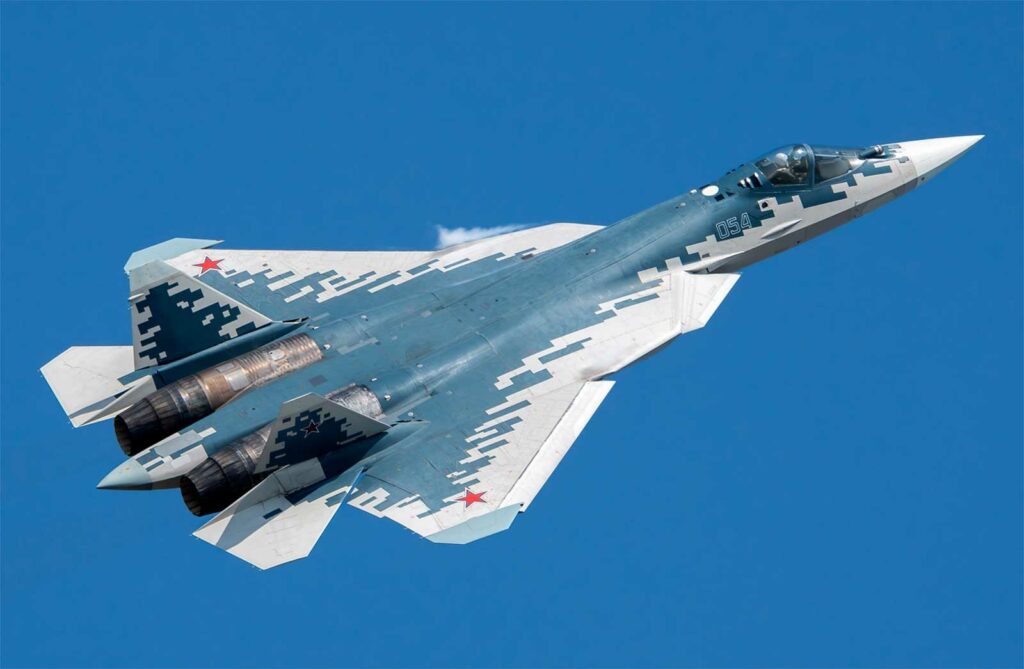
Limitations that remain despite the new engine
Changing engines does not solve everything. The Su-57 still faces several structural limitations. Its stealth, particularly lateral and rear, remains below US standards. Its internal payload is large, but restrictive for certain missions.
Production remains slow. Even with a standardized engine, production rates remain modest, with only a few aircraft delivered each year. This limits the real strategic impact in the short term.
Finally, although the Su-57’s digital ecosystem is improving, it has not yet reached the level of network integration of Western forces. The engine improves the platform, but not the overall collaborative combat architecture.
What this means for Russian doctrine
The adoption of the Izdeliye 30 allows Russia to consider a more offensive use of the Su-57, with rapid penetration and local air superiority profiles. It also reinforces the aircraft’s credibility as an escort platform for combat drones.
In a doctrine focused on regional deterrence, the gain in supercruise and power contributes to credibility projection, even with a limited number of aircraft.
However, the effect remains concentrated on specific scenarios. The Su-57 is not designed to be a mass fighter, but a targeted tool in a larger ensemble.
A necessary but not decisive evolution
The arrival of the Izdeliye 30 was essential. Without this engine, the Su-57 would have remained an unfinished aircraft, stuck between two generations. With it, the aircraft finally achieves the level of performance expected of a fifth-generation fighter in terms of kinematics.
However, this evolution does not upset the overall balance with Western forces. It corrects a deficit without creating a major breakthrough. The Su-57 becomes more coherent and credible, but still faces industrial, digital, and quantitative limitations.
The real question, therefore, is not whether the engine improves the Su-57. It does. The question is whether this improvement will be enough to transform a technically ambitious program into a decisive strategic tool. At this stage, the answer remains open.
Sources
- United Aircraft Corporation – official communication dated January 3, 2026
- Public technical data on the Izdeliye 30 engine
- Comparative performance analyses of the Su-57, F-35, and Rafale
- Specialized publications on supercruise and modern fighter engines
War Wings Daily is an independant magazine.