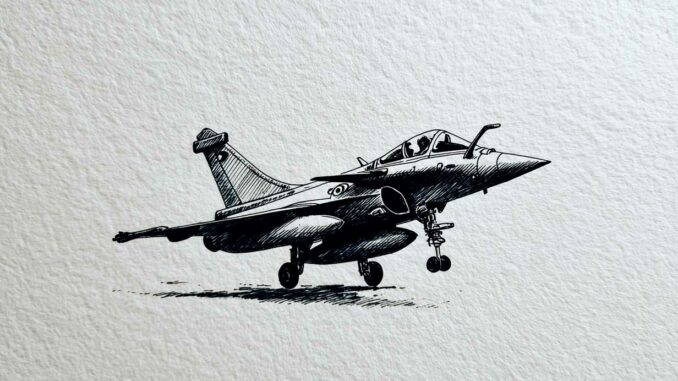
SCAF uncertain: Can Dassault launch a sixth-generation fighter jet, at what cost, and with what national or European funding?
In summary
The risk of SCAF getting bogged down raises a simple question: what will France do if the “European” 6th generation fighter jet does not materialize? Dassault Aviation has a large cash reserve and a solid Rafale order book, but this is no substitute for a state budget. The Rafale, especially in the F5 standard, can extend France’s credibility into the 2030s, with a logic of collaborative combat and deterrence. But crossing the threshold into the 6th generation requires a long-term financial effort, in the order of tens of billions of euros for France if it carries the platform alone. The question is therefore not “Can Dassault pay?”, but “Who pays, when, and for what autonomy?” European funds can help with technological building blocks, but they cannot finance an entire program. Faced with the F-35, the Tempest, and the NGAD, the real risk is a relevant aircraft that comes too late.
The shock of a failed SCAF and the question posed to France
The possibility of a SCAF that does not happen changes the equation without simplifying it. It removes a multinational framework, but it does not remove the need. France must maintain its air superiority, deep strike, and penetration capabilities in the face of modern defenses. It must also maintain a credible trajectory for airborne nuclear deterrence. And it must do so in an environment where standards of connectivity, data fusion, and electronic warfare are rapidly increasing.
In this scenario, two reflexes emerge. The first is to extend the Rafale F5 further, evolving it into a “Rafale++.” . The second is to launch a national successor, even if the bar is high. The two can coexist. But they do not have the same budgetary logic. Extending an existing platform is expensive, but remains manageable. Creating a new fighter jet from scratch requires a generation of funding.
What is rarely stated clearly is simple: without SCAF, France cannot “wait and see.” The industrial lead time for a fighter jet is long. A capability gap must be prepared for ten to fifteen years in advance.
The financial reality of Dassault Aviation and what it allows
A war chest that is not a program budget
Dassault’s figures are impressive. At the end of June 2025, the company claimed to have an order book worth around €48.3 billion and €9.547 billion in available cash. On paper, this looks like an ideal cushion for investment.
In reality, however, this is not a free pot of money. A significant portion of this cash comes from customer deposits. It finances contract execution, inventory, ramp-up, and supply chain stability. The proof is in the indicators: industrial backlogs and advances increase when production accelerates. If Dassault burns too much cash, it undermines its ability to deliver, and therefore its export credibility, which is the very source of its strength.
A distinction must therefore be made between “ability to invest” and “ability to finance a sovereign program.” The former is real. The latter exceeds the scale of a single company, even a highly profitable one.
A solid R&D effort, but too weak for a generational leap
In 2024, Dassault’s R&D expenditure is around €437 million. In the first half of 2025, it is around €182 million. This is significant on the scale of a business jet or a standard Rafale. It is not on the scale of a breakthrough fighter jet.
A sixth-generation fighter is not just an aircraft. It is also a sensor architecture, links, an electronic warfare suite, connected effectors, and a digital development method. The bill is systemic. If France wants a complete program, the annual effort is measured in billions, not hundreds of millions.
In other words, Dassault can co-finance, absorb risks, and pre-finance components. But Dassault cannot bear the burden of a national program equivalent to what the SCAF is aiming for on its own.
The Rafale as a technological and industrial foundation
The F5 standard and the UCAV as a credible accelerator
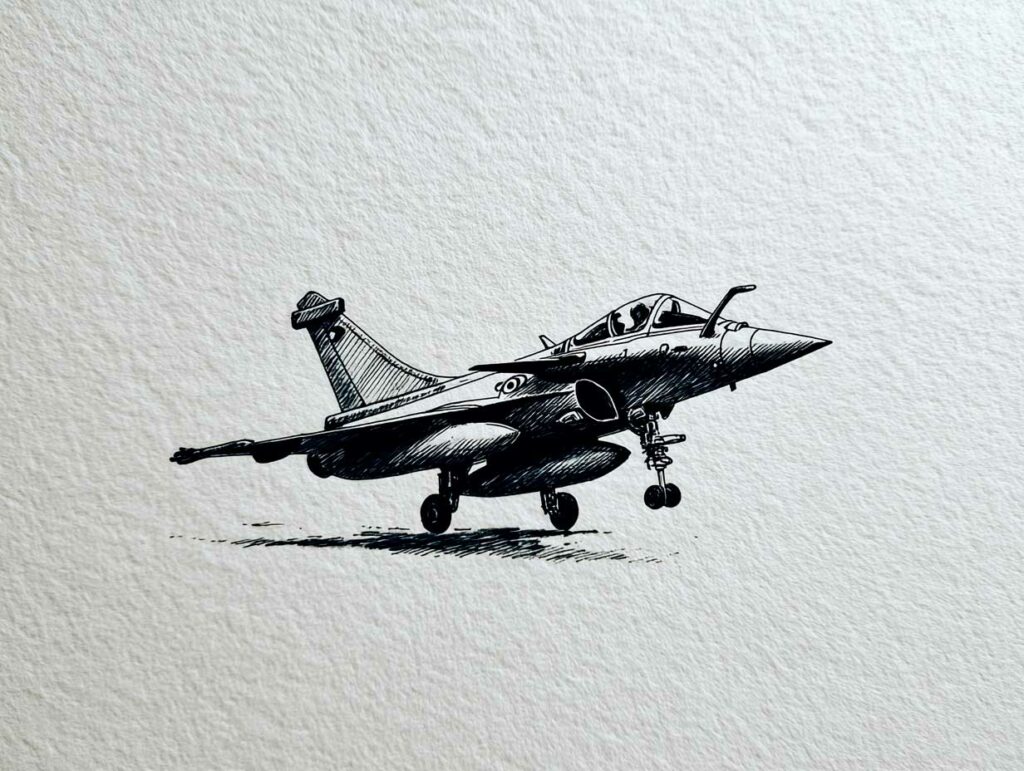
If SCAF stalls, the Rafale becomes the linchpin. The F5 standard, heralded as a leap in capability, aims precisely at what “tomorrow’s combat” is looking for: greater connectivity, greater human-machine cooperation, and enhanced integration with accompanying drones. The debate is not about whether this “makes the Rafale a 6th generation aircraft.” It does not make it a stealth aircraft of a new design. But it can make the Rafale an effective, and therefore dangerous, network node, especially if the French Air Force maintains an excellent training-doctrine-ammunition chain.
This point is strategic for Dassault. A Rafale that remains competitive attracts exports. Exports finance industrial depth, and therefore the ability to prepare for the post-Rafale era.
Deterrence and navalization: requirements that tighten the specifications
France has constraints that few other countries face. The nuclear mission imposes requirements for safety, certification, missile integration, and posture continuity. The onboard component imposes severe constraints on the structure, landing gear, approach, and robustness.
These constraints make a successor more expensive. They also make cooperation more difficult, because not all partners have the same needs. If SCAF fails precisely because of these differences, a French national program will have to take them on fully. This is realistic. But the cost must be accepted.
A “Dassault alone” 6th generation fighter jet: relevant or too late?
Faced with the F-35, the competition is based on mass and network
The F-35 is now a standard for interoperability and data sharing. It also has a structural advantage: the size of the fleet and standardization. A future French aircraft will not beat that in terms of volume.
The question of relevance therefore becomes: can it offer a qualitative differential? This involves electronic warfare, survivability, range, integration with drones, and the ability to hold its own in a contested environment without depending on an American supply chain. In this area, France, which has mastered its technological stack, can remain very credible, especially if it accepts a “system” approach rather than a “just aircraft” approach.
Faced with Tempest/GCAP, the timing factor becomes cruel
The British-Japanese-Italian program aims to enter service in the mid-2030s. The United Kingdom alone has announced that it will invest more than £2 billion in the upstream phase by 2025. Even if the figures are incomplete and subject to change, they illustrate one fact: competitors are financing early, so they are learning early.
If France waits until 2026 to make a decision and then relaunches a national program, it runs the risk of having an aircraft that arrives after 2040, i.e., after the peak of European renewal. In this case, it will be technically relevant but commercially complicated. The market will already have “chosen” elsewhere.
When it comes to NGAD, the budget barrier is the real wall
The United States has orders of magnitude unmatched in Europe. The annual budget requests for NGAD and the scale of the contracts announced show an ability to absorb major financial risks. It is not a question of engineering talent. It is a question of scale.
France alone will not build an “American-style” NGAD. It can do something else. It can aim for a balance between stealth, operational autonomy, cooperation with drones, and sustainable cost. This is sometimes smarter than copying a model that is out of reach.
The plausible budget and the question of who will pay
European orders of magnitude that make your head spin
Public estimates for the SCAF vary, but they run into the tens of billions. Parliamentary reports mention total costs of €50 to €80 billion, and other sources put the figure at €100 billion or more. Even if these figures combine development, industrialization, and support, they indicate the level of complexity involved.
If SCAF disappears, France does not recover a “share” to pay. It recovers a responsibility. For a national program, the scale remains massive. A realistic scenario would be a cumulative effort of €20 to €40 billion for France over fifteen to twenty years, depending on the exact scope, the level of disruption, and the degree of openness to partners.
The annual bill and the time constraints
Such an effort corresponds to approximately €1 to €2.5 billion per year over the duration. This is not impossible in a country that spends more than €60 billion per year on defense. But it is not neutral. It requires trade-offs in terms of ground-to-air defense, ammunition, space, drones, and operational readiness.
And this is where the answer becomes clear: Dassault will not “decide” alone. Without a firm multi-year commitment from the government, no manufacturer can tie up a decade of critical resources on a 6th generation gamble.
European funds: useful aid, but not a substitute
EDF and EDIP subsidies finance components, not a complete aircraft
The European Union has real tools at its disposal. The European Defense Fund is worth around €8 billion for 2021-2027. Annual calls for proposals are around €1 billion. EDIP, adopted for 2025-2027, adds €1.5 billion in grants.
These amounts matter. They can finance sensors, materials, embedded AI, communications, and demonstrators. They cannot finance a complete fighter aircraft program. This is not a criticism. It is the size of the check.
SAFE loans and the EIB can help industrialization, but not all development
Europe is also moving forward with loan financing. The €150 billion SAFE mechanism is designed to facilitate acquisition and production, with long maturities. The European Investment Bank is also increasing its defense budgets announced for 2026.
These tools can support ramp-up, the supply chain, and certain industrial investments. They are not a substitute for sovereign financing of high-risk R&D, especially when it comes to sensitive technologies.
Credible trajectories for Dassault and France
The path to smaller, more coherent cooperation
If SCAF fails, France may seek more limited cooperation within a clear scope. For example, sharing escort drones, sensors, or a combat cloud architecture, without sharing the prime contractorship for the fighter. This is less spectacular politically, but more realistic industrially.
The path of an assumed “Rafale++,” then a state-led successor
The other path is pragmatic. Accelerate the Rafale F5, integrate a UCAV, enhance survivability, and maintain operational superiority into the 2030s. Then launch a national successor when funding is secured and the critical components are mature.
This choice has a cost. But it has one virtue: it reduces the risk of a poorly financed leap forward.
The decisive factor is political. If France wants complete autonomy on a 6th generation fighter, it will have to pay for complete autonomy. If it wants to share the bill, it will have to accept compromises in terms of governance and requirements. It’s an equation, not a slogan.
Sources
Reuters, December 16, 2025, “FCAS fighter jet ‘very unlikely’…”
Reuters, December 16, 2025, statements by Éric Trappier on FCAS
Dassault Aviation, Financial Release 2024 Results (March 5, 2025)
Dassault Aviation, 2025 First Half-year Results – Financial Release (July 22, 2025)
Ministry of the Armed Forces / DGA, “Rafale standard F5: first orders…” (October 14, 2024)
FlightGlobal, “Rafale F5 bulks up with conformal fuel tanks” (June 15, 2025)
Senate, report “2040, the SCAF odyssey” (senat.fr)
Ministry of the Armed Forces, LPM 2024-2030 – overview (defense.gouv.fr)
Légifrance, Law No. 2023-703 of August 1, 2023 (LPM 2024-2030)
UK Government, “Major funding boost to progress future fighter jet program” (April 14, 2023)
European Commission, European Defense Fund (EDF) – official pages and results of calls for proposals 2024-2025
Council of the EU, European Defense Industry Program (EDIP) – December 8, 2025
Reuters, December 11, 2025, SAFE loans scheme (€150 billion)
Air & Space Forces Magazine, December 5, 2024, NGAD FY2025 budget request
Associated Press, March 21, 2025, NGAD / F-47 announcement and initial contract
War Wings Daily is an independant magazine.