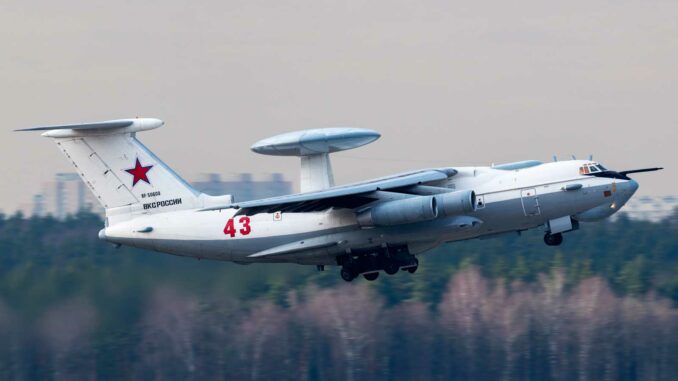
The loss of the A-50 radar aircraft has left Russian aviation blind. Detection, air combat, and ground-to-air defense capabilities have been severely compromised.
Summary
The successive destruction of several A-50 Mainstay airborne early warning and control aircraft is one of the most serious military setbacks suffered by Russia since the start of the conflict. These platforms played a central role in monitoring the air battlefield, coordinating fighters, and providing early warning of threats. Their disappearance has created a major capability gap. Without these airborne sensors, Russian aircraft must activate their own radars to detect the enemy, making them immediately detectable by Ukrainian and NATO defense systems. This loss upsets the air balance, reduces the operational range of Russian fighters, and weakens ground-to-air defense. In practical terms, Russia is now operating with significantly reduced situational awareness over large sections of the front, with direct consequences for aircraft survivability and operational effectiveness.
The central role of the A-50 in the Russian system
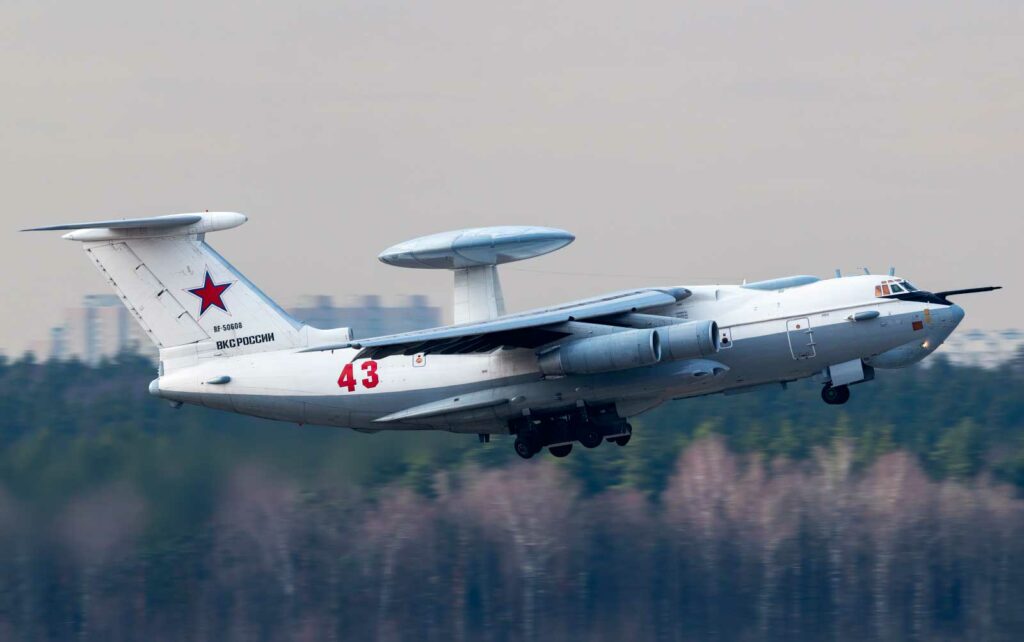
The A-50s are the cornerstone of the Russian air command system. Designed for long-range detection, they provide extensive radar coverage, far beyond what is possible with the sensors carried by fighter jets.
Installed on a cell derived from the Il-76, the A-50’s rotating radar can monitor an airspace of several hundred kilometers, detecting aircraft, missiles, and drones. This capability gives the air force an overview of the theater, which is essential for anticipating enemy movements.
In Russian doctrine, the A-50 is not limited to early warning. It coordinates interceptions, guides fighters to their targets, and transmits data to ground-to-air defense systems. It acts as a flying command node, connecting sensors, effectors, and decision-making centers.
A small fleet that cannot be replaced in the short term
Even before the recent losses, Russia already had only a limited fleet of this type of aircraft. Open estimates suggested fewer than ten operational A-50s, some of which had been modernized to the A-50U standard.
Each aircraft represents years of development, complex components, and a specific industrial chain. Unlike a fighter jet, a radar aircraft cannot be mass-produced quickly. The destruction of several airframes therefore amounts to an almost definitive loss in the context of the current conflict.
This rarity explains the gravity of the situation. Losing an A-50 is not like losing just any other aircraft. It means losing a structural capability, with no immediate replacement.
The circumstances of the destruction and the lessons learned
The A-50s were destroyed far from the front line, sometimes several hundred kilometers away. This highlights a major development in the conflict: Ukraine’s ability to strike high-value targets deep inside enemy territory.
Whether it be long-range missiles, ground-to-air systems operated in innovative ways, or combined strikes, the result is the same. Platforms that were considered relatively protected are no longer so.
This vulnerability has forced Russia to move its few remaining A-50s even further away. But keeping them at a distance reduces their operational effectiveness, as their effective detection range is reduced.
Why the absence of A-50s makes Russian aircraft visible
Without airborne radar, fighters must rely on their own sensors. This poses a fundamental problem. Even modern fighter radar has a limited range and, above all, a detectable electromagnetic signature.
When a Russian aircraft activates its radar, it immediately becomes visible to Ukrainian and NATO electronic surveillance systems. These signals are analyzed, located, and transmitted to ground-to-air batteries or enemy fighters.
This situation creates a permanent dilemma. Flying with the radar off is like being blind. Flying with the radar on is like being detectable and targetable. The A-50s solved this dilemma by providing information without exposing the fighters.
The direct consequences on air combat
In practice, the loss of the A-50s profoundly changes the way Russian pilots operate. Interceptions become riskier. Engagement distances are reduced. Fighters must get closer to identify a threat.
This favors Ukrainian forces, which can exploit larger air denial zones. Surface-to-air missiles, guided by Western sensor networks, benefit from better anticipation of Russian trajectories.
The result is a more hostile sky for Russian aviation. Each mission carries an increased risk. This translates into a decrease in the frequency of sorties and increased operational caution.
A major impact on Russian surface-to-air defense
A-50s also play a key role in coordinating ground-to-air defense. They can detect low-altitude targets or those hidden by terrain, complementing ground-based radars.
Without this aerial layer, Russian ground-to-air systems lose detection depth. Reaction times are longer. Blind spots multiply.
This weakens the ability to counter Ukrainian missile and drone strikes, especially those flying at low altitude. The Russian sky becomes less secure, despite the apparent density of the systems deployed.
Increased dependence on ground-based and allied sensors
Deprived of its aerial eyes, Russia must rely more on ground-based sensors. However, these are fixed, vulnerable, and sometimes overwhelmed by diversionary attacks.
In contrast, Ukraine benefits from massive Western intelligence support. Data from satellites, surveillance aircraft, and remote sensors more than compensate for the lack of equivalent domestic platforms.
This intelligence imbalance is growing. Russia still has powerful strike capabilities, but it is using them with degraded battlefield awareness.
The limitations of Russian workarounds
Moscow is trying to adapt its methods. Increased use of drones, dispersal of missions, and more cautious flight profiles are among the responses observed.
But none of these solutions can replace a real radar surveillance aircraft. Drones offer neither the range, processing power, nor resilience of an A-50. Ground sensors do not cover everything.
Accelerated modernization or the commissioning of a theoretical successor cannot be achieved in the short term. Industrial time does not match the tempo of the conflict.
Strategic blindness with lasting consequences
The loss of the A-50s is not limited to a tactical constraint. It affects Russia’s ability to plan and conduct complex air operations over time.
Without a global vision, decisions become more reactive than proactive. Errors of judgment increase. Room for maneuver is reduced.
This partial blindness has a reverse deterrent effect. Where air superiority was supposed to protect ground forces, its weakening further exposes the entire military apparatus.
A now structural vulnerability
Even if Russia manages to preserve the last A-50s, their use will remain limited. Each sortie is a gamble. Each mission exposes an irreplaceable strategic platform.
In the long term, this situation imposes a difficult choice. Either accept a partially blind sky, or risk the loss of the last airborne sensors. Neither scenario is favorable.
Modern aviation relies on information.
Deprived of its key sensors, an air force retains its capabilities but loses its coherence. This is precisely what is at stake today.
The destruction of the A-50s is not a mere episode. It marks a turning point. In a conflict where data has become a weapon, losing your eyes is like fighting in the fog against an adversary who can see clearly.
Sources
- Public analyses of A-50 aircraft losses
- Specialized reports on airborne radar surveillance
- Doctrinal studies on the use of AWACS in high-intensity conflict
- Open data on Ukrainian air defense capabilities
- Western military analyses on information superiority
War Wings Daily is an independant magazine.