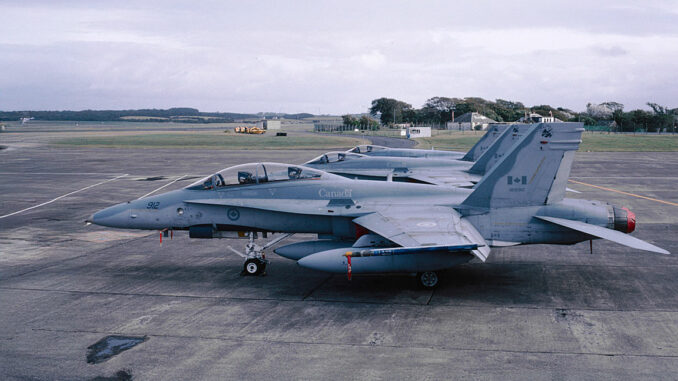
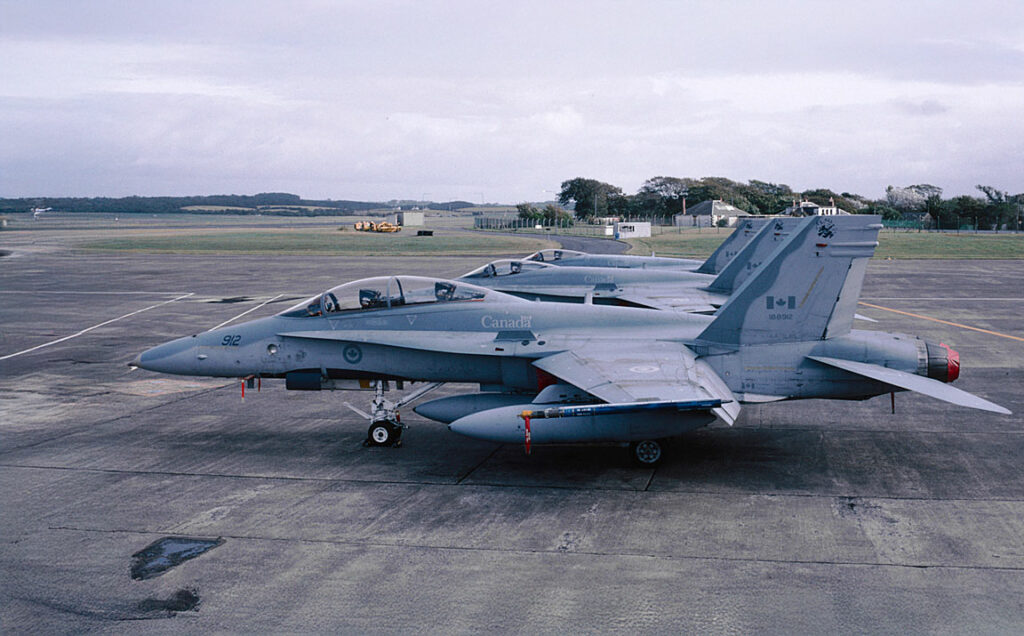
Forty years of hesitation, life extensions, and political battles over replacing the CF-18s: how Canada trapped itself in the face of modern threats.
Summary
Since the early 1980s, CF-18 Hornet fighters have been the backbone of Canadian air defense. But this initial success has gradually turned into a political, budgetary, and capability headache. Failing to make a quick decision, Ottawa has increased modernization efforts and extended the life of aircraft that will be nearly 50 years old in 2032, while purchasing used F/A-18s from Australia to fill a capacity gap deemed insufficient. At the same time, the “budget snake” of the F-35 Lightning II has been plagued by announcements, cancellations, relaunches and, even today, a revision of the contract under pressure from costs and the strategic context. Between costly modernization, criticism from the Auditor General, and growing concerns about the defense of the Far North, this saga has damaged the image of the Royal Canadian Air Force and highlighted the limitations of an overly politicized procurement process. The choice of 88 F-35As finally provides a trajectory, but delays and cost overruns raise a simple question: will Canada be able to bridge the gap between its stated ambitions and its actual capabilities in time?
The genesis of an aging symbol of Canadian air power
Initially, there was no indication that this would turn into a saga. At the turn of the 1980s, Canada selected the F/A-18 Hornet to replace several aging fighters, with a contract for 138 aircraft (98 single-seaters and 40 two-seaters) for approximately C$4 billion at the time. The choice was based on rational criteria: a twin-engine aircraft suited to the vastness of the Arctic, already developed for the US Navy, and offering a good compromise between cost, versatility, and capabilities.
For three decades, the CF-18s have been involved in all of Canada’s major engagements: the Gulf War, the Balkans, Afghanistan, NATO missions in the Baltic states, and air policing within NORAD. They escorted Russian bombers over the North Atlantic and patrolled a vast airspace daily, from the Pacific to the Atlantic via the Arctic. This operational longevity reinforced the image of a robust aircraft, but the illusion eventually began to crack as threats and technology evolved.
In the early 2000s, Ottawa launched a major incremental modernization program. AN/APG-73 radars, Link 16 data links, avionics and electronic warfare system upgrades: in total, these upgrades represent approximately C$2.6 billion and are explicitly aimed at maintaining the CF-18s to NATO standards until the end of the 2010s. In practice, these investments postponed the real debate: should they be replaced, and if so, with what?
The lack of a quick decision on replacing the CF-18s gradually turned this fleet into a symbol of Canadian political and military inertia. As the years went by, maintenance costs increased and the gap widened with the new-generation fighters being put into service by Canada’s allies.
The planned obsolescence of a fleet extended until 2032
Faced with accumulated delays, Canada launched the Hornet Extension Project in the early 2020s. The objective is clear: to ensure that the CF-18 fleet remains capable of fulfilling NORAD and NATO commitments until 2032, when the new fleet is theoretically expected to be fully operational.
The program has two components. The first covers up to 84 aircraft and focuses on regulatory compliance and interoperability: new transponders, modern radios with satellite capabilities, mission computer upgrades, simulator enhancements, and the integration of a secure data link. The second focuses on 36 aircraft considered to have the longest remaining service life, with active electronically scanned array (AESA) radars, new short- and medium-range air-to-air missiles, and an automatic ground avoidance system.
On paper, these improvements make the CF-18s more credible in the face of current threats and extend their usefulness. In reality, they do not change the nature of the platform: a fourth-generation fighter, non-stealth, with limited growth potential and subject to aging structures. The 2018 report by the Auditor General of Canada is explicit: by 2032, the CF-18 will be approximately 50 years old and will have “fallen below the level of its peers” in terms of performance and availability.
This life extension has a financial cost—approximately $1.3 billion for the Hornet Extension Project alone, not including maintenance contracts—but also an operational cost. As the aircraft ages, its availability rate declines, forcing the cannibalization of some airframes to keep others in service. Mechanics spend more time dealing with corrosion, structural fatigue, and parts obsolescence than preparing aircraft for training or operations.
The consequence is hard to admit: every dollar invested in keeping the CF-18s in the air is a dollar that is not being used to speed up the arrival of their successor.
The purchase of Australian F/A-18s, a criticized band-aid solution for an exhausted fleet
One of the most controversial episodes in this saga is the purchase of used F/A-18s from Australia. After considering the acquisition of 18 new F/A-18E/F Super Hornets from Boeing as an interim solution, Ottawa abandoned this plan in 2017 amid the trade dispute between Boeing and Bombardier.
The government then turned to Canberra, which was gradually retiring its Classic Hornets. In total, Canada acquired 25 Australian F/A-18A/Bs, 18 of which were to be returned to service and 7 used as spare parts or test beds. The price of the batch was approximately US$68 million, not including upgrade and integration costs.
Militarily, these aircraft are not fundamentally different from the Canadian CF-18s: they are the same age, of the same design generation, and have the same limitations when faced with modern ground-to-air defense systems. A 2018 report warns that these second-hand aircraft do not represent a real leap in capability and do not address the shortage of pilots and technicians, identified as one of the major bottlenecks in the fleet.
Symbolically, the effect is disastrous. To many observers, Canada appears to be a G7 country forced to buy second-hand fighter jets to maintain its minimal defense posture. This decision fuels the perception of “day-to-day management” of air defense, where each decision pushes back the next without ever addressing the underlying problem: the choice of a credible replacement.
The F-35 “budget snake” at the heart of political indecision
At the center of the saga is the Future Fighter Capability Project and, above all, the F-35 Lightning II. Canada has been a partner in the Joint Strike Fighter program since the early 2000s, which has enabled its industry to secure contracts worth several billion US dollars.
In 2010, Stephen Harper’s Conservative government announced its intention to acquire 65 F-35As without a competitive bidding process, arguing that it was necessary to interoperate with the United States and key NATO allies. The Auditor General quickly criticized the transparency of the costs and the management of the program. Under pressure, Ottawa froze the project, launched additional studies, and opened the door to competition.
Justin Trudeau’s Liberals came to power in 2015 with an explicit promise not to purchase the F-35. A new procedure was launched in 2017, open to Saab (Gripen E), Boeing (Super Hornet), Airbus (Eurofighter), and Dassault (Rafale). Gradually, NORAD and Five Eyes interoperability constraints ruled out the Europeans, while Boeing’s Super Hornet was deemed non-compliant with requirements. In March 2022, only two finalists remained: the F-35A and Gripen E.
In January 2023, Canada formalized the acquisition of 88 F-35As for an initial estimated cost of C$19 billion, including aircraft, equipment, infrastructure, and initial support. The schedule calls for the first delivery of training aircraft to the United States in 2026, the arrival of the first aircraft in Canada in 2028, initial operational capability around 2029-2030, and full capability between 2032 and 2034.
But the saga does not end there. In 2025, a report by the Auditor General estimates that the cost of the program has already jumped by at least 45% to between C$27.7 billion and C$33.2 billion, due in particular to exchange rate effects and rising infrastructure costs, with construction projects already three years behind schedule. The new Prime Minister, Mark Carney, orders a review of the contract, without formally canceling it, but reassessing the timetable and strategic dependence on the United States.
The result: fifteen years after the initial announcements, Canada has returned to the F-35, but at the cost of damaged credibility, major cost overruns, and increased pressure on defense finances.
The real combat capability of a fleet on its last legs
The central question remains: what can the CF-18s still offer on a modern battlefield? Successive upgrades have made it possible to integrate more powerful radars, AIM-120 AMRAAM and AIM-9X missiles, advanced targeting pods, and communication systems compatible with NATO standards.
However, there are several unavoidable limitations. First, the radar signature of a fourth-generation non-stealth fighter remains high when faced with modern Russian or Chinese surface-to-air systems. In an environment saturated with active antenna radars, long-range systems, and passive sensors, the CF-18’s survivability is reduced. Second, the airframe architecture dates back to the late 1970s: even when reinforced, it no longer offers the growth margins required for 21st-century network warfare.
The Auditor General’s reports also highlight an availability issue: as aircraft age, maintenance hours per flight hour increase, parts shortages become more frequent, and operational deployment rates decline. The shortage of pilots and technicians, already identified in 2018, remains an issue in 2025, limiting the actual number of aircraft that can be deployed simultaneously.
Finally, the issue of volume is not insignificant. With a fleet of approximately 94 modernized aircraft, but a smaller number actually available for operations, the RCAF must cover its NORAD commitments, NATO missions, and domestic operations. In a prolonged crisis scenario, the ability to keep pace is clearly in doubt.
The specific challenge of the Far North and Arctic sovereignty
It is in the Arctic that the limitations of the system are most apparent. Canada is facing a simultaneous rise in power by Russia and China in the region: reinforcement of Russian bases beyond the Arctic Circle, strategic bomber patrols, joint Russian-Chinese exercises near Alaska, and intensified naval activities in waters made more accessible by the melting ice cap.
CF-18s can still carry out occasional interceptions and participate in exercises such as Operation Nanook, which mobilizes several hundred military personnel each year in northern Canada to test logistics, communications, and cooperation with allies. But the combination of vast distances, extreme weather conditions, and limited infrastructure weighs heavily on aging aircraft.
The F-35As, if they arrive on schedule, will offer clear advantages: stealth, integrated sensors, data fusion, and the ability to collect and share information for the benefit of other platforms (AWACS, ground-to-air defense systems, ships). The Canadian government highlights the F-35’s ability to fly non-stop from Cold Lake to Inuvik (approximately 2,200 km) to illustrate its suitability for defending Arctic sovereignty.
However, this potential remains theoretical for now. Until ground infrastructure, long-range radars, and the overall modernization of NORAD are complete, the F-35 will be just one link in a still-incomplete system. And every delay in commissioning the new aircraft or in Arctic construction projects prolongs the dependence on aging CF-18s to defend the Far North.
The cost to Canada’s image of a saga that erodes its credibility
The saga of replacing the CF-18s is not just about budget figures or technical specifications. It weighs heavily on Canada’s image among its allies and its own military. In the eyes of Washington and NATO partners, the slowness of the process fuels the idea of a country that talks a lot about defense but struggles to invest in line with its commitments.
For the Royal Canadian Air Force, the human impact is tangible. Pilots and mechanics who have served for years on CF-18s feel they are working on a fleet that political discourse considers obsolete, while asking them to compensate for delays and strategic hesitations. This disconnect weighs on morale, staff retention, and the attractiveness of the profession, in a context of fighter pilot shortages in several Western countries.
On the industrial front, however, Canada has been able to capitalize on its participation in the F-35 program: more than US$3.3 billion in contracts have been awarded to Canadian industry for the development and production of F-35 components, and there are prospects for the maintenance of the global fleet. But this success is clouded in the public eye by the perception of a program that is out of control, with rising costs and repeated delays.
The saga also has a political cost. Each government—Conservative or Liberal—has used the issue to distinguish itself from its predecessor, promising either to break with the past or to streamline the process. As a result of all the back and forth, the guidelines have become diluted, leaving the impression that the issue is driven more by electoral cycles than by a long-term vision of air defense.
The end of the saga, or the beginning of a new chapter?
Today, on paper, the story finally seems to be taking shape: the CF-18s extended by the Hornet Extension Project, the gradual arrival of 88 F-35As as part of the Future Fighter Capability Project, and a broader modernization of North American aerospace defense architecture. However, several uncertainties remain.
The revision of the F-35 contract launched by the Carney government, the substantial increase in costs, infrastructure delays, and the tense political context with the United States could still disrupt the schedule. At the same time, Russia and China are rapidly adapting their doctrines and capabilities in the Arctic, forcing Ottawa to demonstrate through action that its investment in the new fleet translates into a real presence on the ground.
Canada no longer has the luxury of postponing decisions: each additional year that the CF-18s remain on the front line increases the risk of a capability gap, a major accident, or diplomatic difficulties with an ally who believes that the burden of collective defense is unevenly distributed. The “saga” of the replacement of the CF-18s will remain a textbook example of how a country can become a prisoner of its own strategic hesitations.
The real question now is no longer whether the F-35 is the right aircraft, but whether Canada will be able to complete this transition on time, train enough crews, modernize its infrastructure, and transform its investments into a credible, visible, and deterrent capability in the skies of the North.
Sources
- Department of National Defense, “Hornet Extension Project,” updated July 9, 2024.
- Department of National Defense, “Future Fighter Capability Project,” updated January 28, 2025.
- Office of the Auditor General of Canada, “Canada’s Fighter Force – National Defense,” 2018 report.
- Reuters, news report “Cost of Canada’s new US-made fighter jet fleet set to rise, watchdog says,” June 10, 2025.
- Associated Press, “Canada to review the purchase of US-made F-35 fighter jets in light of Trump’s trade war,” 2025.
- Business Insider, article on Canada’s reassessment of the F-35 contract, 2025.
- CSIS, “Why Did China and Russia Stage a Joint Bomber Exercise near Alaska?”, July 30, 2024.
- The Guardian, “Canadian military flies the flag in frozen north as struggle for the Arctic heats up,” March 9, 2025.
- Wikipedia, “McDonnell Douglas CF-18 Hornet” and “Lockheed Martin F-35 Lightning II Canadian procurement,” accessed December 2025.
- Articles from Defense News, Australian Aviation, and others on the sale of Australian F/A-18s to Canada, 2017–2021.
War Wings Daily is an independant magazine.