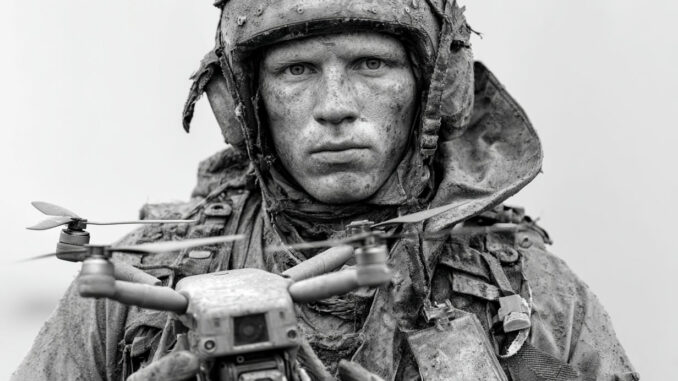
Drone manufacturers are stepping up their demonstrations and detailed technical specifications. Could this marketing hype reveal sensitive secrets and undermine national security?
In summary
The market for both civilian and military drones is booming, pushing drone manufacturers to engage in fierce competition, with aggressive marketing focused on performance, autonomy, and strike capabilities. This promotion is driven by obvious commercial logic, in a sector estimated to be worth more than $13 billion in 2024 for the commercial market alone, with double-digit annual growth. But by multiplying strike videos, detailed technical specifications, and public demonstrations, manufacturers are exposing valuable information to adversaries capable of exploiting it through open source intelligence. Radar signatures, acoustic profiles, flight envelopes, and data link latencies can all be deduced from content originally intended to convince a customer. The question is therefore no longer whether to communicate, but how to do so without jeopardizing national security and technological sovereignty.
The drone market: an ideal showcase for aggressive marketing
Drones are no longer a niche market. The commercial segment is estimated to be worth around $13.86 billion in 2024, with projections of over $65 billion by 2032, representing annual growth of more than 10%. On the military side, estimates put the market at around $15.8 billion in 2025, reaching more than $22.8 billion in 2030. This momentum is fueling global competition among manufacturers, from light tactical drones to combat systems weighing several hundred kilograms.
In the civilian sector, Chinese manufacturer DJI is expected to control around 70% of the global drone market in 2024, with a dominant presence in image capture, mapping, and industrial inspection. In the military sector, players such as Baykar with the Bayraktar TB2, General Atomics, Israel Aerospace Industries, and Chinese and Iranian groups are securing more and more export contracts, particularly in Africa, the Middle East, and Eastern Europe.
This explosion in sales is accompanied by a very dense media ecosystem: trade shows such as IDEX in Abu Dhabi, Eurosatory in Paris, and AUSA in the United States; social media campaigns; high-definition strike videos; downloadable technical data sheets; webinars; and flight demonstrations. Drones are becoming a loss leader for a whole section of the defense industry, with the idea that image counts almost as much as actual performance.
Aggressive marketing by drone manufacturers as a tool of influence
For manufacturers, aggressive marketing is not just about signing contracts. It is becoming a tool for political and strategic influence. Videos of Bayraktar TB2s destroying tanks in Ukraine, Libya, and Nagorno-Karabakh have served as both a commercial showcase and a demonstration of power for Ankara, contributing to the drone’s reputation as a “game changer” and its adoption by more than 30 countries.
Communication campaigns highlight the drone’s autonomy (sometimes more than 24 hours), operational ceilings above 7,500 m, multimode payloads (optronics, synthetic aperture radar, electronic warfare), and precision strike capabilities with guided munitions. Some technical data sheets detail the frequency ranges of the links, data rates, and redundancy modes, even if this means touching on traditionally classified or sensitive information.
In the civil sector, manufacturers of logistics and industrial inspection drones are promoting their ability to fly beyond visual line of sight (BVLOS), 4G/5G integration, payloads of several kilograms, and the ability to cover several dozen kilometers per flight. These arguments are used to convince infrastructure operators, rapid delivery companies, and local authorities to invest in drones, in a context where drones are presented as a lever for modernizing cities and networks.
This narrative hype feeds into a global narrative: the drone as a symbol of modernity, precision, and efficiency, even as an instrument of national soft power. But the more detailed the discourse, the more it opens up windows of opportunity for malicious actors.
The blurred line between commercial information and technological secrecy
The main difficulty lies in the very nature of these systems: they are based on dual-use technologies. A civilian inspection drone, capable of carrying a stabilized 4K camera, a laser rangefinder, and flying for 40 minutes at 100 km/h, can quickly be militarized for intelligence or light attack missions.
Brochures and videos provide a wealth of clues that can be exploited by intelligence services or armed groups through open source intelligence. By analyzing demonstration images, an adversary can estimate flight profiles (speed, angles of attack, climb rates), infrared signatures (exhaust positions, hot spots), and even radar signatures if more technical data is published. Footage of firing tests posted on social media can sometimes be used to assess actual accuracy, the time between detection and strike, or even the reaction of the opposing defense.
Technical data sheets can reveal vulnerabilities: control link frequency ranges, type of encryption used, backup modes, dependence on specific navigation satellites. This information facilitates the development of jammers, decoy systems, or solutions for hacking data links. For example, some civilian marketing campaigns advertise proprietary protocols or remote update capabilities, which, if poorly controlled, can create as many entry points for an attacker.
Investigations into the value chains of certain armed drones have already shown how, based on promotional photos and catalogs, experts have traced the origin of many Western components integrated into systems exported to sensitive areas. This fuels debates on both the ethics of sales and the risks of circumventing export control regimes.
Vulnerabilities created for national security
The risk is not limited to the disclosure of industrial secrets. It directly affects national security. On the one hand, the global spread of high-performance drones, often through aggressive marketing, facilitates the proliferation of armed drones between states but also to non-state actors. Systems capable of flying over 100 km, with military payloads of several dozen kilograms, are gradually finding their way into the hands of regular forces, but also militias and insurgent groups.
On the other hand, the widespread use of foreign drones in sensitive civilian applications is creating strategic dependence. The US authorities consider that drones manufactured in China, widely used by police services and network operators, represent a “significant risk” to critical infrastructure due to cyber vulnerabilities and the risk of data exfiltration to Beijing.
Agencies such as CISA and the FBI have published guides detailing the risks associated with Chinese drones: collection of images of sensitive sites, capture of location metadata, update channels that can be exploited by an attacker, and unpatched vulnerabilities in firmware. These concerns explain the proposed legislation seeking to ban the purchase of new models from certain manufacturers for government use, or to impose enhanced security audits.
Finally, the psychological dimension matters. Manufacturers no longer hesitate to broadcast images of real strikes, edited like advertising clips. Beyond ethical considerations, this content allows adversaries to analyze operating procedures, rules of engagement, and even the reactions of the chain of command. Combined with other sources, it provides particularly accurate image-based intelligence at virtually no cost.
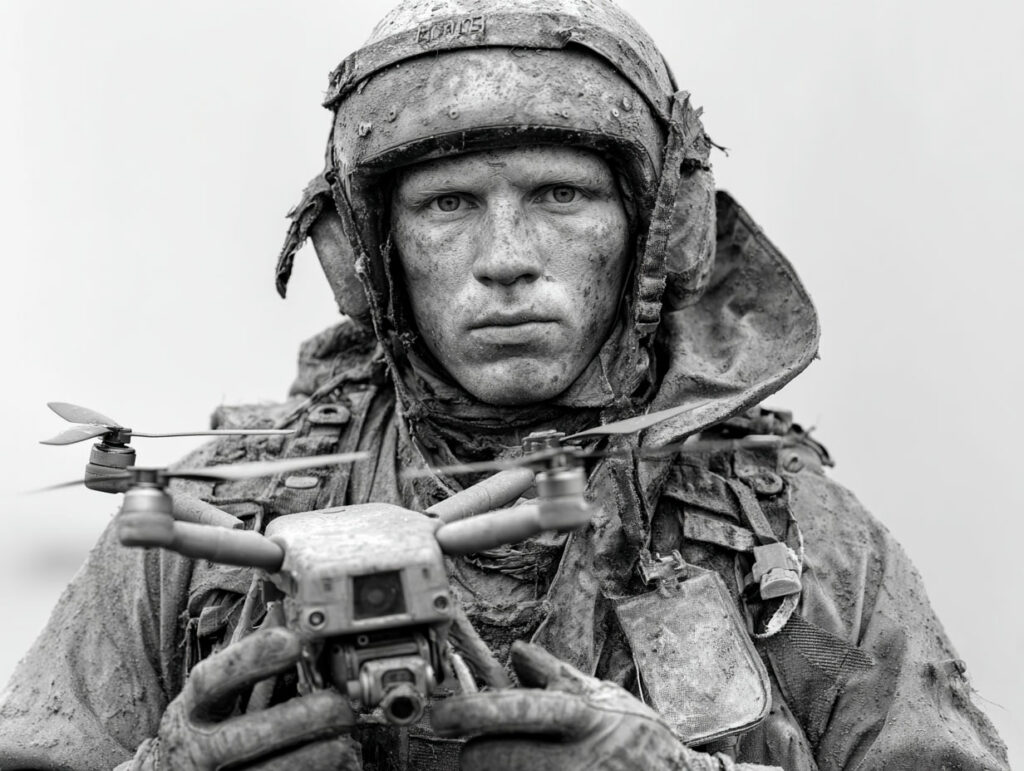
International regulation in the face of dual-use technologies
States have clearly identified these issues, but regulation is progressing more slowly than commercial dynamics. The Arms Trade Treaty (ATT) sets standards for regulating transfers of conventional weapons, requiring an assessment of the risks of violations of international humanitarian law or diversion to unauthorized actors. However, many armed drones or dual-use systems fall partially outside its scope or are exported through complex legal arrangements.
At the same time, regimes such as the Wassenaar Arrangement and national or regional regulations, such as Regulation (EU) 2021/821 on dual-use goods, regulate the export of sensors, software, electronics, and critical components used in drones. Checklists are regularly updated to include lasers, navigation systems, data link components, and cyber surveillance tools.
However, these texts target material transfers or the provision of technical assistance, not directly marketing communications. Yet a detailed brochure, a presentation at a trade show, or a technical webinar can, in fact, constitute a form of dissemination of sensitive information. Some countries have begun to broaden the concept of “technology transfer” to include intangible exchanges, such as public presentations and documents available online, but enforcement remains uneven.
Manufacturers are thus caught between several constraints: complying with export rules, reassuring the authorities about the protection of defense secrets, while remaining sufficiently transparent to remain credible to customers. There is a strong temptation to push the line as far as possible, as long as the administration does not impose sanctions.
Ways to make drone marketing more responsible
Limiting risks does not mean returning to absolute secrecy. There are several ways to reconcile commercial development with the protection of strategic interests. The first is to define clear red lines at the national level: performance elements (exact altitude, link range, payload margins) that remain classified, video backgrounds checked to ensure that no sensitive installations are revealed, and systematic blurring of certain screens or interfaces in demonstrations.
Authorities can impose communication charters on companies benefiting from public contracts, requiring systematic review of marketing materials by specialized services. In some countries, communication about electronic warfare capabilities or embedded AI algorithms is already heavily regulated, precisely to prevent the leakage of know-how.
Manufacturers, for their part, have an interest in integrating these constraints into their brand strategy. Positioning that emphasizes robustness, regulatory compliance, and responsible data management can become a selling point in itself, particularly for government customers concerned about technological sovereignty. In the civilian sector, emphasizing cybersecurity, server location, and transparency on data flows responds to growing concerns.
Finally, states could make greater use of existing multilateral instruments to address the issue of communication. International guidelines on the promotion of weapons systems, including drones, could clarify what constitutes legitimate commercial information and what constitutes overly sensitive know-how. This would not stop the drone race, but it would limit the blind spots of marketing that, through enthusiasm, has become an unwitting vector of strategic vulnerability.
Sources
– Fortune Business Insights, “Commercial Drone Market,” 2024–2025.
– MarketsandMarkets, “Military Drone Market,” 2025.
– Connected Commercial Drones Report, 2025 – DJI market share.
– CISA / FBI, “Cybersecurity Guidance: Chinese-Manufactured UAS,” January 17, 2024.
– Atlantic Council, “A global strategy to secure UAS supply chains,” 2024.
– ProPublica, investigation into Western components of Turkish Bayraktar TB2 drones, 2022.
– Baykar, Bayraktar TB2 technical data sheet and export press releases, 2023–2025.
– Arms Trade Treaty, text and implementation guides (ICRC, Amnesty).
– Regulation (EU) 2021/821 and updates to the list of dual-use items, European Commission, 2024–2025.
War Wings Daily is an independant magazine.