EA-18G Growler vs Shenyang J-16D: a duel of electronic warfare, sensors, jamming, range, and survivability, with OSINT figures and limitations.
Comparing the Boeing EA-18G Growler and the Shenyang J-16D is like comparing two different philosophies of electronic warfare. The Growler is an aircraft designed from the outset for carrier-based electronic attack. It is integrated into a complete operational chain, with SEAD/DEAD doctrine, refueling aircraft, data links, anti-radar missiles, and proven jamming pods. Its value lies as much in its sensors as in its integration into the American and allied “system of systems.”
The J-16D is China’s response, built on a heavy fighter airframe derived from the Su-27 family. It prioritizes range, available electrical power, the carriage of multiple pods, and the escort of remote strike packages. The problem is that China publishes very few verifiable technical figures. Some of the data on the J-16D is therefore OSINT, sometimes contradictory, and should be read as orders of magnitude, not as a manufacturer’s data sheet.
Methodology here: firm figures when they are sourced, and technical assessment when data is lacking. And yes, I make judgments, but I clearly separate what is measured from what is deduced.
A technical presentation of the Boeing EA-18G Growler
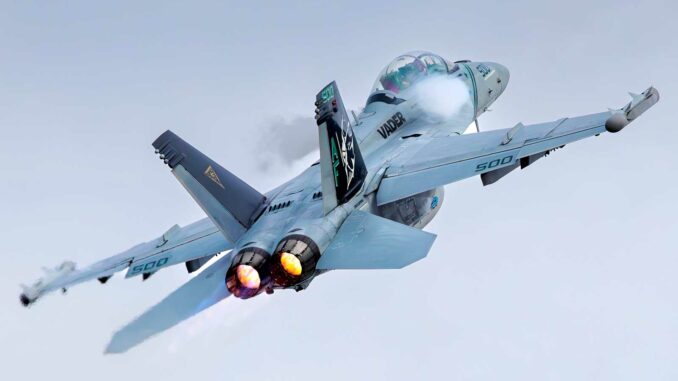
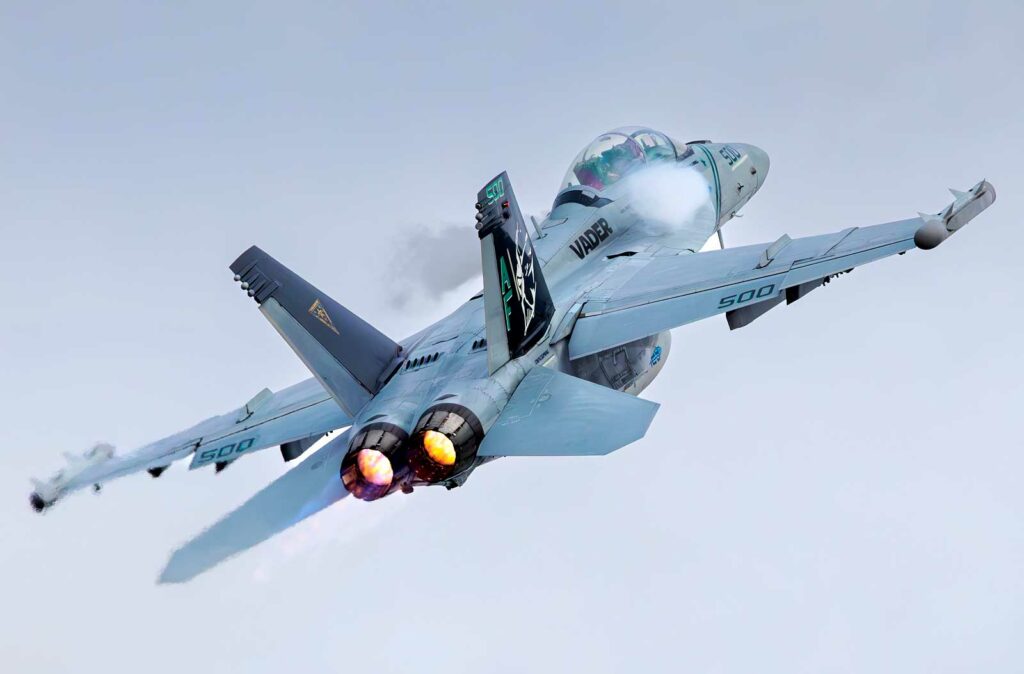
The EA-18G Growler is the US Navy’s electronic attack aircraft. It uses the F/A-18F airframe and replaces the internal cannon with equipment dedicated to electronic warfare. Crew: 2 people (pilot + Electronic Warfare Officer).
In terms of performance, public data sheets agree on a maximum speed of around Mach 1.6, or 1,960 km/h (1,218 mph), a ceiling of 15,240 m (50,000 ft), and a published range of 1,570 km (976 mi) “fully armed with external fuel tanks” (a useful figure, as it is more realistic than a ferry range). The aircraft is powered by two F414 engines.
The heart of the Growler is its sensor/jammer suite: AN/ALQ-218 receivers at the wing tips, historic ALQ-99 pods, and transition to the Next Generation Jammer (NGJ) for increased power, jamming agility, and reliability. It also retains an AN/APG-79 AESA radar, which is valuable for tactical situations and certain air-to-air functions.
In terms of armament, the Growler can escort, protect, and also strike: typically AIM-120 air-to-air missiles and AGM-88 HARM/AARGM anti-radar missiles, depending on configuration and integration. Its real strength is doctrinal: it can operate from an aircraft carrier, integrate into packages, and work with highly mature liaison and targeting standards.
A technical presentation of the Shenyang J-16D
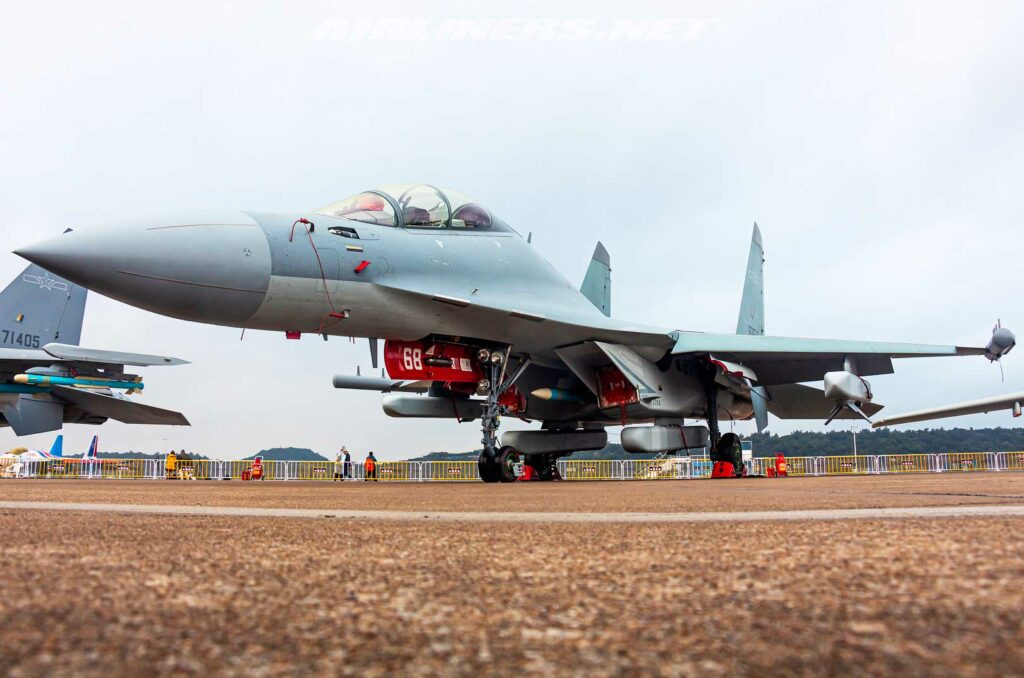
The J-16D is the electronic warfare variant of the J-16, itself derived from the “Flanker” family. The most robust elements in open sources describe: wing tip pods, replacement of certain nose equipment (sensors), and removal of the cannon in favor of internal mission equipment. Public demonstrations show a configuration with multiple pods under the wings and near the air intakes, plus wing tip pods, confirming a concept similar to jamming escort.
The J-16D’s flight performance figures have not been officially released. OSINT estimates give the J-16 family a maximum speed of around Mach 2.0 (approximately 2,120 km/h, 1,317 mph) and a ceiling of around 17,000 m (55,774 ft), but these values should be treated with caution: they vary depending on weight, altitude, and engine version.
The J-16D’s appeal lies mainly in its heavy airframe: more payload, more potential internal fuel, and electrical and cooling headroom for modern jamming systems. Photos and exhibition descriptions indicate up to four jamming pods under the wings/air intakes, plus pods at the wingtips, and missile payload under the fuselage. In short, China is aiming for an aircraft capable of “clearing” part of the electromagnetic spectrum to accompany a strike and complicate the lives of enemy radars, communications, and surface-to-air systems.
Major limitation: without verified data on transmitted power, covered bands, receiver sensitivity, data fusion, and links, it cannot be “proven” whether or not it outperforms the Growler. We can only judge the logic of the architecture and its likely use.
A comparison table by criteria with points
Reading rule: when J-16D data is missing, I note “not public” and give points for demonstrable elements (e.g., aircraft carrier capability) or clear structural advantages (e.g., heavy airframe for payload/energy).
| Criterion | EA-18G Growler | J-16D | Points |
|---|---|---|---|
| Maximum speed | 1,960 km/h (1,218 mph) | Est. ~2,120 km/h (1,317 mph), unofficial | J-16D |
| Cruising speed | Rare public data (mission profile depends on pods) | Not public | EA-18G (operator data + stabilized doctrine) |
| Climb rate | Not systematically published (close to F/A-18F) | Not public | Equal (no solid basis) |
| Maximum altitude | 15,240 m (50,000 ft) | Est. ~17,000 m (55,774 ft), unofficial | J-16D |
| Range | Published 1,570 km (976 mi) with external tanks | Not public (heavy airframe suggests more) | J-16D (probable structural advantage) |
| Combat range | Variable; depends on refueling and load | Estimates vary widely, unofficial | Tie (too uncertain) |
| Flight endurance | Not public (embedded profiles) | Not public | Tie |
| Agility | Super Hornet airframe, optimized for aircraft carriers, but pods are a disadvantage | Heavy Flanker-type airframe, more inertial | EA-18G |
| Turn radius | Not public | Not public | Tie |
| Low speed | Very good for landing and approach | Not designed for landing | EA-18G |
| Engine power | 2× F414 (class ~98 kN with PC each, depending on variant) | 2× WS-10 (exact figures vary) | Equality (heterogeneous sources) |
| Engine reliability | Mature, USN/allied fleet, industrialized support | Not public at comparable level | EA-18G |
| Fuel consumption | Naval aircraft, range/payload compromise | Larger airframe, often more fuel-hungry | EA-18G (per useful km, more optimized) |
| Afterburner | Yes | Yes | Tie |
| Radar | AN/APG-79 AESA (public and documented) | AESA claimed according to sources, limited details | EA-18G |
| Communications | US/allied networks, interoperable standards | PLA networks, not NATO interoperable | EA-18G |
| Electronic warfare | ALQ-218 + ALQ-99 + NGJ ramping up | Multiple visible pods; performance not quantified | EA-18G (level of proof) |
| Radar warning receiver (RWR) | Integrated into EW package | Probable, not public | EA-18G |
| Navigation | Military INS/GPS + mission integration | Not public | EA-18G |
| Weapons systems | HARM/AARGM integration, air-to-air, mission data files | PLA missiles, exact integration not public | EA-18G |
| Weapons diversity | Large USN catalog | Large PLA catalog, but J-16D often “EW mission” | Equal |
| Maximum payload | Multiple stations, EW pods + missiles | Heavy airframe, potentially higher payload | J-16D |
| Weapons accuracy | US targeting chain, highly mature guided munitions | Progressing rapidly, details not public | EA-18G |
| New weapons integration | NGJ + developments, visible pace | Not public | EA-18G |
| Reduced radar signature | Not stealthy, but emissions management and escort | Not stealthy, large airframe | Equality |
| Infrared signature | Not stealthy | Not stealthy | Equality |
| Acoustic signature | Not relevant at high altitude | Not relevant | Tie |
| MTBF | ALQ-99 historically criticized, NGJ aims for improvement | Not public | Tie (insufficient data) |
| Ease of maintenance | Structured USN/allied logistics chain | Not public | EA-18G |
| Operational availability | Measured in a deployed fleet | Not public | EA-18G |
| Versatility | EW + escort + naval missions | EW + escort likely, heavy strike base | Equality |
| STOL | No (but specific aircraft carrier capabilities) | No | Equality |
| Aircraft carrier | Yes (core concept) | No | EA-18G |
| Self-protection | Chaff/flares + integrated EW | Chaff/flares + probable integrated EW | Equality |
| Armor | Fighters, limited protection | Same | Equality |
| Ejection seat | Proven Western standard, wide envelope | Chinese standard, little public data | EA-18G |
| Cockpit ergonomics | Designed for two-person crew, highly refined EW workflow | Likely two-person crew; ergonomics not documented | EA-18G |
| Information management | USN fusion + tactical standards | Not public | EA-18G |
| Flight controls | Mature naval fly-by-wire | Fly-by-wire likely | Parity |
| Unit cost | Variable depending on batch; public figures discussed | Not public | Equality |
| Operating cost | High, but known and controlled | Not public | Equality |
| Training cost | Well-structured USN/AUS chain | Not public | EA-18G |
| Modularity | Pods + NGJ updates, scalable architecture | Visible pods, rapid modernization possible | Tie |
| Life cycle | Program monitored, upgrades planned | Not public | EA-18G |
Total points (excluding ties)
- EA-18G Growler: 17
- Shenyang J-16D: 4
- Ties/undecided due to lack of data: numerous
A technical verdict
If the question is asked in operational and verifiable terms, the answer leaves little room for doubt. In 2025, the EA-18G Growler retains the advantage. Not because it offers better pure performance in terms of speed or altitude, but because it is based on a coherent, proven, and fully integrated system. Receivers, jamming capabilities, data links, anti-radar missiles, and the move towards the Next Generation Jammer form a controlled whole that is already in use, trained, and documented. In electronic warfare, value is not measured by a single parameter, but by the robustness of the entire system and its credibility in real-world conditions.
Opposite it, the J-16D stands out as a player to watch closely. Its heavy airframe allows it to carry a large number of pods, paving the way for simultaneous actions on multiple bands or functions. China’s industrial trajectory is rapid, and its intentions are clear. But at this stage, the available data does not allow for an accurate assessment. The actual power of emissions, frequency agility, resistance to adverse jamming, quality of transmitter geolocation, and richness of threat libraries remain largely out of the public eye.
This is where the difference lies. As long as these key parameters remain opaque, the J-16D remains a credible vector on paper, but with unproven performance. The Growler, on the other hand, is based on facts, exercises, and proven standards. All other things being equal, it is this accumulation of evidence that, even today, tips the balance.
Sources
- U.S. Navy — “EA-18G Growler Airborne Electronic Attack Aircraft” (Navy.mil Fact File), Sept. 17, 2021
- Royal Australian Air Force — “EA-18G Growler” (specifications, speed/ceiling/range)
- The War Zone (TWZ) — “China’s J-16D Electronic Attack Jet Seen Sporting Jamming Pods…” (pods visible)
- People.cn — “China’s J-16D electronic warfare aircraft reveals jamming pods…” (exhibition description)
- ODIN / TRADOC (WEG) — “J-16D Chinese Electronic Warfare Aircraft” (OSINT summary sheet)
- Air & Space Forces Magazine — “T-7 Making Progress on New Ejection Seat…” (ACES 5 context / program)
War Wings Daily is an independant magazine.