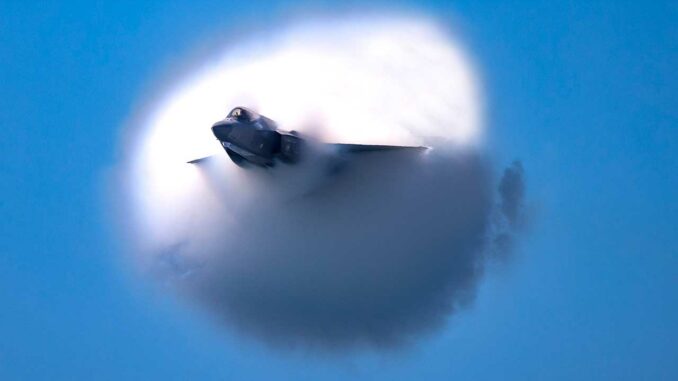
At Mach 1 and beyond, aircraft undergo a change in conditions: shocks, heat, stress. This places demands on the structure and coating, both underneath and on top.
In summary
Breaking the sound barrier is not just a matter of “going faster.” Supersonic speed shifts aerodynamics into a world of compressibility, standing waves, and stress peaks. The first visible effect is the creation of shock waves, which shift the center of pressure and impose sudden local stresses on the wings, air intakes, and tail surfaces. The second effect, less spectacular but more structural, is aerodynamic heating: the “total” air temperature at the stall point rises with Mach number, which heats the skin, expands the airframe, and stresses the assemblies. Finally, the factor that most quickly kills margins, especially at low altitudes, is dynamic pressure: at the same Mach number, it explodes in dense air, resulting in strict envelope limits. “Normal” airliners avoid supersonic flight for reasons of drag, noise, and structure. Fighter jets, on the other hand, accept it, but only for limited periods, altitudes, and temperatures, because supersonic performance comes at a cost in terms of weight, maintenance, and service life.
The physical reality behind supersonic speed
Flying at supersonic speed means that the aircraft exceeds the speed of sound in the surrounding air. This “sound” is not a constant: it depends mainly on temperature. At low altitudes, it is around 340 m/s (≈ 1,225 km/h). At around 11,000 m, the speed of sound drops to around 295 m/s (≈ 1,060 km/h). As a result, Mach 1.8 does not have the same true speed at different altitudes, and above all, it does not have the same loads.
Passing above Mach 1 creates areas where the flow can no longer “prevent” the air upstream. The pressure reorganizes itself in leaps and bounds: these are shocks. On the scale of an aircraft, this means:
- steeper pressure gradients on the wing;
- increased sensitivity to angles of attack and small variations in geometry;
- so-called “wave” drag, which immediately penalizes fuel consumption and the necessary thrust.
This is why supersonic design is a discipline in its own right: you don’t just “reinforce” a subsonic aircraft, you change its compromises.
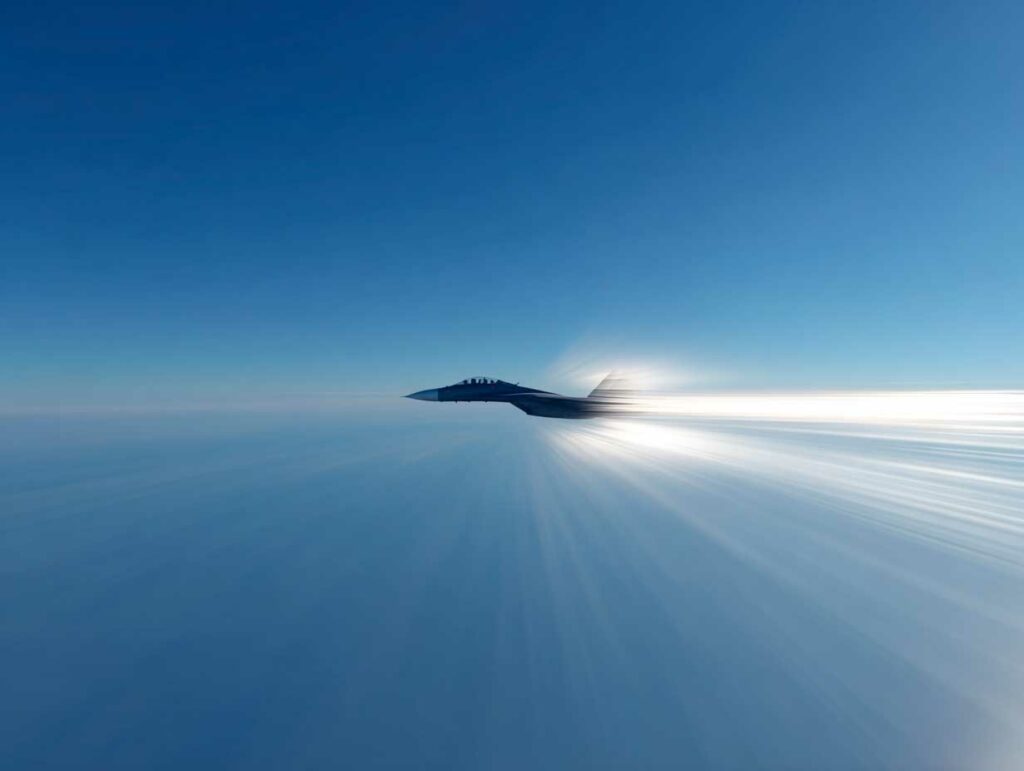
Mechanical loads acting on the structure
Supersonic flight first imposes more aggressive aerodynamic forces. Two mechanisms dominate.
Dynamic pressure, the true arbiter
The overall load increases with dynamic pressure (q), which is approximately proportional to air density and the square of speed. At equal Mach numbers, flying low is mechanically more violent than flying high.
A simple example illustrates the difference. Let’s take Mach 1.5:
- At sea level: speed ≈ 510 m/s (≈ 1,840 km/h). With a density of ≈ 1.225 kg/m³, q ≈ 0.5 × 1.225 × 510² ≈ 159,000 Pa, or ≈ 159 kPa.
- At around 11,000 m: speed ≈ 443 m/s (≈ 1,595 km/h). With a density of ≈ 0.364 kg/m³, q ≈ 0.5 × 0.364 × 443² ≈ 36,000 Pa, or ≈ 36 kPa.
At the same Mach number, the “available” load on the airframe can therefore be about four times higher at the bottom than at the top. This is why supersonic aircraft have very strict envelope limitations at low altitudes: it is not a matter of vanity, but a structural necessity.
Shocks and their local stress peaks
Shocks do not just increase drag. They create areas of concentrated stress: leading edges, air intakes, fairings, pylons, control surfaces. These peaks accelerate:
- fatigue of fasteners and rivets;
- the risk of local buckling on thin panels;
- the appearance of coupled vibrations (buffeting) that cause the structure to “hammer.”
In practice, supersonic design translates into skins and spars dimensioned for these transient loads, not just for a “smooth” load factor in subsonic flight.
Heat, the silent enemy of skin and assemblies
Supersonic flight heats up the aircraft because the kinetic energy of the flow is converted into internal energy when the air is slowed down and compressed. A widely used relationship links the total temperature (at the stagnation point) to the ambient temperature: as Mach increases, the total temperature rises.
At 11,000 m, the air is typically around 216 K (−57 °C). At Mach 2, the total temperature becomes approximately 216 × (1 + 0.2 × 4) ≈ 389 K, or ≈ 116 °C. We are already in a zone where:
- conventional paints and sealants age quickly;
- joints expand;
- the rigidity and fatigue resistance of certain alloys deteriorate.
The example of Concorde is telling: the aircraft was designed to withstand high skin temperatures, with a nose reaching up to 127°C and a tail around 90°C, which caused measurable expansion of the fuselage (up to several tens of centimeters according to technical reports). This is not a minor detail: the entire airframe must withstand this “thermal cycle” on every flight.
At higher Mach speeds, the difference becomes dramatic. The SR-71 is an extreme example: at Mach 3, the structure can reach temperatures of several hundred degrees Celsius, enough to render aluminum unsuitable and require very specific material and assembly choices.
The concrete effects on a “normal” aircraft designed for subsonic flight
A subsonic transport aircraft is optimized for Mach 0.78–0.85 in cruise. Its wing is designed to delay transonic flight, not to sustain supersonic flight. If it were pushed beyond that:
- compressibility drag would increase significantly, as would fuel consumption and the thrust required;
- shock-related loads and vibrations would appear in areas not designed for them;
- skin temperature would become a factor in accelerated aging, particularly for composites, adhesives, seals, and paints.
In other words, it’s not “just an engine problem.” .” It’s a problem with the airframe, the coating, and certification.
The typical design of a fighter jet for supersonic flight
A fighter jet is designed to frequently fly at transonic speeds and reach supersonic speeds when tactics require it. But this comes at a price.
Shapes that limit damage
Fighters adopt aerodynamic compromises:
- leading edges adapted to transonic/supersonic speeds;
- a slender fuselage and carefully designed volumes (area rule) to reduce wake drag;
- air intakes capable of handling shocks and providing acceptable flow to the compressor.
Structures and materials that can withstand stress
To withstand heat, loads, and cycles, we find:
- aluminum alloys where temperatures remain moderate and mass must remain low;
- titanium and stainless steels in hot or highly stressed areas (leading edges, engine vicinity, anchor points);
- carbon composites to save weight and increase rigidity, but with close attention to adhesives, resins, and permissible temperatures.
The key point is thermal compatibility: if two adjacent materials expand at different rates, the fasteners and joints become areas of stress concentration. Supersonic flight multiplies these cycles and accelerates fatigue.
Coatings and the “functional skin”
On a modern fighter jet, the coating is not just cosmetic. It can include radar-absorbing coatings (skins and layers that contribute to stealth), anti-erosion protection (rain, sand), and anti-corrosion layers.
The reality is simple: the more “functional” the skin is, the more expensive it is to maintain. And supersonic flight, by heating and imposing shear stresses on the flow, tends to degrade the outer layers more quickly, especially on the leading edges and separation zones.
The consequences of supersonic flight at low altitude
Flying fast at low altitude is the worst of both worlds:
- high density → high loads (q);
- turbulence and shear → stronger vibration excitations;
- rain, dust, spray → accelerated erosion.
At Mach 1.2–1.5 at low altitude, the airframe can reach its stress limits well before reaching a spectacular “thermal” limit. Pilots and flight manuals know this: low supersonic flight is done in short windows, or not at all, depending on the mission and configuration (external weapons, fuel tanks, etc.). It’s not a question of courage, it’s a question of airframe life.
The consequences of supersonic flight at high altitude
At high altitudes, the air is colder and less dense. Paradoxically:
- aerodynamic loads decrease significantly (q), so the structure breathes;
- but true airspeed increases at a given Mach number, and heating at the stall point remains controlled by Mach.
This is the range where supersonic flight can be maintained for longer without destroying the airframe due to overload. This is also where certain aircraft are “comfortable”: supersonic flight becomes more rational, even if afterburner consumption and infrared signature remain issues.
The clear trade-offs imposed by supersonic flight
Sustainable supersonic flight requires accepting at least one of these costs:
- higher structural mass (meaning less fuel or less payload);
- more complex and costly materials and assemblies;
- more extensive maintenance of the skin and joints;
- strict envelope limits to protect the airframe.
The myth is to believe that “Mach 2” is simply a matter of engine performance. The reality is that the airframe pays the price with each acceleration: thermal cycles, load cycles, coating aging, assembly tolerances. Fighter jets accept this cost because it benefits their tactics. “Normal” aircraft do not accept it because it is not cost-effective in terms of economics, noise regulations, and durability.
The perspective that matters for the next generation
The question is not just “going faster.” It’s “going faster without ruining the skin.” The expected advances come mainly from:
- more heat-tolerant materials and resins;
- multi-functional skins that are more resistant to erosion;
- faster maintenance and repair methods;
- more precise envelope management (measured structural temperatures, margins calculated in real time).
Supersonic flight will remain a tool. It is only valuable if it is sustainable for the structure and if the coating does not become the Achilles’ heel that turns speed into immobilization in the hangar.
Sources
- NASA Glenn Research Center, “Stagnation Temperature” (total temperature/Mach ratio).
- NACA Research Memorandum (1952), adiabatic stagnation temperature equation.
- Aerospaceweb.org, “Ask Us – Concorde History III” (skin temperatures and gradients).
- Smithsonian National Air and Space Museum (How Things Fly), SR-71: structural temperatures in supersonic flight.
- Wikipedia (technical summary), Concorde: heating, alloys, orders of magnitude.
- DoD DOT&E FY2016, F-35: assessment of structural temperatures in high-speed portions of the envelope.
- U.S. Air Force / ACC, “LO: how the F-22 gets its stealth” (nature and requirements of coatings).
- Wikipedia, “Dynamic pressure” (definition q = 1/2 ρ V² and interpretation).
War Wings Daily is an independant magazine.