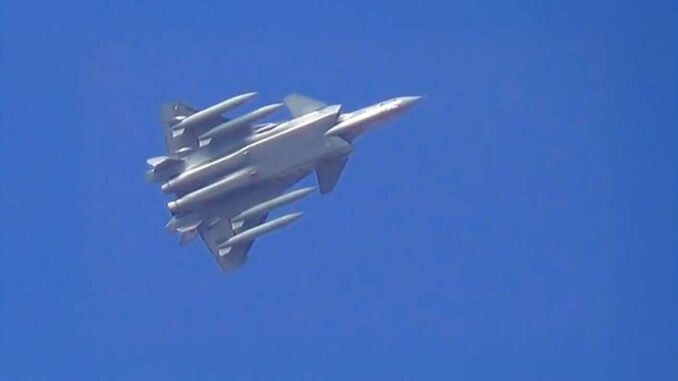
With four external fuel tanks, the J-20 extends its range and changes the equation for US refueling aircraft as far as Guam.
In summary
The appearance of a Chinese J-20 equipped with four external fuel tanks marks a major strategic shift in the Pacific. By increasing its range from approximately 4,000 km to nearly 5,500 km, Beijing is introducing an asymmetric approach that no longer relies on in-flight refueling. This configuration allows the Chinese stealth fighter to operate sustainably in the first island chain and project strike capability to the second island chain, including Guam, without relying on vulnerable refueling aircraft. Conversely, US forces continue to structure their air superiority around platforms such as the KC-46 Pegasus, which have become priority targets. This development does not make the J-20 the perfect fighter, but it shifts the center of gravity of air combat toward logistics and autonomous range, where industrial and doctrinal choices carry as much weight as stealth.
Range as a key strategic variable
Since the Cold War, range has always determined the operational value of a fighter. In the Pacific, this reality is amplified by distance. Between forward bases, archipelagos, and American staging areas, the distances are measured in thousands of kilometers. China has long been constrained by this geography, dependent on a coastal network and aircraft with limited range.
The J-20 partially changes this situation. Designed as a heavy interceptor and air superiority fighter, it already has a large airframe and an internal fuel capacity greater than that of many Western fighters. The addition of drop tanks exploits this structural margin to transform range into a strategic tool.
This choice is not neutral. It assumes a temporary degradation of stealth, but it has a specific objective: to reach areas where the adversary relies on air logistics to survive.
The four-tank configuration explained
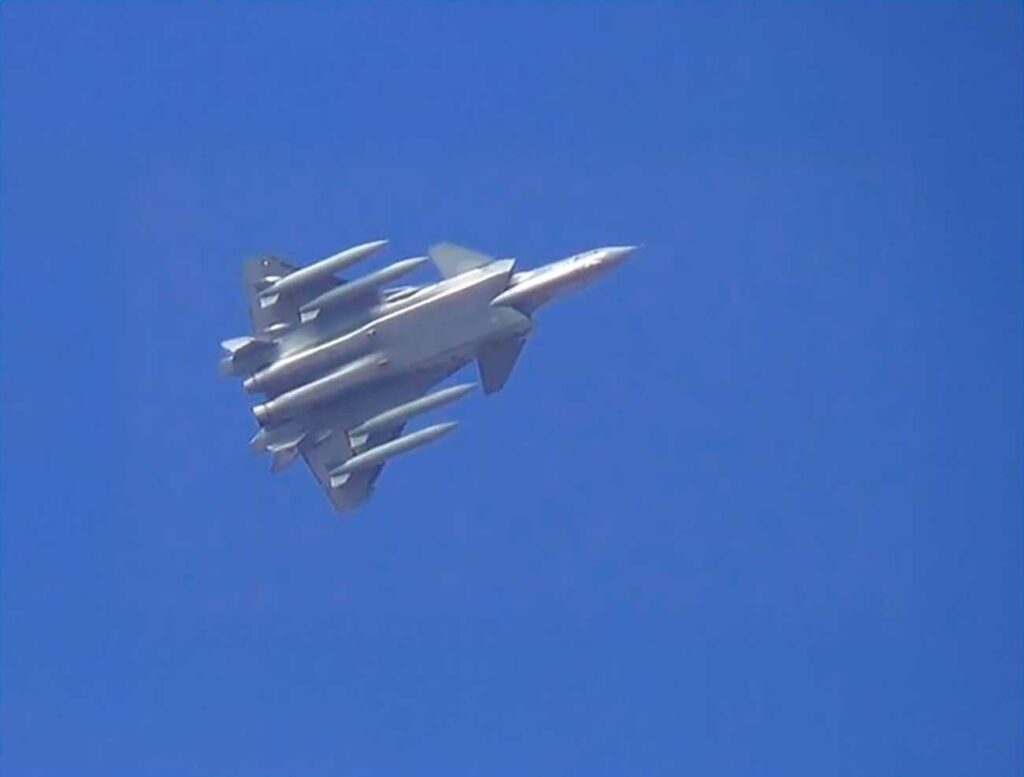
Open images and observations show a J-20 equipped with four external tanks, two under the wings and two additional ones, probably of medium capacity. Estimates converge on a unit volume of between 1,500 and 2,000 liters per tank. When fully loaded, the aircraft can therefore carry between 6,000 and 8,000 liters of additional fuel.
In terms of mass, this represents approximately 4.8 to 6.4 tons of fuel (average density of 0.8 kg/l). This load affects performance, but it is still compatible with high-altitude ferry flights without heavy external armament.
The effects are clear:
- increase in ferry range to approximately 5,500 km;
- ability to take off from mainland China and reach the second island chain without refueling;
- ability to drop fuel tanks before a more discreet tactical phase.
The logic of the first and second island chains
For years, China’s strategy has been based on the concept of island chains. The first island chain includes Japan, Taiwan, and the Philippines. The second island chain extends eastward, encompassing Guam and the Marianas.
Traditionally, China sought to deter or control the first chain. The second remained a relative sanctuary for US forces, thanks in particular to the air bases and strategic depth offered by Guam.
A J-20 capable of reaching this area without external support changes the perception of risk. It is not necessarily a massive strike capability, but a presence capability. Being present, even on an ad hoc basis, forces the adversary to disperse its resources and protect assets that were previously considered relatively safe.
The asymmetric advantage over American fighters
The US forces field extremely high-performance fighters such as the F-22 Raptor and the F-35 Lightning II. Their weakness is not their individual performance, but their dependence on in-flight refueling.
In the Pacific, an F-22 or F-35 must almost always rely on tankers to operate at long range. These aircraft, particularly the KC-46, are not very stealthy, have limited maneuverability, and are forced to follow predictable flight paths. They become prime targets for long-range missiles or enemy fighters.
The four-tank J-20 exploits this asymmetry. It does not need a tanker for certain penetration or show-of-force missions. It can wait, patrol, or transit deep into enemy territory, while the adversary must protect a fragile logistics chain.
The physics behind the “tanker threat”
The idea that tankers are vulnerable is not new. What has changed is the ability to threaten them without exposing oneself massively. A long-range fighter can force tankers to stay further away, mechanically reducing the time in the area of the fighters they support.
Every 100 km that a tanker is forced to retreat translates into a measurable operational loss. Fighters must carry more fuel, reducing their payload, or shorten their presence. In a high-intensity conflict, this constraint becomes decisive.
The J-20 does not need to shoot down tankers en masse. It simply needs to make their use risky in order to disrupt the entire enemy system.
The compromises of the external configuration
Let’s be clear. A J-20 with four external tanks is not stealthy in the strict sense of the word. Its radar signature increases, as does its drag. This configuration is not intended for discreet penetration in an environment saturated with ground-to-air defenses.
But China seems to accept this compromise for certain phases:
- long-distance transit;
- deterrent presence;
- logistical pressure on the enemy.
Once the tanks have been jettisoned, the aircraft returns to a configuration more in line with its initial role. This modularity is at the heart of the approach: separating the logistical phase from the tactical phase.
An indirect response to the lack of a mature tanker fleet
China is developing its own tanker fleet, notably around the Y-20U. But this capacity remains limited in number and experience compared to that of the United States. Rather than seeking to catch up symmetrically, Beijing is taking a different approach: reducing the need for refueling.
This logic makes economic sense. A fighter capable of operating without a tanker for certain missions reduces the pressure on the support fleet. It also offers greater political flexibility, as it is less dependent on exposed forward bases.
Implications for Guam and beyond
Guam is often described as a pivot for American projection in the Pacific. Its distance from mainland China has been a factor in its relative security until now. With a J-20 with a 5,500 km range, this distance is no longer an absolute obstacle.
This is not to say that Guam is suddenly vulnerable to a massive J-20 attack. It is to recognize that the logistical comfort zone is shrinking. Every Chinese capability that can reach this depth forces the US to invest more in defense, dispersion, and resilience.
What this development reveals about modern air warfare
The debate surrounding the four-tank J-20 goes beyond the Chinese question. It illustrates a broader trend: modern air warfare is increasingly a war of range and support, as much as a war of platforms.
A highly advanced aircraft that is dependent on visible and predictable logistics can be challenged by an adversary that relies on endurance and autonomy. Conversely, a less stealthy fighter that is capable of operating far from support can impose disproportionate costs.
An equation that forces American choices
Faced with this logic, the United States has no simple solution. Providing greater protection for refueling aircraft, making them more stealthy, increasing the number of forward bases, or developing refueling drones are all costly options.
The long-range J-20 does not render the US fleet obsolete. But it shifts the center of gravity of the problem. Air superiority is no longer just about the skies, but about the ability to maintain a survivable logistics chain under constant threat.
From this perspective, the J-20’s four-tank configuration is not a technical detail. It is a strategic signal to Washington: distance is no longer a sanctuary, and logistics is now a target in its own right.
Sources
U.S. Department of Defense, reports on the vulnerability of refueling aircraft
Air Force Magazine, analyses of the role of the KC-46 in the Pacific
The Aviationist, open studies on the J-20 and its external configurations
China Aerospace Studies Institute, work on island chain strategy
International Institute for Strategic Studies, files on the range of modern fighter aircraft
War Wings Daily is an independant magazine.