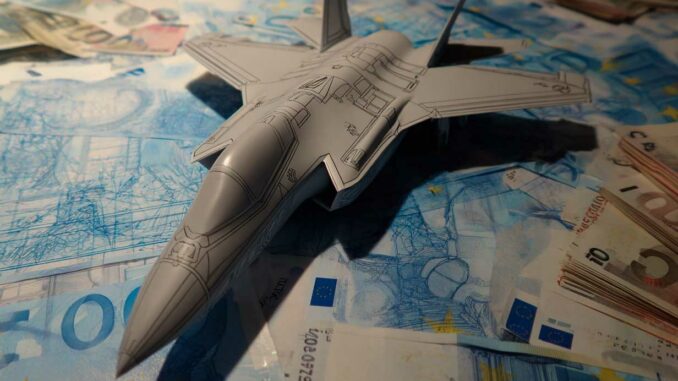
The cost of the SCAF is skyrocketing: budgets, phases, production, possible deviations, and trade-offs. How much can Europe afford to pay?
In summary
The SCAF (Future Air Combat System) has become as much a test of budgetary reality as it is an arms program. The amounts cited publicly vary, as they sometimes combine research, development, demonstrators, industrialization, and production over several decades. One clear milestone exists: €3.2 billion for phase 1B, allocated at the end of 2022 for approximately three and a half years, focused on design and demonstrations. For the entire program, the press and parliamentary analyses now mention a budget of €80 to 100 billion over the duration. The problem is not just “the figure,” but the dynamics: long-term inflation, tripartite governance, export rules, technological stacking (aircraft, drones, cloud), and direct competition with other priorities (deterrence, ammunition, Rafale F5, PA-NG). Feasibility will depend on tough trade-offs: technical scope, schedule, volume ordered, and ability to avoid national duplication.
The SCAF budget, a difficult accounting item to frame
Talking about the “cost of SCAF” without specifying the scope is like adding apples and engineering plans. The program combines a new-generation aircraft, accompanying drones, sensors, weapons, simulators, a communication architecture, and a mission system. Each sub-assembly has its own cycles, its own tests, and its own obsolescence.
In the public figures, there are three layers that often overlap.
First, there is the research and technological maturation budget. This finances building blocks that can sometimes benefit other programs. Next, there is the demonstrator development budget, which covers prototypes, flight tests, integration benches, and system validation. Finally, there is the industrial budget, which is where the real “mass” costs lie: tools, production lines, production qualification, long-term purchases, training, and initial support.
The result is mechanical: a “complete program” estimate cannot be compared to a “demonstration phase” budget. And this is precisely where communication becomes ambiguous, sometimes deliberately so. A program may seem “tenable” as long as we stick to R&D and demonstrators. It becomes a different beast when we talk about production and maintenance.
Phase 1B, the only solid and official figure
The most robust milestone, documented in black and white, is the Phase 1B contract announced at the end of 2022: €3.2 billion for approximately three and a half years, covering R&T and the overall design of the demonstrators. This is a significant amount, but it remains an intermediate step: it does not finance an operational fleet, nor full industrialization, nor a support cycle.
However, it does show two very concrete things.
First, the SCAF is no longer a “concept.” It is already consuming billions, with an industrial organization based on pillars (engine, sensors, cloud, stealth, etc.). Second, from this phase onwards, the program involves enormous coordination complexity, as each pillar involves prime contractors and partners, with critical interfaces.
One point deserves to be stated frankly. At this stage, a schedule slippage is not a “neutral delay.” In combat aeronautics, delaying means paying twice: engineering teams are extended, and existing fleets must be extended with costly standards.
The estimated long-term cost, a frightening order of magnitude
Over time, public estimates have become more realistic. We are seeing a return to a range of €80 to €100 billion as the overall order of magnitude. Even if this figure aggregates several decades and several components, it has an immediate political consequence: it places the SCAF in a category comparable to the largest European programs, but with a greater dependence on consistency between partners.
It is also important to understand the “why” behind this structural inflation. A new-generation fighter jet costs more than a 1990s aircraft, not because “everything is getting more expensive,” but because the value has shifted toward integration: data fusion, cyber hardening, electronic warfare, connectivity, and real-time processing. The SCAF adds another layer: coordination with drones and combat cloud.
This is an operational promise, but it also means costs for software, validation, security, and redundancy. And this type of cost quickly spirals out of control because it is difficult to freeze early on without compromising performance.
Financing the SCAF in the face of military budget realities
SCAF will not be financed “in a vacuum.” In France, the 2024-2030 Military Programming Law sets an overall trajectory of €413.3 billion. This seems massive, but this budget must simultaneously cover increases in ammunition, the modernization of major capabilities, and strategic programs.
However, several recent budgetary signals show that the program is tightly calibrated, with tensions on execution, deferred charges, and high outstanding payments. In this context, the military budget allocated to the SCAF becomes a subject of direct competition with highly visible political priorities.
This is where budgetary feasibility comes into play: not in the ability to sign a check for a demonstrator, but in the ability to maintain continuous spending over fifteen to twenty years without disrupting other critical segments. A program such as the SCAF requires consistency, which is constantly challenged by political cycles and strategic uncertainties.
Budget sharing between partners: the real area of fragility
The sharing of the SCAF budget between France, Germany, and Spain is often presented as a matter of course: “we pool resources, so it’s easier.” This is sometimes true. But there is a trade-off: every euro pooled adds to the negotiations, industrial compromises, export clauses, and slower governance.
The industrial logic of the best athlete is supposed to limit this drift: entrusting each area to those who know how to do it best, instead of imposing artificial divisions. In practice, European cooperation suffers when political logic takes precedence over technical efficiency.
And we must be clear: if governance slows down, costs go up. This is not an opinion, it is a complex program mechanism.
Another sensitive issue is national export restrictions. A system designed for three becomes more difficult to export if one partner can block a sale. However, export is often the implicit argument that makes the unit cost “bearable,” because it increases volume and amortizes industrialization.
Development costs, production costs, and the volume trap
The cost of the SCAF program can be broken down into two categories: development and production. Development is costly, but it can be smoothed out. Production, on the other hand, depends on a brutal variable: the number of aircraft and systems ordered.
If the planned fleets are reduced, the unit cost skyrockets because the fixed costs remain the same.
This is a classic trap. The Rafale has shown that a program can become economically strained if the national volume decreases, even if the aircraft is subsequently exported. Conversely, a European program can become “affordable” if the partners commit to a credible and stable volume.
The thorny question is therefore simple: how many fighter jets of the future will actually be purchased, at what rate, and in what versions? Without an answer, talking about the future unit cost remains speculation.
European funding: useful but marginal on this scale
We often hear that “Europe will provide funding.” Yes, there are instruments, such as the European Defense Fund, which mobilizes hundreds of millions of euros per year. But let’s be clear: on the scale of a program costing tens of billions, these budgets are a supplement, not a mainstay.
Public funding for SCAF will remain predominantly national, via defense budgets. “European funding” serves mainly to encourage cooperation, stimulate technological building blocks, and structure an industrial base. It will not replace a firm budgetary commitment from Member States.
In other words, hoping to “make Brussels pay” is a comfortable political narrative, but a weak budgetary solution.
The SCAF budget for 2040: an equation with multiple unknowns
The SCAF is aiming for entry into service around 2040, according to the frequently cited trajectories. At that date, three variables will weigh heavily.
The first is long-term inflation on high-tech programs. Even with moderate inflation, fifteen years of development will change the bill. The second is operational requirements, which may evolve: drone threats, ground-to-air defense, electronic warfare, saturation. Each requirement added late in the game is costly.
The third is the risk of duplication: if each country simultaneously finances overly ambitious transitional solutions (national standards, separate drones, incompatible clouds), the SCAF becomes an “extra layer” instead of a replacement.
That is why the question of budgetary feasibility is not “can we pay $3 billion?”, but “can we avoid paying $100 billion that is poorly distributed, poorly managed, and too late?”
Industrial spin-offs: a valid but not magical argument
The SCAF budget and industrial spin-offs are often presented as justification: jobs, technological sovereignty, critical skills. This argument is valid. Losing the ability to design a new-generation fighter jet in Europe would have an immense strategic cost.
But let’s not kid ourselves: the benefits do not cancel out the bill. They shift part of the expenditure to the economy, but the money still comes out of the defense budget.
The real question, then, is the effectiveness of the expenditure: does each billion invested produce a credible, exportable, sustainable military capability that is delivered on time? This is where governance, scope trade-offs, and schedule discipline are decisive.
The uncomfortable question: pay more or reduce ambition
If the overall budget is confirmed at around €80 to €100 billion, states will have three options, none of which are comfortable.
Pay more, accepting that the SCAF will take up a larger share of defense spending. Reduce ambition, by freezing certain components or delivering in increments, at the risk of a less differentiated system. Or spread it out, which is often the worst solution: this increases the total cost and delays entry into service, thus requiring the financing of extensions.
The debate must be framed properly: is the SCAF a program designed to be truly affordable, or a program designed to be ideal on paper? The line in the sand is European sovereignty. If the SCAF fails due to a lack of budgetary and political discipline, Europe will buy elsewhere, and the strategic cost will be much higher than the accounting cost.
Sources
- Joint press release from Dassault Aviation / Airbus / Indra / EUMET, award of the Phase 1B contract (December 16, 2022).
- Law No. 2023-703 on military programming for 2024-2030 (LPM).
- Ministry of the Armed Forces, presentation of the 2024-2030 LPM (€413 billion).
- Senate, “2040, the SCAF odyssey” (information report, background and governance).
- Le Monde, total cost estimate and analysis of industrial tensions (October 28, 2025).
- Reuters, update on deadlocks at the end of 2025 and order of magnitude “up to €100 billion” (December 11, 2025).
- European Commission, European Defense Fund: €910 million mobilized (May 8, 2025).
- Le Monde, Senate alert on sustainability and deferrals of expenditure in budget execution (May 15, 2025).
War Wings Daily is an independant magazine.