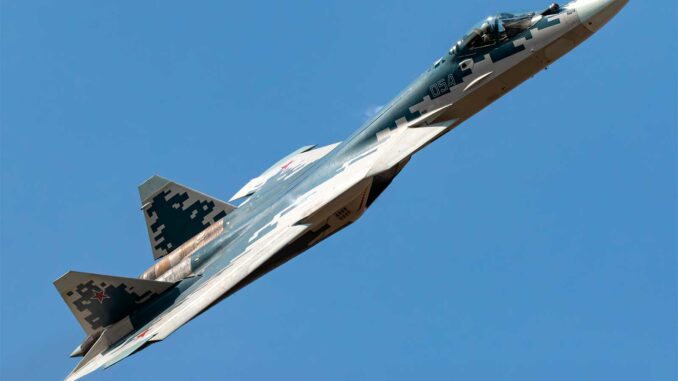
Detailed feedback on the actual use of the Su-57 Felon in Ukraine: doctrine, successes, limitations, industrial EX, and tactical lessons.
Summary
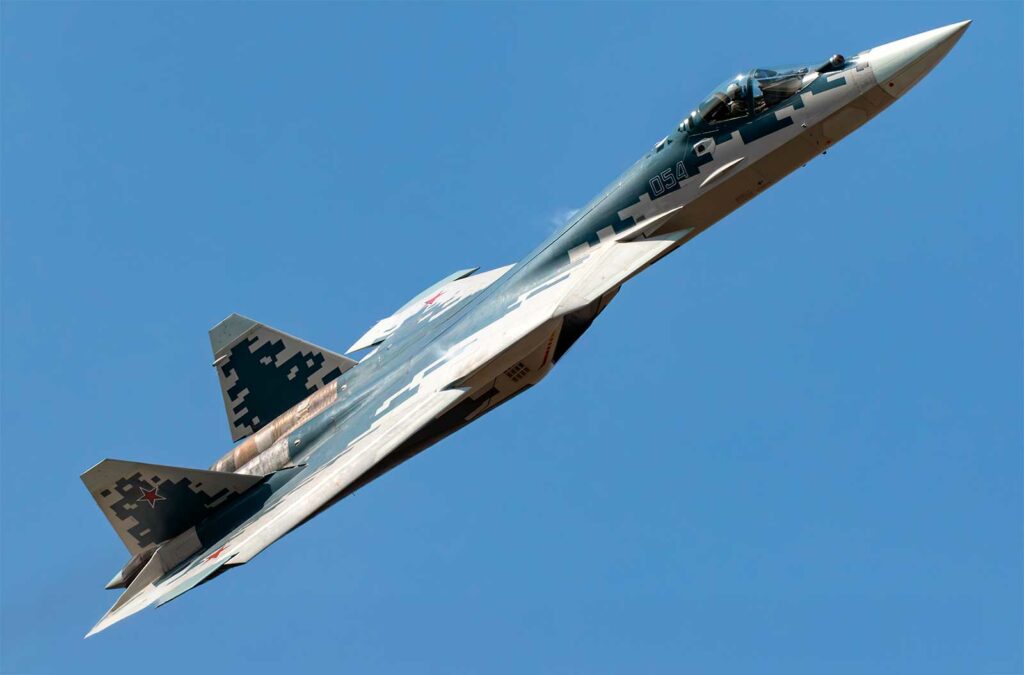
Between 2022 and 2025, the Su-57 Felon was not deployed as a conventional air superiority fighter. Russia made a clear choice: to preserve its only fifth-generation aircraft by using it as a long-range strike and detection platform, far from Ukrainian air defenses. This operational feedback reveals a cautious, almost conservative doctrine focused on engagement from a distance, the use of stealth cruise missiles, and very long-range air-to-air firing. The few incidents, particularly on the ground, have highlighted structural vulnerabilities that have nothing to do with stealth in flight. At the same time, the conflict has served as an industrial laboratory: ramp-up under sanctions, arrival of the production engine, and real-world testing of collaborative combat with the Okhotnik drone. This assessment strongly qualifies the initial marketing rhetoric: the Su-57 is neither a failure nor a Russian equivalent of the F-35, but a specialized tool, used methodically and without taking unnecessary risks.
The logic of measured engagement from the outset
From the early months of the conflict, Moscow set a clear limit on the use of the Su-57 Felon. Unlike the Su-34 and Su-35, which were engaged daily near the front lines, the Su-57 remained in the background. This choice was not dictated by a lack of confidence, but by a cold analysis of the cost-benefit ratio.
The available fleet is small. Between 2022 and 2023, there will be no more than a dozen aircraft that are truly operational. Losing a Su-57 in combat would have had a disproportionate strategic, industrial, and symbolic impact. Russia has therefore favored a doctrine in which the aircraft’s added value lies in its sensors, relative stealth, and range, rather than in close combat.
This approach contrasts with Western expectations. Many anticipated a show of force or aggressive use to validate the Russian fifth-generation concept. This was not the case. The Su-57 was treated as a rare asset, to be used only where no other vector could offer the same effect.
The doctrine of engagement from a distance
The deliberate rejection of Ukrainian A2/AD bubbles
One fact stands out in the feedback: the Su-57 almost never penetrated Ukrainian access denial zones. These zones, protected by legacy Patriot, S-300, and S-400 systems, remain extremely dangerous, even for a partially stealth aircraft.
Unlike the F-35, which was designed to operate in the heart of modern air defenses, the Su-57 was never intended to absorb losses in a saturated environment. Its stealth is real, but limited. The Russians know this. They have therefore chosen to be cautious, keeping the aircraft in Russian airspace or beyond the line of contact, while exploiting its long-range strike capabilities.
This choice has been consistent throughout the 2022-2025 period. There is no credible evidence of the Su-57 penetrating deep into Ukrainian territory.
The Su-57/Kh-69 duo as a strategic strike tool
The Su-57’s main operational success is based on the use of the Kh-69 stealth cruise missile, carried in its internal weapons bay. This is a key point. The missile, with an estimated range of 300 to 400 km (190 to 250 mi), allows strategic targets to be struck without exposing the carrier.
Critical infrastructure, such as the Trypilska thermal power plant, has been hit in this context. The Su-57 acts here as a discreet launch vehicle, reducing the likelihood of early detection by Ukrainian radars. The combination of stealth aircraft and stealth missile multiplies the effect: detection becomes delayed and interception more complex.
This mode of operation confirms one reality: the Su-57 is not a breakthrough aircraft, but a long-range sniper, designed to strike without showing itself.
The role of super-radar in air-to-air combat
Another often underestimated aspect is the use of the Su-57 as a detection and guidance platform in air-to-air combat. Several reports mention R-37M missiles being fired at Ukrainian aircraft at distances of over 150 km (93 mi).
In this scenario, the Su-57 does not need to approach. It uses its sensors, data fusion, and rearward position to detect and designate targets. The missiles can be fired by itself or by other fighters, with the Su-57 acting as an advanced flying sensor.
This function fits perfectly with its actual doctrine. Survivability is paramount. Close combat is avoided. The aircraft exploits its most valuable asset: its ability to see before being seen.
Baptism by fire… on the ground
The Akhtubinsk incident as a wake-up call
The most serious setback for the program did not come from the sky, but from the ground. In June 2024, the Akhtubinsk base, a key site for testing and parking the Su-57, was hit by an attack by Ukrainian kamikaze drones.
At least one aircraft was damaged, or even destroyed according to some sources. The aircraft was parked without adequate protection at a base that had previously been considered out of reach. The event had an immediate impact: it demonstrated that stealth in flight does not protect against vulnerability on the ground.
Lessons learned by the Russian military command
The response was swift. Russia invested heavily in reinforced hangars, hardened shelters, and anti-drone devices for its so-called “niche” bases. This cost, rarely mentioned, is nevertheless a direct consequence of the lessons learned.
This episode serves as a stark reminder of a brutal truth: a fifth-generation aircraft is a comprehensive system. Its protection is not limited to its materials or radar signature. It includes infrastructure, perimeter defense, and logistics. In this regard, the Ukrainian conflict served as a stark reminder.
The human-machine partnership put to the test
Full-scale testing with the S-70 Okhotnik
Russia did not settle for conservative use. It also used the conflict as a test bed for collaborative combat. In October 2024, a major incident occurred: a Su-57 was forced to shoot down its own S-70 Okhotnik wingman drone after it lost control over Ukraine.
The event was revealing. It proved that the concept was no longer theoretical. The pilot-drone pairing was tested in real war conditions, under jamming and constant threat.
Still not fully mature
The analysis is uncompromising. While the concept has been validated, the drone’s data link and decision-making autonomy have shown their limitations. Environments saturated with electronic warfare remain a major challenge. Russia has not sought to hide this partial failure. It has integrated it into its development cycle.
This feedback is consistent with that observed on the Western side: collaborative combat is the future, but it remains fragile in the face of heavy electromagnetic interference.
Industrial and technical feedback
Production under constraints but continuing
Despite sanctions on electronic components, the Komsomolsk-on-Amur production line continued to deliver. In 2024 and 2025, several batches left the factory. At the end of 2025, the operational fleet is estimated at between 25 and 30 aircraft.
This figure remains modest, but it marks an industrial continuity that many thought impossible in 2022. Russia has circumvented some of the restrictions, at the cost of slower standardization and increased dependence on certain alternative suppliers.
The late but decisive arrival of the production engine
One major technical point emerges from the REX: the effective transition to the AL-51-F1 engine, sometimes called Izdeliye 30. The first Su-57s flew with a transitional engine. The latest models delivered finally have the production engine.
This change enables supercruise, i.e., supersonic flight without afterburners, at around Mach 1.3 to Mach 1.5 (1,600 to 1,850 km/h). This capability was sorely lacking. It has now been achieved, even if it comes late in the program cycle.
Stealth accepted as a compromise
Feedback also shows that the stealth coating on the Su-57 is more robust and easier to maintain than that on the F-35. On the other hand, the radar signature is higher. The Russians accept this compromise.
The reasoning is clear: for long-range firing and advanced detection missions, the aircraft is sufficiently stealthy without generating prohibitive maintenance costs. This doctrinal choice explains the difference in philosophy between the two programs.
What the Su-57 really reveals in war
The 2022-2025 assessment is more nuanced than the caricatural discourse. The Su-57 did not dominate the Ukrainian skies, but that was not its role. It was not lost in aerial combat, but it did reveal vulnerabilities on the ground. It validated concepts, while exposing technical limitations.
This feedback paints a clear picture of the future: the Su-57 will remain a specialized tool, integrated into a larger system, rather than a versatile fighter deployed on a large scale. Russia seems to have understood this. The question is no longer whether it can do everything, but how to use it without exposing it unnecessarily in a conflict where technology forgives no mistakes.
Sources
Reuters
RUSI
CSIS
The War Zone
TASS
Ukrainian Air Force press releases
Commercial satellite images analyzed by Maxar
Russian industry reports (UAC)
War Wings Daily is an independant magazine.