The Mikoyan Skat explores autonomous target recognition using AI. A technical analysis of the ATR, its real limitations, and its operational status.
Summary
The Mikoyan Skat is often presented as a Russian precursor to the stealth combat drone. Brought back into the spotlight by work on autonomous target recognition (ATR) based on deep learning, it illustrates a clear strategic direction: enabling an unmanned aerial system to identify, classify, and prioritize targets without relying on a satellite link, and therefore resilient to electronic jamming. Technically, these approaches are inspired by architectures known in the civilian and military worlds, comparable to YOLO-type real-time detection models. In practical terms, however, the Skat remains a technology demonstrator, not deployed operationally, whose concepts feed into subsequent Russian programs. The ATR is not a gadget: it is a doctrinal pivot in a context where electronic warfare degrades communications and forces platforms to make decisions locally. Understanding Skat therefore means understanding Russia’s path towards more autonomous drones, but also its industrial and operational constraints.
The Skat’s position in Russia’s drone strategy
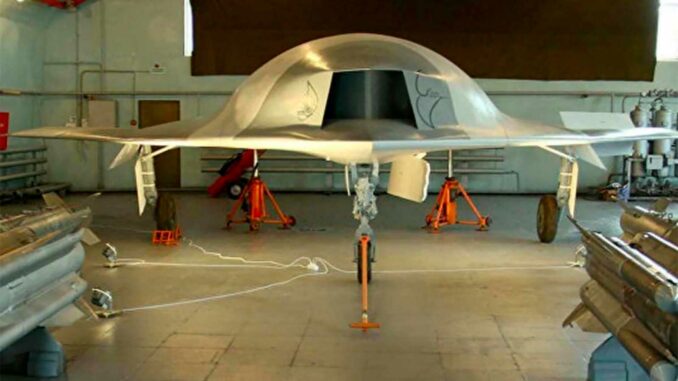
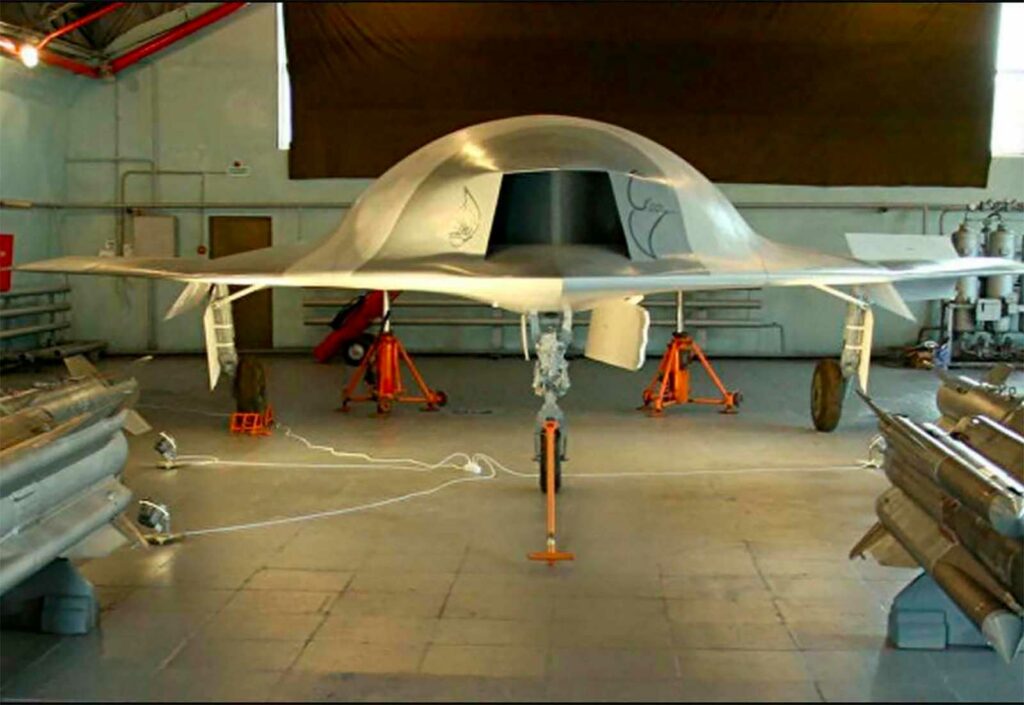
Unveiled publicly in the mid-2000s, the Mikoyan Skat was never designed as a drone for immediate production. It was a stealth demonstrator, intended to validate a flying airframe, reduced radar signatures, and concepts of use for new-generation UCAVs.
Its flying wing architecture responds to a simple logic: reduce the radar equivalent surface area, optimize internal payload, and provide a stable platform for advanced sensors. From the outset, the Skat was designed for air defense suppression, precision strike, and armed reconnaissance missions. The idea of increased decision-making autonomy gradually emerged as electronic warfare became central to contemporary doctrines.
The Skat is therefore not a hidden operational drone, but a conceptual foundation. Its technical choices have informed subsequent thinking on the use of more recent drones, in a context where Russia anticipates high-intensity conflicts, saturated with jamming and denial of access.
Autonomous target recognition as a doctrinal breakthrough
Autonomous Target Recognition marks a clear break with conventional remote control. In a traditional scenario, the drone collects images, transmits them to a human operator, and then waits for a decision. This model breaks down when data links are jammed, delayed, or cut off.
ATR aims to shift the decision-making loop to the drone itself. In concrete terms, this means that the system can:
- detect objects on the ground,
- classify them according to pre-trained categories,
- assess their military priority,
- propose, or even execute, an action.
In the case of Skat, this logic is particularly consistent with its intended role in highly contested areas, where constant communication with a command center is unrealistic.
The technical functioning of a deep learning-based ATR
Technically, a modern ATR is based on convolutional neural networks. These models analyze images from electro-optical, infrared, or synthetic aperture radar sensors. YOLO-type architectures are known for their ability to detect and classify objects in real time, with reduced latency.
The principle is as follows. The model is trained on millions of annotated images representing vehicles, weapon systems, buildings, or thermal signatures. Each pixel is analyzed, and the network learns to recognize relevant patterns. Once onboard, the algorithm processes the sensor streams on the drone.
In a UCAV such as the Skat, the ATR does not simply say “target or not.” It combines tactical metadata: mobility, potential threat, proximity to civilian targets. These parameters enable automatic prioritization, which is essential when multiple targets appear simultaneously.
Robustness in the face of electronic warfare
One of the major advantages of onboard ATR is its resilience to jamming. When GNSS or satellite signals are degraded, a drone that depends on an operator becomes blind or inoperative. Conversely, an autonomous system retains its local capacity for action.
The Skat was designed to operate in environments where communications are intermittent. ATR therefore enables mission continuity: the drone continues on its trajectory, analyzes its environment, and retains its strike or reconnaissance capability.
However, this autonomy has its limits. Without a connection, human validation disappears, raising ethical and control issues. Technically, this also requires extreme reliability of the algorithms, as a classification error can have major consequences.
The actual operational status of the Mikoyan Skat
It is essential to be clear. The Mikoyan Skat is not operational. No deployment in combat units has been confirmed. The program has served as a technological showcase and laboratory of ideas, but has not led to mass production.
The ATR capabilities associated with the Skat are therefore at a conceptual and experimental level, validated on test benches and demonstrators, but not in a real theater of operations. The Russian systems deployed today use technological building blocks from this work, but in different configurations.
This distinction is crucial to avoid any overestimation. The Skat is a doctrinal ancestor, not a stealth drone already in service.
Variants and developments envisaged around the Skat concept
The Skat has not had any officially named operational variants. However, several areas of development have been discussed in Russian industrial and military circles.
The first area concerns internal payload capacity, with precision-guided munitions designed to limit radar signature. A second area concerns the integration of multispectral sensors, enabling the UAV to cross-reference visual, infrared, and radar data.
Finally, doctrinal developments envisage cooperation between drones, with several platforms sharing their ATR analyses locally to saturate an enemy’s defenses. Here again, the Skat serves as a conceptual reference rather than a final product.
The planned weaponry and its link to ATR
The Skat was designed to carry precision air-to-ground munitions, potentially from the guided bomb or small tactical missile family. ATR plays a key role here. It allows the weapon to be adapted to the target, depending on its nature and environment.
For example, an isolated armored vehicle does not require the same ammunition as a mobile radar surrounded by civilian structures. ATR provides this decision-making granularity, reducing the need for immediate human intervention.
However, this automation raises a central question: how far should lethal decision-making be delegated? On this point, Russia, like other powers, is moving forward in cautious steps, testing decision support before full autonomy.
The practical limitations of ATR in a UCAV
Despite its promise, ATR is not infallible. Deep learning models are sensitive to training data.
An unfamiliar environment, an atypical thermal signature, or effective camouflage can degrade performance.
In addition, the implementation of these algorithms requires high computing power, compatible with the mass, cooling, and energy consumption constraints of a stealth drone. The Skat, as a demonstrator, has made it possible to explore these trade-offs, without fully resolving them.
Finally, the absence of a human link poses a problem of operational responsibility, which remains politically and legally sensitive.
What the Skat says about the future of Russian combat drones
The Mikoyan Skat is not a secret weapon ready to strike. It is more interesting than that. It reveals a strategic vision: that of an air force capable of operating despite massive jamming, relying on intelligent autonomous systems.
ATR, inspired by real-time detection models, becomes an efficiency multiplier. It does not replace human command, but it reduces dependence on communications, which is crucial in modern warfare.
As conflicts evolve into environments saturated with interference, these concepts will become increasingly important. The Skat will probably go down in history as a discreet but formative milestone, having paved the way for more advanced, autonomous, and integrated drones.
Sources
Public documents and Mikoyan presentations on the Skat UCAV
Technical analyses of Russian UCAVs and onboard autonomy
Specialized publications on military Autonomous Target Recognition
Open works on deep learning applied to military sensors
War Wings Daily is an independant magazine.