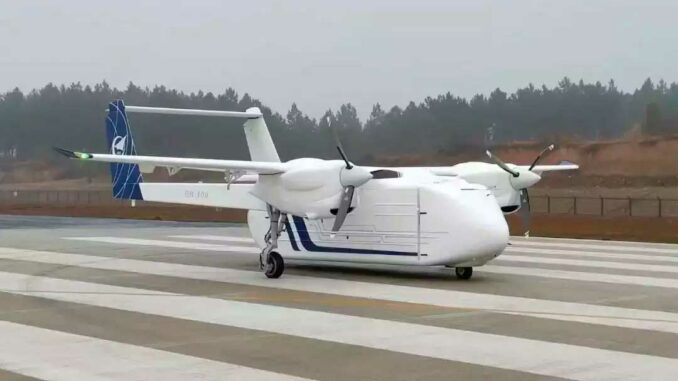
On January 26, Beijing showcased a cargo drone tested at high altitude, highlighting a strategy in which CASC, CASIC, and NORINCO are transforming civilian technologies into military assets.
Summary
On January 26, Chinese media highlighted the success of new tests of cargo drones capable of carrying heavy loads and operating in difficult conditions. Behind the “logistics” image lies a broader issue: China is rapidly industrializing large-capacity cargo drone platforms and standardizing their use in challenging environments, including high altitudes. The demonstrators cited by the media illustrate the same logic: shortening transport times, reducing dependence on infrastructure, and quickly switching from civilian to security use. CASC, CASIC, and NORINCO embody this dynamic: state-owned groups that absorb civilian technological building blocks (autopilots, sensors, AI, mass production, logistics) and reinject them into the military. Should we be concerned about China’s lead, particularly in drone swarms? Yes, in terms of volume, iteration speed, and doctrine. But superiority in real-world conditions still depends on one sticking point: surviving electronic warfare and airspace disputes.
The fact of the day behind the announcement
On January 26, Beijing did not “discover” the cargo drone. Instead, it chose to celebrate a series of visible advances: successful test flights, published performance figures, and above all, a simple narrative — “drone logistics will open up remote regions.” This narrative has real economic value, but it also serves a strategic purpose: to familiarize people with the idea that a large drone can become a normal link in a national supply chain.
Several programs, led by state-owned groups, illustrate this trajectory. On the CASC side, a cargo-type aircraft, the FP-985 Taurus, was promoted after a long-distance demonstration in a plateau area: approximately 1,200 km, an altitude of up to 7,500 m, a maximum takeoff weight of 5.7 t, and a payload of over 2 t, with a range of over 2,000 km. On the NORINCO side, the Tianma-1000 was presented as an autonomous transport platform capable of operating in complex terrain, with a ceiling of 8,000 m, a takeoff/landing distance of less than 200 m, and an announced range of 1,800 km.
Although the platforms differ, the logic is the same: to prove that “utility” drones can leave the laboratory and perform demanding mission profiles, with rapid autonomy and reconfiguration capabilities.
Uses for a large-capacity cargo drone
A large cargo drone is not just a “flying truck.” Its value lies in moving freight when roads, bridges, runways, or weather make conventional transport slow, expensive, risky, or impossible.
Civilian logistics as a test bed
There are many credible civilian use cases: supplying remote areas, transporting perishable goods, delivering critical parts to construction sites, providing disaster relief, or maintaining a minimum flow of goods when infrastructure is cut off. The economic benefits are easy to see: if a drone can reduce a journey of several hours to a short flight, it changes the equation for the “last mile” in areas where the marginal cost of transport is very high.
Above all, these civilian missions generate operational data: reliability, maintenance, weather behavior, valley navigation, performance on rough tracks. This is exactly the data a military program needs, without the political cost of an explicitly martial trial.
Military logistics changing scale
The shift to military logistics is straightforward. A heavy cargo drone can:
- resupply an isolated post (ammunition, batteries, rations, parts),
- transport sensitive equipment without exposing a crew,
- support an operation in mountainous or island terrain,
- evacuate equipment or lightly wounded personnel depending on configuration,
- perform precision drops, including at night.
The key point is exposure to risk. Replacing a manned helicopter with a drone on certain missions reduces the human cost and allows for more dangerous air routes to be “attempted.” It’s not spectacular, but it’s decisive in a long campaign.
The technical reason for high-altitude testing
Testing at altitude is not a media stunt. It is a brutal way of checking whether the avionics, propulsion, airframe, and automation systems can withstand the elements when the air becomes an enemy.
At high altitudes, the air is less dense: lift decreases, true airspeed increases for the same lift, takeoff and landing distances increase, and engine margin deteriorates. Weather constraints accumulate: valley winds, wind shear, icing, orographic turbulence, low clouds. In other words, if a drone is stable and controllable in this environment, it will be easier to certify and operate elsewhere.
“Plateau” scenarios have obvious military value. They simulate theaters where airfields are rare, runways are imperfect, and terrain dictates routes. They also require mastery of safety functions: protection against icing, wind tolerance, automated approach procedures, and autonomous landing in poor visibility.
The place of CASC, CASIC, and NORINCO in the ecosystem
It is important to be precise about the acronyms, as they describe an industrial organization.
- CASC (China Aerospace Science and Technology Corporation) is a historic pillar of space and major aerospace programs. It also carries drones and transport platforms, often through subsidiaries, in connection with civil and state needs.
- CASIC (China Aerospace Science and Industry Corporation) is another state-owned giant, with a strong presence in defense systems, sensors, missiles, networks, and dual technologies. Even if a particular cargo drone is not “CASIC-branded,” CASIC is at the heart of the building blocks that matter: communications, data links, resilient navigation, components, and system integration.
- NORINCO is a land defense conglomerate, but it has long expanded into cross-cutting areas. The fact that a “land” player is pushing a utility aerial platform is not an anomaly: it is proof that China wants complete systems, from autonomous vehicles to logistics networks.
The implicit message is simple: sectoral boundaries matter less than the ability to industrialize quickly and integrate.
The mechanics of civil-military fusion in China
Civil-military fusion is not a vague slogan. It is an industrial policy that aims to circulate innovations, talent, production methods, and supply chains between the civilian and military sectors, with few safeguards and strong coordination.
In concrete terms, this translates into:
- transfers of components and software (sensors, navigation, AI, batteries, telecoms),
- standards and certifications that “prepare” the transition to security uses,
- civilian volumes that finance industrialization, then a military that benefits from lower unit costs,
- civilian operating data that feeds into military development (predictive maintenance, fleet management, flight safety).
This model is particularly powerful in cargo drones: civilian needs (delivery, express, rescue) and military needs (supply, airdrops) largely overlap. The boundary becomes a question of onboard sensors, encrypted links, and doctrine of use.
Civilian technologies that become military multipliers
We need to look less at the airframe and more at the “building blocks” that make it useful.
Autonomy and fleet management
The qualitative leap comes from the ability to plan, dispatch, reroute, and maintain a fleet, not just fly a drone. Route planning, obstacle avoidance, weather management, automated loading, and autonomous landing: these are functions designed for large-scale civilian logistics, but they immediately become relevant in military operations.
Mass production and standardization
China’s lead can be seen in the pace: longer series, faster iterations, and lower unit costs. Although the precise figures vary depending on the program, the industrial logic is consistent: the civilian sector creates volume, while the military reaps the benefits of maturity.
Connectivity and resilience
The real weakness of drones is their connections: jamming, deception, GNSS disruption, cyber attacks. This is where “defense” integration becomes critical: encryption, redundant connections, alternative navigation, degraded modes. The discourse on large cargo drones often masks this reality: a “perfect” drone in a permissive environment can become useless if the connection is lost.
Drone swarms, between promise and operational reality
China communicates a lot about drone swarms. The subject is serious, but two pitfalls must be avoided: panic and contempt.
Yes, Chinese industrialization facilitates “numbers.” However, swarms rely on numbers, redundancy, and saturation: many vectors, each relatively inexpensive, coordinated to overwhelm defenses. Yes, Chinese doctrine and research are exploring collective autonomy, distributed reconnaissance, and multi-axis attack modes.
But a credible swarm in actual combat must survive three types of violence:
- electronic warfare (jamming, spoofing, takeover),
- short-range ground-to-air defense (guns, missiles, lasers, drone interception),
- terrain friction (weather, relief, losses, collisions, classification errors).
In other words, swarming is not magic. It is a discipline of engineering and training, and the difference will be made by robustness in contested environments.
Reasons to worry and reasons to keep a cool head
Let’s be frank.
Reasons to worry
- China is making rapid progress on dual-use platforms: a large “civilian” cargo drone can accelerate military logistics capabilities.
- State-owned groups know how to industrialize: they can produce, maintain, and deploy on a large scale.
- The flow of civilian technology to the military is organized, not accidental.
- The “low-altitude economy” narrative trivializes the expansion of the drone ecosystem.
Reasons to keep a cool head
- Superiority is not measured by technical specifications, but by survivability under jamming and mission success rates.
- Heavy drones remain more visible and less maneuverable targets than small FPVs or loitering munitions.
- Drone logistics has limitations: weather, maintenance, dependence on loading points, and vulnerability of hubs.
- Many announcements are milestones, not already operational large-scale fleets.
The correct interpretation is therefore twofold: China is making real progress, but this progress will only be decisive if it translates into robust concepts of use, tested in environments dense with countermeasures.
The endgame that Beijing is seeking to establish
A heavy cargo drone tested at altitude is not just a flying object.
It is a piece of architecture: an economy that produces platforms, an administration that opens up airspace, state-owned groups that capture civilian technologies, and an armed force that recovers mature capabilities.
The real challenge for other powers is not to imitate exactly. It is to respond in three concrete areas: accelerating production and iteration, strengthening resilience (communications, navigation, cyber), and investing in countermeasures. If this triptych is missing, the surprise will not come from a Chinese “super drone,” but from a commonplace: drones everywhere, all the time, at costs that few industries will be able to match.
Sources
- Xinhua, “China’s homegrown ‘Tianma-1000’ unmanned cargo aircraft completes maiden flight,” January 11, 2026.
- CGTN, “Tianma-1000 unmanned cargo aircraft completes first flight test,” January 11, 2026.
- China Daily, “Big cargo drone aces elevated test flight,” January 16, 2026.
- CASC (SpaceChina) quoting China Daily, “Big cargo drone aces elevated test flight,” January 16, 2026.
- People’s Daily Online (Xinhua), “China’s new cargo drone makes first flight, boosting unmanned logistics” (Caihong-YH1000), May 23, 2025.
- Defense One, “China’s burgeoning drone arsenal shows power of civil-military fusion,” June 17, 2025.
- CSET (Georgetown), “Pulling Back the Curtain on China’s Military-Civil Fusion,” 2025.
- CNA, “PRC Concepts for UAV Swarms in Future Warfare,” 2025.
- Reuters, “Robot dogs and AI drone swarms…,” October 27, 2025.
- CFR, “Civil-Military Fusion: The Missing Link…,” January 29, 2018.
War Wings Daily is an independant magazine.