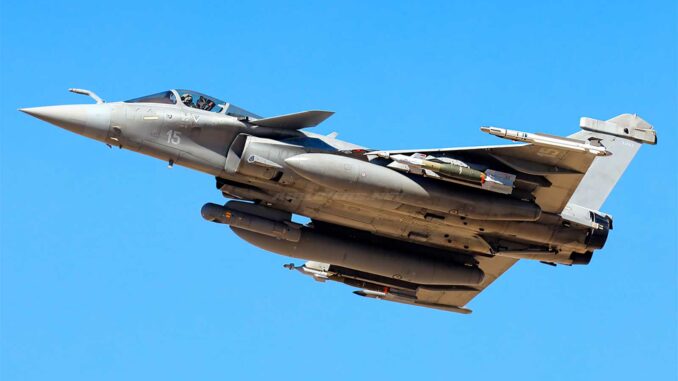
Surprise order, 20 Rafales dispersed in 8 hours: what the Topaze exercise says about base survival, logistics, and retaliatory strikes.
Summary
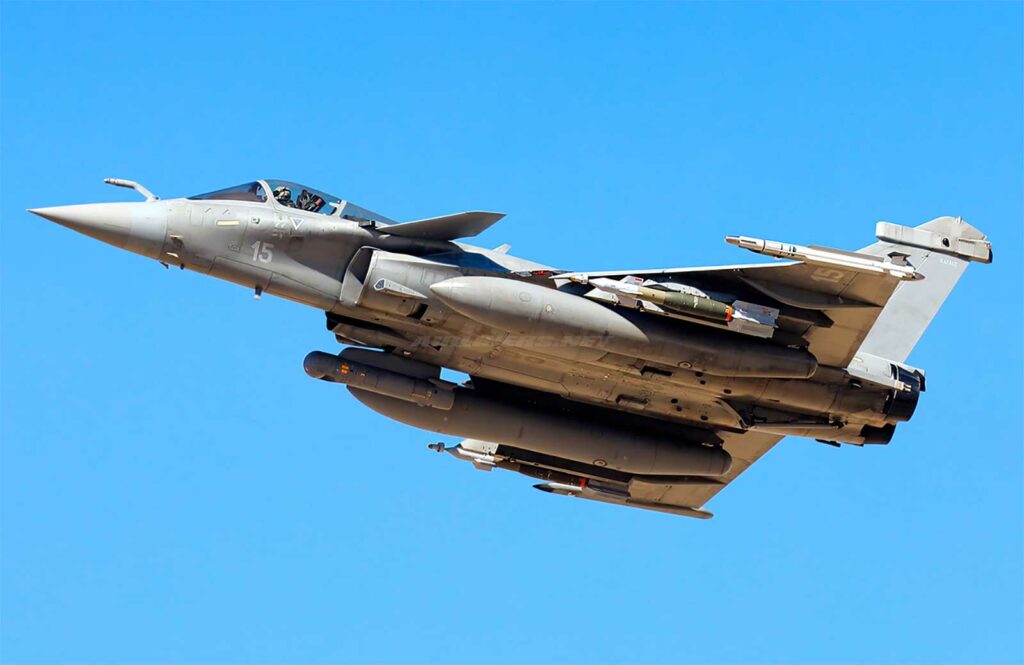
On January 27, 2026, the 30th Fighter Wing received an unannounced dispersal order as part of the Topaze exercise. Twenty Rafale aircraft left Mont-de-Marsan Air Base 118 to be dispersed across four sites, including a civilian airport. The objective was clear: to prevent a massive strike on a main base from neutralizing a significant portion of the air force in one fell swoop. The exercise tested decision-making speed, the chain of command, the security of the bases, and the ability to maintain technical support and weaponry away from the usual infrastructure. The scenario did not stop at simple “dispersal”: twenty-four hours later, the crews followed up with a simulated SCALP strike mission from the deployment sites. Topaze reminds us of a basic fact: resilience is built through logistics and people, as much as through the aircraft on the ground.
The surprise trigger and the mechanics of dispersion
The principle is simple. Prevent a base from becoming a trap. In practice, it is a difficult maneuver, under time constraints.
In the exercise, the alert is presented as imminent. The decision is therefore to quickly “move” a significant portion of the aircraft. The message is clear: we are not testing a convenient relocation. We are testing the ability to continue the war after an initial salvo.
This point deserves to be stated frankly. A modern fighter base concentrates aircraft, ammunition, fuel, command resources, workshops, and people. A well-prepared strike can target the runway, depots, and parking lots in a matter of minutes. If the base is blocked, the surviving aircraft become useless.
The attack scenario and the decision-making authority
Dispersion is controlled at the fighter maneuver level. It is not a “local” decision made in a hurry at the last minute. In the Topaze case, the maneuver is announced as being orchestrated by the BAAC and placed within a logic of operational continuity: activity must not be interrupted, even under pressure.
This is where the concept of the C2 chain becomes central. Without reliable decision-action links, dispersal only serves to save aircraft. However, the military objective is to save the ability to carry out missions, and therefore to achieve results.
The choice of sites and what it reveals
The deployment sent 20 aircraft to Cognac, Cazaux, Mérignac, and Clermont-Ferrand. The choice is telling. Military sites are mixed with civilian sites.
This is not based on the logic of very short “road” runways. The Rafale is not designed for that. It is based on a more pragmatic French approach: increasing the number of credible, available airfields that are sufficiently equipped to support a minimum level of activity.
The runway figures illustrate this realism. Clermont-Ferrand has a main runway of 3,015 m (9,892 ft). Bordeaux-Mérignac has two runways, one of which is 3,100 m (10,171 ft) long. Cognac and Cazaux offer lengths of around 2,400 m (approximately 7,900 ft). These are comfortable margins for fighter operations, even with loads and fuel.
The rationale for a dispersal exercise in 2026
Topaz is inspired by an idea that has become commonplace in Ukraine: strike bases to break the rhythm. Even without destroying many aircraft, a force can be neutralized by rendering the runway unusable, burning fuel, or saturating defenses through repetition.
This is a change in mindset for Western air forces. For years, the focus has been on optimizing projection from established bases. High intensity puts the emphasis back on a tougher problem: surviving the first few hours.
In this context, dispersion aims at three very concrete things.
First, reducing the risk of massive losses.
We are moving from a single point of vulnerability to several points that are more difficult to strike simultaneously.
Second, to complicate enemy planning. A strike prepared on a known site is simpler than a strike on four sites, including a civilian one, with rapid movements.
Finally, to maintain the capacity for action. This last point is more important than the other two. There is no point in saving aircraft that cannot fight.
The technical requirements of the Rafale outside its base
The “reduced footprint” argument is appealing. It needs to be reframed. It is not a question of hunting with two trucks and a jerry can. It is a question of moving part of a factory and then running it.
However, the exercise validates a useful reality: the Rafale can operate with a reduced logistical footprint compared to heavy deployments, provided that there is an already structured host site.
The minimum requirements to be guaranteed
A runway is needed, but that’s not all. Traffic management, procedures, emergency services, and security measures are also required.
Fuel of the right standard is needed, with quality control. And throughput is needed. A fighter jet consumes fuel quickly. A dispersion that queues up for refueling quickly becomes an “immobilized” dispersion.
Data is also needed. Weather, planning, threats, coordination, deconfliction. The link between those who make decisions and those who execute them must remain intact, even in degraded situations. This constraint is sometimes more difficult to meet than the runway constraint.
The real bottleneck: armament and maintenance
The sticking point is well known: maintaining availability. The aircraft can land elsewhere. The question is: can it take off again, armed, and at the right pace?
This requires teams of mechanics, avionics and engine specialists, tools, parts, and strict safety discipline. At a main base, everything is on site. At a host site, everything must be brought in or already available.
Armament is even more restrictive. Storage, security, handling, preparation. You don’t “tinker” with complex weaponry at the edge of a civilian runway without concrete procedures.
That’s why day 2 of Topaze is the real test. Official publications indicate that a SCALP raid was carried out from the deployment sites, in simulated response to the attack on BA 118. The mechanics are said to have armed the aircraft the night before. The message is clear: this was not just a dispersal for survival. It was a dispersal that maintained strike capability.
The units involved and the human scale
You ask “how many people.” The exact answer has not been given publicly. But we can give a serious order of magnitude, without telling stories.
The 30th Fighter Wing includes Rafale units, including 2/30 Normandie-Niémen and 3/30 Lorraine, which are cited as being involved. The exercise also involves support, planning, command, and protection teams.
The key point is this: dispersal multiplies requirements. A single main site concentrates specialists. Four sites require critical functions to be duplicated, even if some support remains centralized.
To estimate, a parliamentary benchmark is useful. In 2023, a deployment presented as expeditionary mobilized three Rafale aircraft and 80 airmen, over a long distance, with a base to be “created” in part. The context is different, but the ratio gives an order of magnitude: a few dozen people per aircraft, when autonomy is required.
Topaze is in France. The landing fields exist. So the requirement per aircraft is probably lower. But the exercise involves 20 aircraft and four sites. Even if the ratio is greatly reduced, we quickly arrive at several hundred personnel involved, between detachments, support, command functions, and security. This is a human cost. It is also the structural limit of dispersion.
Credible results and limitations that must be faced
The clearest success is quantifiable. Twenty aircraft dispersed to four sites “today,” and rapid execution presented as a race against time. It is a test of tempo.
The second, more demanding success is the SCALP strike sequence from the deployment sites. This validates at least three things: the weapons followed, the planning followed, and the crews were able to operate from different locations.
Now we need to look at the gray areas.
The first is protection. Dispersal means multiplying the points to be defended. And the most likely threat to a secondary site is drones and sabotage, not necessarily a cruise missile. Protecting a civilian or mixed site requires procedures and reinforcements. Otherwise, we are just shifting the vulnerability.
The second is discretion. A Rafale on a civilian airport can be photographed in ten seconds. In times of crisis, this can help deterrence. It can also help an adversary. A consistent line of communication will have to be chosen, because permanent transparency can be a weakness.
The third is duration. Topaze validates a short, highly dynamic window. High intensity poses a tougher question: how to hold out for several days under pressure, with repairs, resupply, fatigue, and degraded communications. A “48-hour” dispersion is not a “one-week” dispersion.
Doctrinal lessons for high intensity
Topaze is part of a clear trend. Re-learning distributed warfare. The Nordic countries have historically structured dispersion systems, sometimes with very radical road segment logic. France does not follow this model identically. It capitalizes on its network of airfields.
The heart of the matter then becomes a matter of state. Pre-negotiate reception. Pre-positioning certain stocks. Rehearsing with civilian actors. Working on cohabitation with the DGAC, operators, and internal security forces. Without this work, dispersion will remain a “possible” exercise, but not a “reproducible” skill.
The last lesson is the most important. The survivability of bases is not only a matter of movement. It also depends on hardening: shelters, decoys, ground-to-air defense, anti-drone measures, rapid runway repair, and protection of depots. Dispersal is one leg. Hardening is the other.
The end of the idea of a secure base
Topaz says something simple, and a little disturbing. Large fixed bases are points of gravity. Therefore, they are also targets.
The Air and Space Force is demonstrating a useful capability here: moving quickly, maintaining activity, and showing that a modern fighter jet like the Rafale can continue to be effective after an initial strike.
But the exercise also reminds us of a less comfortable truth. Dispersal is costly. In terms of personnel. In terms of logistics. In terms of security. And it creates new vulnerabilities, because the lines of support multiply.
The logical next step is therefore not to celebrate. It is to toughen up and repeat. More often. In more degraded conditions. And with one obsession: to prevent a “nice exercise day” from one day turning into an inadequate response to a real attack.
Sources
Air and Space Force, LinkedIn post “Exercise #TOPAZE – Day 2” (January 29, 2026).
CDAOA, LinkedIn post on the TOPAZE dispersion and the C2 chain (January 27, 2026).
National Assembly, report mentioning the MORANE deployment (3 Rafale, 80 airmen) and the Rafale format.
Bordeaux-Mérignac Airport, infrastructure page (runway lengths).
Aeroport . fr, Clermont-Ferrand Auvergne Airport fact sheet (runway 3015 x 45).
Cazaux Air Base 120, runway data (2,400 m).
Cognac-Châteaubernard (BA 709), runway data.
Saab, presentation of the Bas 90 concept (doctrinal context of dispersion).
War Wings Daily is an independant magazine.