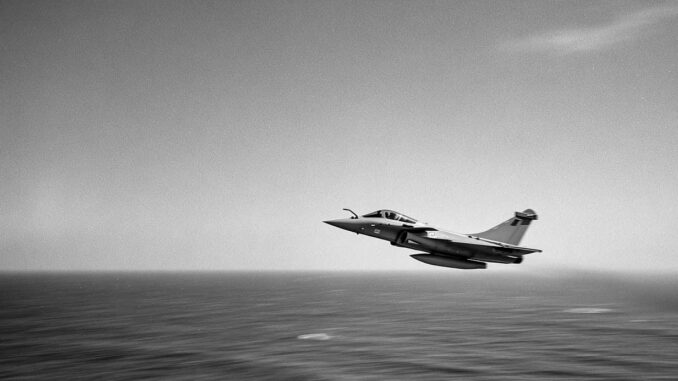
The aircraft carrier Charles de Gaulle leads the largest French military exercise since the Cold War.
On January 29, 2026, the aircraft carrier Charles de Gaulle left the Toulon naval base with its carrier strike group to take part in ORION 26, a military exercise on an unprecedented scale involving 12,500 French military personnel and forces from 24 partner countries. On board the flagship of the French Navy, 20 Rafale Marine aircraft are deployed for high-intensity combat simulations in the Atlantic. This training takes place in a tense geopolitical context marked by the need to prepare European armies for major engagements.
Summary
The aircraft carrier Charles de Gaulle set sail from Toulon on January 29, 2026, to join ORION 26 in the Atlantic. This military exercise, which runs from February 8 to April 30, is the largest joint training exercise organized by France since the end of the Cold War. It involves 12,500 French military personnel, 25 ships including the aircraft carrier, 140 aircraft, 1,200 drones, as well as cyber and space assets. Forces from 24 countries, mainly European but also American and Emirati, are participating in this training, which aims to prepare the armed forces for high-intensity conflict. The 2023 edition of ORION cost €35 million. The exercise tests France’s ability to be the first to enter a theater of operations and to command a multinational coalition within a NATO framework.
The Charles de Gaulle at the heart of a demonstration of naval power
The departure of the French naval air group from Toulon marks the launch of the maritime phase of ORION 26. The aircraft carrier Charles de Gaulle, the only nuclear-powered ship in Western Europe, is the centerpiece of this armada. Measuring 260 meters long and with a displacement of 42,000 tons, this flagship can carry up to 40 aircraft and 2,000 sailors.
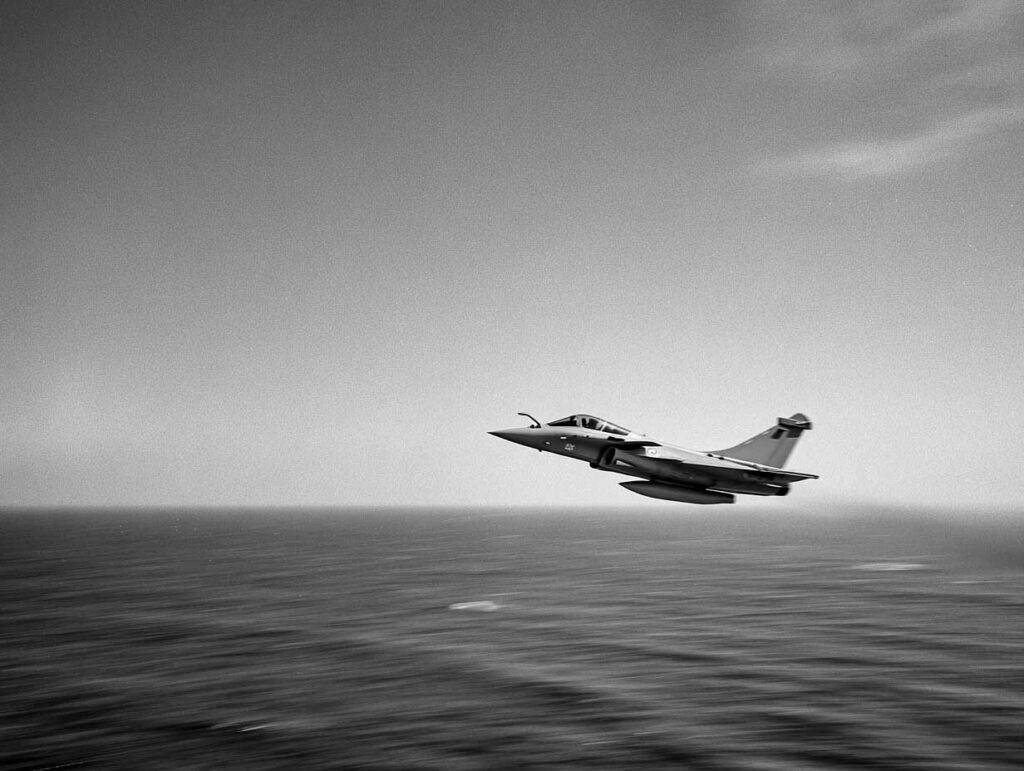
For this mission, the air group includes 20 Rafale Marine aircraft to the F3R standard, two E-2C Hawkeye airborne early warning aircraft, and several helicopters. The French Navy has a total fleet of 42 Rafale Marine aircraft, divided between three fighter squadrons. The decision to embark 20 aircraft for ORION 26 represents a compromise between operational capacity and the availability of aircraft for other missions.
The aircraft carrier began ramping up its operations in September 2025 by welcoming young pilots for their qualification, then in November with an operational conditioning course. The ship will not return to Toulon until April 2026, after several months of intensive operations.
An international armada of 25 ships in the Atlantic
The French naval air group is not operating alone. The ORION 26 exercise brings together 25 large naval units, including French and allied frigates, two amphibious helicopter carriers, a nuclear attack submarine, and a supply ship. This concentration of naval resources is one of the largest fleets assembled in recent years by the allied navies in the Atlantic.
Warships from several European nations accompany the Charles de Gaulle. The Italian frigate Andrea Doria was present in Toulon before departure. British, Spanish, Greek, and Norwegian units are also participating in the exercise. This multinational dimension aims to strengthen interoperability between allied navies at a time when NATO is seeking to increase its military presence, particularly in response to tensions on Europe’s eastern flank.
The choice of the Atlantic as the area of operation marks a change from ORION 23, which took place mainly in the Mediterranean. The French aircraft carrier had not been to the Atlantic since 2020, when its deployment in northern Europe was disrupted by the health crisis. This area represents a strategic space for maneuvering in the defense of European interests.
An unprecedented high-intensity combat exercise
ORION 26 stands out for its scale and level of realism. From February 8 to April 30, 2026, the exercise will simultaneously mobilize 12,500 French military personnel alongside several thousand allied soldiers from 24 countries.
In addition to the carrier strike group, the exercise involves three combined arms brigades, 140 aircraft and helicopters, 1,200 drones of all types, cyber assets, and 20 space sensors.
The training will take place in several phases over approximately four months. The first phase, which began on January 6, consists of operational planning developed in a joint process with allies. The deployment phase begins on February 8 with an initial operation from the Atlantic coast, including amphibious and airborne operations. A third phase, from April 7 to 30, integrates French forces into a NATO exercise, allowing them to test their integration into NATO command structures.
The ORION 26 scenario is directly inspired by a scenario developed by NATO. It incorporates recent developments on the battlefield, particularly those observed in Ukraine. The French armed forces are testing innovations in the fields of drones, satellite jamming, and electronic warfare. The stated objective is to reproduce all phases of a modern conflict, from hybrid conflict to high-intensity engagement.
The three land brigades and the air dimension
In addition to the naval component, ORION 26 mobilizes considerable land and air resources. The Army is deploying an army-level headquarters and three combined arms brigades, representing more than 10,000 combatants and approximately 3,000 vehicles. Between 15 and 20% of the forces involved come from allied countries.
In terms of air power, 140 aircraft are participating in the exercise, along with 40 helicopters and two MALE (medium-altitude, long-endurance) drones. The Air and Space Force is also deploying six ground-to-air defense systems. This air power will enable coordination between the various components to be tested in a multi-domain environment.
Drones are a major focus of the exercise. With 1,200 combat and specialized drones, ORION 26 should help accelerate progress in this crucial area. The 2023 edition revealed the urgent need to make progress on robotic systems, a lesson reinforced by observations from the conflict in Ukraine.
The exercise is being conducted across approximately 15 French departments, including French Guiana. This extensive geographical footprint allows the armed forces to train with their equipment in realistic conditions, in open terrain and in contact with the civilian population.
Interministerial coordination at the heart of preparedness
ORION 26 is not limited to military training. Throughout the exercise, 12 ministries are mobilized to test the responsiveness and coordination between civilian and military actors. This interministerial dimension culminates on March 30 and 31 with a war game involving territorial commands in mainland France and French Guiana, as well as representatives from ministries and prefectures.
The objective is to test national resilience in the face of hybrid threats. In a modern conflict, the adversary does not limit itself to military actions. It also carries out cyberattacks, disinformation campaigns, and sabotage operations on national territory. ORION 26 simulates these adverse reactions to prepare all government services.
The operational reserve plays a major role in this exercise. Reservists are not confined to peripheral functions. They directly reinforce active units and participate fully in missions. Their civilian skills, whether technical, digital, logistical, or medical, provide concrete added value.
Local authorities and a network of private actors are also involved. This unprecedented civil-military coordination aims to strengthen the collective capacity to act, command, and cooperate in the face of a major crisis affecting the national territory.
A political signal to allies and adversaries
ORION 26 takes place in a particularly tense geopolitical context. Europe and NATO’s strategic competitors are stepping up hybrid actions aimed at weakening Western cohesion. The war in Ukraine has highlighted the need for armies capable of coping with high-intensity conflict against a symmetrical adversary.
The exercise demonstrates France’s ability to be the first to enter a theater of operations and lead an international coalition. It sends a strategic signal to potential adversaries, proving the readiness of the French armed forces and their legitimacy to assume a central role in European defense.
ORION 26 also prepares for the alert status of NATO’s Allied Reaction Force. Starting in the summer of 2026, France will assume command of NATO’s 300,000-strong projection force. The Army will arm the command post of the land component, while the Air and Space Force will be certified as part of this mission. The French Navy is de facto the only nation outside the United States capable of taking command of carrier strike groups including American units.
US participation in ORION 26 comes amid a complex diplomatic context, marked by President Donald Trump’s statements on Greenland. However, the French military is tempering these political tensions. Operational cooperation between US and French forces continues as normal, with both countries remaining allies within NATO.
Lessons learned from ORION 23 and developments in 2026
The first edition of ORION, which took place between February and May 2023, mobilized more than 12,000 French and allied military personnel. It involved 2,300 vehicles, 60 aircraft, 26 surface vessels, 100 combat drones, six ground-to-air defense systems, and 20 satellites. It cost €35 million.
ORION 23 identified several areas of weakness. In particular, the exercise revealed the urgent need to accelerate the use of drones by the armed forces and to strengthen air defense capabilities at the divisional level. For the Belgian army, which had deployed more than 600 soldiers and 150 vehicles, the exercise had been particularly demanding. In the early days, the Belgian tactical group lost an entire company during a simulated enemy artillery strike.
ORION 26 builds on this proven foundation while seeking to test new methods of action. The exercise focuses on multi-domain combat training and the conduct of complex operations in a degraded environment. Logistical support chains are particularly put to the test. In a high-intensity conflict, the ability to supply, repair, resupply, and provide medical care determines endurance over time.
Information and communication systems are the focus of particular attention. ORION 26 tests secure and resilient networks capable of absorbing massive volumes of traffic and operating in degraded situations. The digital defense commissariat and simulation tools enhance the realism of the exercise.
Increased military budget for high intensity
ORION 26 is part of a broader rearmament program for the French armed forces. After several decades of budget cuts, France has been rebuilding its military capabilities since 2017. The 2024-2030 military programming law provides for a budget of more than €400 billion, an increase of one-third compared to the previous period.
This increase is intended to modernize equipment, but also to replenish ammunition stocks that are considered to be a cause for concern in the event of a prolonged conflict. France is also supplying equipment to Ukraine, including 30 Caesar self-propelled howitzers with a unit value of €7.5 million, and is training 2,000 Ukrainian soldiers on its territory.
An exercise on the scale of ORION 26 requires significant investment. Flight hours, fuel, maintenance cycles, spare parts, and training days represent immediate costs. While the 2023 edition cost €35 million, the budget for the 2026 edition has not been publicly disclosed. However, these expenses are considered essential for revealing weaknesses that would cost much more to fix in times of crisis.
The future deployment of the Charles de Gaulle remains open
Usually, the Charles de Gaulle’s deployments are detailed by the Ministry of the Armed Forces, which communicates extensively on the objectives and regions visited. For this mission, communication remains particularly limited. The unstable geostrategic context is leading the authorities to allow for room for maneuver depending on developments in the international situation.
For the moment, only the aircraft carrier group’s participation in ORION 26 has been confirmed. After the exercise in April, several options are open to the French command. Logically, the aircraft carrier group should continue its deployment to Northern Europe, a region where France and NATO are seeking to increase their military presence.
A French presence in the Far North would be part of the response to pressure on European allies. The aircraft carrier Charles de Gaulle has already operated in these waters and could return there for exercises with the Nordic navies. This option would also allow the carrier strike group’s capabilities to be tested in Arctic conditions.
However, in the event of a crisis in the Middle East, particularly if tensions with Iran escalate, the French armada could be repositioned in warmer waters. It would then help to protect European energy supplies transiting through the Persian Gulf, as well as allied countries and French military installations in the region.
This flexibility illustrates the value of the aircraft carrier group as a diplomatic and military tool. Capable of traveling 1,000 kilometers per day thanks to its nuclear propulsion, the Charles de Gaulle offers France a degree of autonomy and a capacity for power projection that is unique in Europe.
ORION 26 is much more than just a military exercise. It is a strategic rehearsal designed to reveal the strengths and weaknesses of the French armed forces before a real crisis forces them to confront them. In a continent that is relearning vulnerability, this training becomes a message to partners, adversaries, and public opinion. Power is not measured solely in terms of equipment, but in the ability to integrate it into a coherent whole and to maintain a position without cutting oneself off from the European and Atlantic community.
Sources:
Ministry of the Armed Forces and Veterans Affairs, defense.gouv.fr
Mer et Marine, meretmarine.com
Le Journal du Dimanche, lejdd.fr
France Bleu, francebleu.fr
Forces Operations Blog, forcesoperations.com
Epoch Times, epochtimes.fr
Air & Cosmos, air-cosmos.com
Wikipedia, Orion Exercise and Charles de Gaulle
La Nouvelle Tribune, lanouvelletribune.info
Ecostylia, ecostylia.com
France 24, france24.com
Enderi, enderi.fr
Military Forum, forum-militaire.fr
Military Zone, opex360.com
War Wings Daily is an independant magazine.