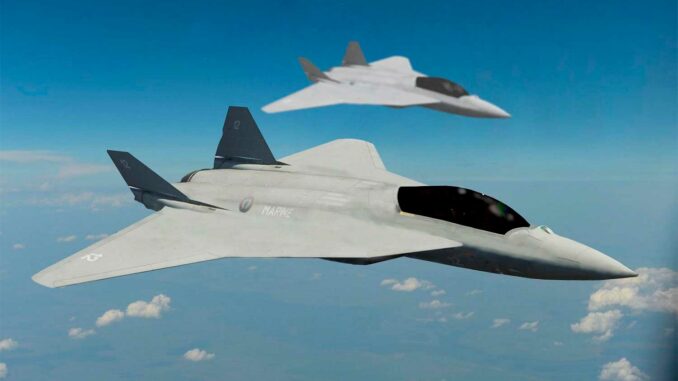
Airframe, engines, sensors, drones, and doctrine: a technical and strategic anatomy of the 6th generation fighter jet, criterion by criterion, without duplication.
In summary
A 6th generation fighter jet is less a “new aircraft” than a combat node designed to survive and make decisions in a saturated environment: jamming, multi-domain sensors, long-range missiles, drones, and logistical pressure. Its airframe aims for more robust stealth across multiple spectra, but this requires severe compromises in aerodynamics and maintenance. Propulsion becomes the arbiter: range, electrical power, and cooling dictate the rest. The avionics are structured as an open architecture to quickly integrate new sensors and effects without requalifying the entire system with each evolution. The pilot is shifting toward a command role: supervising distributed effectors, notably loyal wingmen, and arbitrating the rules of engagement. Armament is expanding to include non-kinetic effects, while directed energy weapons remain constrained by energy and thermal management. Finally, the aircraft is judged on its operational consistency: resilient network, predictive maintenance, sustainable costs, and credible doctrine vis-à-vis peers.
Size and dimensions, between force projection and flight deck reality
The optimal size for “striking far” without betraying the signature
- A larger airframe increases internal fuel capacity. This is the most direct way to increase range without external fuel tanks.
- A larger size allows for longer weapon bays. This is critical when targeting very long-range air-to-air missiles, standoff strike weapons, or rapid-fire munitions.
- More internal space facilitates thermal management. A stealth aircraft must “hide” its heat sources, i.e., dissipate heat within the structure, not just evacuate it.
- Size also improves the “electrical margin”: alternators, converters, buffer storage, cooling of computers and sensors.
- The downside is brutal: higher mass, higher unit cost, greater infrastructure and maintenance requirements.
Aircraft carrier compatibility, a ruthless filter
- Elevator, hangar, and maneuvering constraints impose strict dimensional limits. Folding wings and handling solutions add weight and complexity.
- The marine environment requires increased structural robustness: corrosion, landing impacts, harsher cycles, more frequent maintenance.
- Power generation and cooling systems must remain reliable in a saline atmosphere without increasing the number of interventions.
- An aircraft that is “too large” becomes slow to arm, move, and deploy. On aircraft carriers, sortie rate is as important as pure performance.
- A realistic approach is to separate the two: a manned core optimized for penetration from land bases, and a naval component with dedicated compromises.
The strategic compromise of “big + effectors” rather than “small and alone”
- The most credible 6th generation resembles a family: a more enduring manned aircraft, supported by drones and connected munitions.
- The “small fighter” loses its advantage if the threat requires long-range, long-duration flights with full internal fuel tanks.
- The “large fighter” loses its meaning if the cost prevents fleet volume and resilience to losses.
- The operational solution is distribution: the manned aircraft holds command and architecture, while the remote effectors take the risk.
Overall design and architecture, where engineering decides the war
Modular design and the system of systems model
- The airframe must be thought of as a support for evolving functions, not as a fixed object.
- Useful modularity means: replaceable avionics modules, accessible compartments, standardization of interfaces, and rapid requalification.
- The military goal is simple: reduce the time between the emergence of a threat and the integration of a software or hardware response.
- Modularity must be “in the field”: replacement of subassemblies during stopovers, not just in the factory.
- Poorly designed modular architecture becomes a nightmare: vibrations, electromagnetic compatibility, cooling, and cabling explode.
The tailless airframe, clean delta, or flying wing: the choice is not aesthetic
- Removing fins reduces radar reflectors and simplifies certain lateral signatures.
- On the other hand, directional stability becomes dependent on control laws, and therefore on software robustness and sensors.
- A “clean” airframe must limit surface breaks: hatches, joints, protruding antennas, and non-integrated sensors.
- Leading edges, air intakes, and nozzles determine the signature as much as the overall silhouette.
- A highly stealthy geometry can penalize low-speed performance, and therefore naval or STOL compatibility.
Digital thread and digital twin, an industrial weapon
- The digital twin must exist from the design stage: structure, thermal, signatures, avionics, cyber, and maintenance.
- It allows the integration of a new module to be simulated without breaking the aircraft.
- It reduces the risks of “competitive” production: producing before the definition has been stabilized is very expensive.
- The digital twin is only useful if it remains synchronized with the fleet: status sensors, maintenance feedback, and configuration updates.
The “manned or unmanned” option, a doctrinal lever
- An “optionally manned” aircraft aims to reduce human risk on certain missions, but increases the complexity of certification.
- Unmanned modes require safety, cyber protection, and mission continuity logic in the event of a loss of connection.
- The real gain is doctrinal: choosing when to expose a pilot and when to expose an effector.
- Credibility is based on rules of engagement and safeguards, not slogans about autonomy.
Propulsion and performance: reality trumps promises
The adaptive cycle engine: the key to range and energy
- An adaptive engine adjusts its flow to prioritize economy or thrust depending on the profile.
- The operational benefit is twofold: reaching distant locations without massive refueling, then maintaining margins in combat.
- The “third flow” also serves as a reservoir of colder air, thus providing cooling capacity for mission systems.
- Available electrical power becomes a key criterion: sensors, communications, jamming, and intensive computing.
- More complex propulsion increases maintenance, training, and supply chain requirements.
Supercruise and speed: useful, but not magical
- A credible supercruise improves interception kinematics and survivability, especially if it can be sustained without exploding the IR signature.
- High maximum speed is less decisive than sustained speed and the ability to manage heat over time.
- “Beyond visual” maneuvering favors detection, coordination, and cooperative firing, not just Mach speed.
- Hypersonic speed for the fighter itself remains a distant prospect. The most realistic approach is to integrate fast ammunition.
Advanced thermal management, a prerequisite for the 6th generation
- More electrical power means more heat to absorb and mask.
- Exchangers, ducts, and heat sinks must be integrated into the structure without creating visible hot spots.
- The nozzle becomes as much a signature element as a performance element. Masking, flow mixing, and fine control are important.
- Thermal management must function in harsh environments: dust, humidity, salt, sand, and high cycles.
- Without thermal control, “ambitious” capabilities remain theoretical.
Internal payload, the truth about stealth
- Increasing the internal payload avoids external carry and maintains discretion.
- The weapons bay must be sized for long weapons and varied configurations, not just “standard” missiles.
- Weapons bay mechanisms must be fast, reliable, and compatible with high mission rates.
- The integration of a modular “mission pack” is credible if it remains requalifiable and maintainable.
Stealth and survivability, when the adversary is no longer naive
Multispectral stealth rather than “angle” stealth
- Radar signature must be controlled across multiple bands, as modern defenses combine broadband detection and fine tracking.
- Shape reduces reflections, but details give it away: joints, hatches, edges, and openings.
- Absorbent materials must withstand weather, rain, sand, and thermal cycles, otherwise availability will plummet.
- Stealth must not be limited to the front: multi-axis engagements and pack hunting require more consistent discretion.
Infrared reduction, the fight against heat
- The nozzle must minimize visible hot spots. This requires careful design and flow management.
- Surfaces heat up during high-speed flight. Heat dissipation must be distributed to avoid IR “spots.”
- Internal systems constantly generate heat: computers, links, jammers, sensors.
- Credible IR stealth requires discipline in use: emission modes, flight profiles, and power management.
Integrated countermeasures, from decoys to deception
- Passive decoys remain useful against certain threats, but the modern environment requires more adaptive solutions.
- Active countermeasures must be integrated into avionics: detection, classification, response, and synchronization.
- Deception becomes an art: making the enemy believe there is a larger formation, moving the perceived “target,” or saturating the enemy’s loop.
- Survivability is built in layers: stealth, jamming, decoys, maneuvering, and dispersal of effectors.
Survivability in the face of modern threats: hypersonic, swarm, A2/AD
- A very fast missile reduces reaction time. Survival then depends on pre-spotting, not reflexes.
- Drone swarms require a trade-off: fire expensive missiles or neutralize them in other ways.
- In an A2/AD environment, the priority is to break the enemy’s detection-tracking-firing chain.
- The 6th generation must accept the loss of an effector without losing the mission. This is a distributed force logic.
Sensors, avionics, and fusion: the decision factory
The integrated and distributed sensor suite
- AESA radar must be more powerful, more agile, and better cooled to withstand high intensity.
- Antennas distributed across the airframe improve coverage, reduce blind spots, and allow simultaneous functions.
- IRST and 360° optronics enhance passive detection, especially if the adversary jams the radar.
- Missile warning and radar threat detectors must be fast and accurate, as the reaction window is shrinking.
Cognitive data fusion, not just a simple display
- Fusion means correlating, estimating uncertainty, and prioritizing, not just stacking tracks.
- The aircraft must integrate external sources: satellites, drones, AWACS, ground, sea, cyber.
- The system must produce actionable recommendations: trajectory, weapon, firing window, and emission posture.
- Fusion must be resistant to deception: decoys, misleading emissions, phantom tracks, and data poisoning.
Computing power, from “onboard supercomputers” to robustness
- Computing must be distributed and redundant. A failure must not bring down the mission.
- Very high-speed data buses are essential, but they open up a wider cyber front.
- Neuromorphic architectures or other accelerators can help with real-time processing, but military qualification is a long process.
- The system must manage “degraded modes”: when sensors fail, the aircraft must continue to fight.
Cyberprotection, a criterion for survivability
- Cybersecurity must be native: secure boot, segmentation, intrusion detection, and autonomous response.
- Software updates must be fast but controlled: signature, audit, traceability.
- A connected aircraft must survive network loss: local failover, continuity of critical functions.
- The sovereignty of interfaces and keys determines operational autonomy in coalition.
Armament and effects, the full range from kinetic to non-kinetic
Larger, modular internal bays
- The cargo bay must accommodate long ammunition and multiple configurations without heavy reconfiguration.
- Useful modularity resembles “packs”: long-range air-to-air, standoff strike, defense suppression, or armed ISR.
- The deployment mechanism must be fast and discreet, as opening the weapons bay is a signature.
- The weapon architecture must allow for frequent updates: guidance, links, cooperative modes.
Long-range missiles and cooperative firing
- The trend is toward longer BVR, but the real key is the quality of designation and in-flight updates.
- Cooperative firing allows for the separation of “the one who sees” and “the one who fires.”
- Remote effectors can serve as designation relays, advanced sensors, or decoys.
- Doctrine must avoid waste: firing further only makes sense if the probability of effect remains high.
Directed energy weapons, between promise and physical constraints
- An onboard laser requires electrical power, buffer storage, and cooling. Without these three elements, the weapon remains a concept.
- The most credible use is defensive: neutralizing a small drone, degrading a sensor, or disrupting an incoming threat if the window allows it.
- High-power microwaves mainly target electronics and swarms, but the contested electromagnetic environment complicates their use.
- The “virtually unlimited charger” is only true if the platform can provide sustained power and cooling.
- The 6th generation must be designed to accommodate these weapons later, even if it does not carry them in the first standard.
Non-kinetic effects: electronic warfare, cyber, deception
- Integrated electronic warfare must be able to jam, deceive, and protect, with adaptive modes.
- In-flight cyber warfare is more realistic as a component of the overall mission than as a “magic button” in the cockpit.
- Deception becomes a weapon: creating false lines of attack, saturating radars, or imposing costly reactions.
- Non-kinetic warfare is also economical: neutralizing without firing missiles can preserve high-intensity stockpiles.
The human-machine interface, the war of cognitive load
The virtual cockpit and augmented reality
- Reducing physical screens facilitates evolution and limits points of failure, if the software architecture is robust.
- 360° vision via external sensors must be reliable, otherwise it creates false confidence.
- Information must be prioritized: threat, firing window, transmission posture, status of effectors.
- The interface must be designed for periods of maximum stress, not for demonstrations.
AI assistants and decision-making under pressure
- The assistant must suggest, not impose. The pilot must retain control over lethal decisions.
- Recommendations must explain their reasoning: confidence level, assumptions, risks, and alternatives.
- Swarm management requires a command interface: objectives, rules, levels of autonomy, and restrictions.
- A good assistant reduces repetitive tasks and frees the pilot to focus on tactics.
Pilot monitoring and safety on long missions
- Physiological sensors help detect overload, hypoxia, fatigue, and cognitive decline.
- Anti-G protection and workload management are as important as raw performance.
- A 6- to 8-hour mission requires ergonomic choices: comfort, nutrition, stress management.
- Automated modes must be safe in the event of disorientation, sensor failure, or extreme situations.
Network and connectivity, where the aircraft becomes a node
Combat cloud as the backbone
- Real-time sharing must cover sensors, tracks, weapon assignments, damage, and effector statuses.
- The network must function under jamming, with partial losses and variable latency.
- Architectures must support the coalition without exposing everything: compartmentalization, sharing levels, and data control.
- The ability to quickly integrate a new effector or sensor is a direct strategic advantage.
Discretion in communications
- To transmit is to betray oneself. The aircraft must prioritize directional communications and short transmission windows.
- Optical (laser) links can reduce the probability of interception, but require a line of sight and stability.
- Resilience relies on redundancy: multiple links, multiple bands, multiple paths.
- Transmission discipline must be mission-driven: sometimes, silence is more valuable than sharing everything.
Multi-domain integration and the JADC2 concept
- The aircraft must be part of an air-ground-sea-space-cyber interconnection strategy.
- The tactical gain is to reduce the “kill chain”: detect, decide, and engage faster than the adversary.
- The risk is to increase the cyber attack surface and dependence on infrastructure.
- Doctrine must anticipate degradation: how to fight when the network partially collapses.
Collaborative combat, the shift to distributed effectors
Command of escort drones
- The fighter must pilot several drones without becoming an overloaded operator.
- Drones can act as advanced sensors, jammers, decoys, weapon carriers, or communication relays.
- The value comes from dispersion: multiplying axes, saturating defenses, and absorbing losses.
- Coordination must work with degraded links: local autonomy and clear objectives.
The role of “quarterback”: embedded tactical command
- The pilot supervises the overall maneuver: transmission posture, approach axes, rules of engagement.
- The manned aircraft serves as a mobile decision center, but it must not be the only point of failure.
- Drones must be able to continue a task if the link is cut, with strict safeguards.
- A credible 6th generation requires a team doctrine, not individual heroism.
Allied interoperability: political power as well as military power
- A useful collaborative system must operate in coalition, without requiring total dependence on a single standard.
- Sharing levels must be flexible: essential tactical data, without exposing all intelligence.
- Compatibility with older platforms is important, otherwise the sixth generation becomes an “isolated elite.”
- The sovereignty of interfaces and keys is a condition for trust between partners.
Autonomy and artificial intelligence: power and pitfalls
Scalable autonomy and levels of control
- Autonomy must be modular: assistance, task execution, autonomous maneuvering, or autonomous mission under supervision.
- The greater the autonomy, the more evidence is needed: verification, validation, testing in adverse environments.
- Security requires fallback modes: loss of sensors, loss of GPS, loss of connection, or abnormal behavior.
- Good design allows autonomy to be degraded without losing the mission.
AI for electronic warfare and threat management
- AI can help classify emissions, detect patterns, and adapt jamming.
- But the adversary lies, imitates, and traps. Models must be robust to misleading data.
- The decision loop must be transparent: level of confidence and justification of recommendations.
- The best AI is the one that improves decision speed without creating blind dependence.
Predictive maintenance and availability
- Maintenance AI relies on status sensors, wear models, and reliable histories.
- The gain is logistical: reducing unnecessary parts, predicting breakdowns, and avoiding unexpected downtime.
- The risk is false alarms or blind spots: a poorly trained model costs time and money.
- Predictive maintenance must remain auditable, especially in coalition and operations.
Training and education, the invisible prerequisite for high intensity
Simulators and the LVC approach
- LVC allows real aircraft, simulators, and synthetic entities to be combined to create scenarios that would otherwise be impossible.
- This reduces the cost of flight hours while increasing the simulated tactical complexity.
- Modern high intensity requires simulating massive jamming, cyber attacks, drone saturation, and rapid threats.
- Training must be continuous: updates to scenarios, threats, rules of engagement, and adversary tactics.
Training in delegation and calibrated trust
- Piloting effectors requires knowing how to delegate without losing control.
- The pilot must understand the limits of autonomy and recognize when to take back control.
- Trust must be calibrated by experience: too much trust kills, too little renders the system useless.
- Training must incorporate fatigue and cognitive overload, as this is where errors arise.
Adaptive training and reduction of “useless” flight hours
- AI can personalize training: targeting weaknesses, accelerating progress, and standardizing requirements.
- An expensive fleet requires saving airframes without reducing operational levels.
- Exercises must incorporate coalition, network degradation, and degraded modes.
- Level measurement must be objective: tactical performance, not just compliance with procedures.
Maintenance, logistics, and sustainability: the real daily battle
Modular design for quick turnarounds
- Critical modules must be accessible without heavy disassembly: avionics, cooling, power supply, and sensor components.
- Turnaround times between sorties determine usefulness in the field, especially at forward operating bases.
- Standardization of interfaces reduces parts inventory, thereby reducing the logistical footprint.
- An overly compact design may be stealthy but unmanageable in terms of maintenance, and therefore useless in a long war.
Reducing the logistical footprint
- Conditional maintenance reduces unnecessary scheduled interventions, provided that sensors and models are reliable.
- The goal is to move less equipment, fewer technicians, and fewer rare parts.
- The digital support chain must be resilient: cyber, outages, and loss of connectivity.
- An advanced base requires robustness: dust, heat, humidity, and limited infrastructure.
Technical data sovereignty
- Control of maintenance data and software determines strategic autonomy.
- If users cannot diagnose, repair, and update without the manufacturer, they lose power in a crisis.
- Contracts must clarify access to data, interfaces, and reprogramming capabilities.
- Lessons from highly integrated programs call for greater transparency, without industrial naivety.
Production, costs, and challenges: where programs die
Unit cost and the “quality vs. mass” trade-off
- A sixth generation may aim for extreme performance, but the cost may make the fleet too small to survive attrition.
- Public estimates suggest very high costs for certain programs, which fuels the debate.
- The doctrinal solution often consists of pairing a highly advanced fighter with more numerous and less expensive drones.
- The strategy must remain consistent: a perfect but rare aircraft can be neutralized by saturation.
The risks of competition and technological maturity
- Producing before the definition has been stabilized creates costly setbacks and heterogeneous fleets.
- The riskiest technologies are often: propulsion, thermal management, mission software, cyber, and network integration.
- Military qualification of algorithms is a lengthy process, as it requires testing in realistic scenarios.
- Critical supply chains can become an Achilles heel in a long war.
Industrial sovereignty and cooperation
- Multinational programs promise economies of scale, but they complicate governance.
- The distribution of industrial “pillars” must avoid the dilution of responsibilities.
- Strategic autonomy is at stake in interfaces, keys, reprogramming, and data access.
- Success depends on a clear trade-off between ambitions, timelines, and stable funding.
Operational concepts, where the 6th generation is justified or collapses
Distributed force and the dilemma logic
- Survivability comes from the dispersion and multiplication of vectors, not just from the stealth of a single aircraft.
- Effectors must impose dilemmas: fire expensively at a drone, or let a threat pass.
- The system must accept losses and continue to produce effects.
- Planning must incorporate saturation: missile stocks, production rate, and logistical support.
Multi-domain integration in a contested environment
- The 6th generation must function with spatial degradation: disrupted GPS, contested satellites, severed links.
- It must cooperate with ground-to-air defense, naval forces, and ground sensors.
- The goal is to break the enemy’s chain, not just win a dogfight.
- Missions are more varied: air superiority, strike, ISR, electronic warfare, effector escort, and coordination.
Conventional deterrence and credibility in high intensity
- The presence of a 6th generation can be a deterrent, if it is sustainable in terms of numbers and availability.
- Credibility depends on stocks: missiles, parts, engines, and the ability to repair quickly.
- The doctrine must be realistic: modern warfare is a war of attrition and information.
- The 6th generation must provide a reproducible advantage, not just theoretical superiority.
Ethical and legal considerations, because technology alone does not decide
Human control over the use of force
- Lethal decisions must remain under human control, with explicit rules of engagement.
- Autonomy can perform tasks, but the validation of the use of weapons must be governed.
- Auditability is key: understanding why a recommendation was made.
- Compliance with the law of armed conflict must be built in from the design stage, not added later.
Protection against unauthorized use and hacking
- A connected aircraft must be protected against takeover, data manipulation, and false target injection.
- Protections must cover: software, update chains, links, and maintenance.
- “Safe degraded” modes are essential: it is better to lose capability than to lose control.
- Security must be tested like a weapon: attacks, red teaming, and rapid correction.
Sustainability and life cycle, the final battle
Service life and scalability
- A sixth generation will be in service for decades. Software scalability is therefore a prerequisite for relevance.
- Open architectures avoid obsolescence, provided that interfaces are truly controlled and standardized.
- Upgrades must be planned: electrical power, cooling, module space, and mass margins.
- Coalition compatibility must be long-lasting: standards, encryption, and sharing levels.
Environmental sustainability: useful but secondary in high-intensity situations
- Alternative fuels can improve flexibility, but the priority remains available energy and the supply chain.
- Advanced materials pose a challenge in terms of repairability: composites, surface treatments, and coatings.
- Recyclability is a long-term issue, but operational availability takes precedence.
- Credible sustainability means above all: repairing quickly, producing parts, and maintaining engines.
War Wings Daily is an independant magazine.