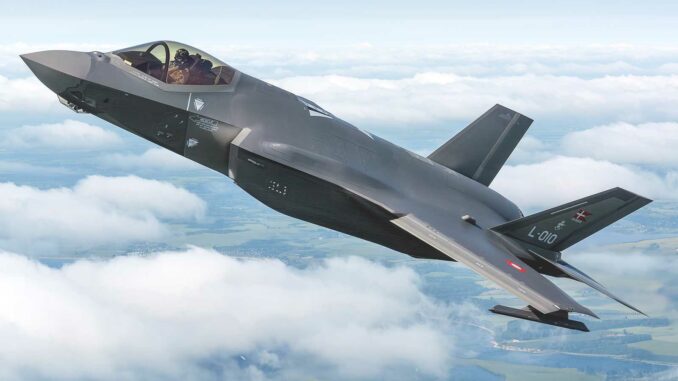
Technical comparison of the J-20 and F-35: engines, sensors, stealth, weapons, costs, and operational logic, within the limits of publicly available data.
Comparing the J-20 and the F-35 requires a simple discipline: separating what is documented from what is based on estimates. The F-35 is a “military-industrial” weapons system that is very transparent by Western defense standards, with official data sheets, audits, availability figures, and costs tracked line by line.
The J-20, on the other hand, remains shrouded in secrecy. Published orders of magnitude exist, but key parameters (actual radar, signatures, engine reliability, availability) are rarely officially confirmed.
From a military standpoint, it is important to understand that these two aircraft are not “clones.” The J-20 is primarily designed for long-range air superiority in the Indo-Pacific theater, with a focus on interception and BVR (beyond visual range) firing, supported by sensors and long-range missiles.
The F-35 is designed as a sensor fusion hub: it sees, correlates, shares, and then strikes, including on the first day of war, with network integration and a very wide range of air-to-ground capabilities.
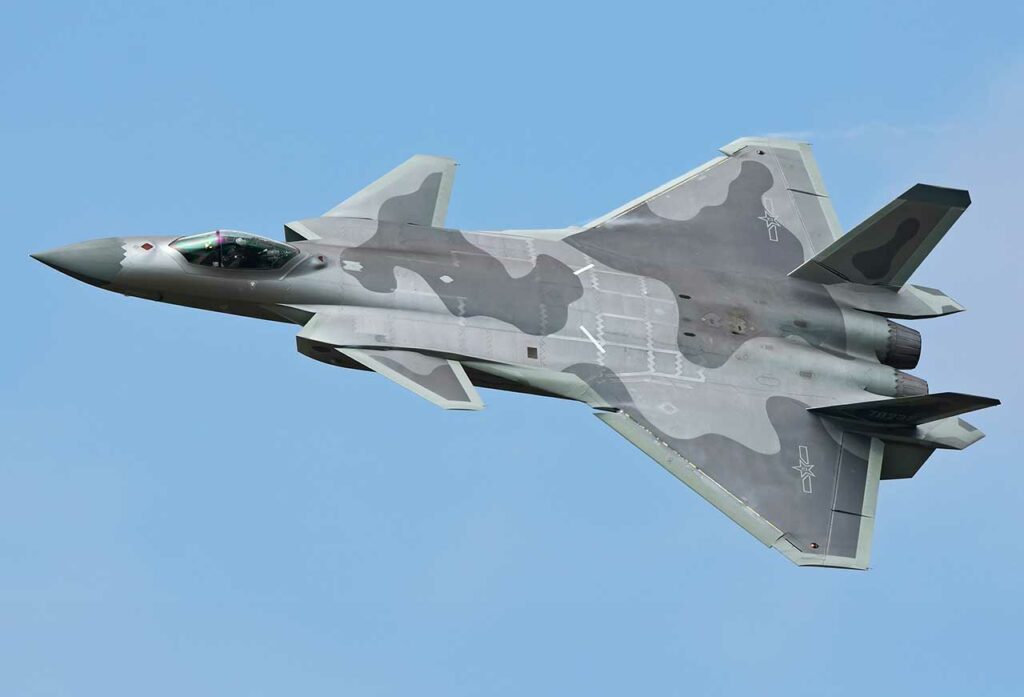
Technical presentation of the J-20
The J-20 (Chengdu) is a twin-engine stealth fighter designed for the PLAAF, with a large airframe for its category. Its military value is clear: it combines low frontal detectability, endurance, and internal BVR missile carry. Credible open literature converges on a typical internal carry capacity of four BVR missiles in the ventral bay, plus two short-range missiles in side bays, with possible upgrades to six BVRs via folding fin ammunition.
On the propulsion side, the engine history is central. Open sources describe a transition from Russian engines to Chinese WS-10C engines (order of magnitude 142–147 kN of thrust with afterburner), pending the WS-15, often presented as the ultimate goal (order of magnitude 180 kN). These values should still be considered “analyst-based.”
In terms of pure performance, most of the public figures (speed, ceiling) are estimates. The one solid point is the logic of use: payload and long-range engagement. The range announced in public summaries varies greatly (approximately 1,200 to 2,700 km, or 650 to 1,460 nm).
In terms of sensors, the J-20 is most likely equipped with an AESA radar, but the details (range, modes, jamming resistance, fusion quality) have not been publicly validated to the same extent as in the United States.
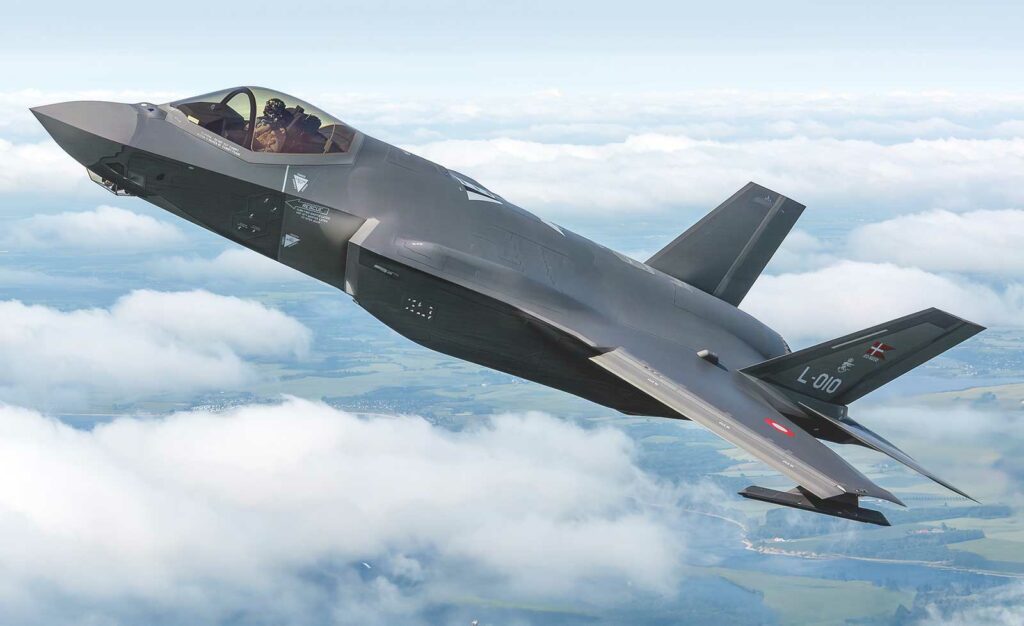
Technical overview of the F-35
The F-35 is a massive program led by Lockheed Martin and available in three versions: A (USAF), B (STOVL), and C (aircraft carrier). Its official maximum speed is Mach 1.6 (approximately 1,930 km/h, or 1,200 mph). Its operational ceiling is given as “above 15,000 m” (50,000 ft).
The technical heart of the F-35 is its sensors and system coherence. The AN/APG-81 AESA radar is designed to perform detection, tracking, fire support, and electronic warfare functions. The aircraft has an integrated optronic suite: EOTS for identification and targeting, and DAS (six IR sensors) for spherical surveillance and missile warning, with helmet display. The AN/ASQ-239 (BAE Systems) electronic warfare suite is designed for warning, self-protection, and integrated EW effects.
In terms of armament, the F-35A has a combat radius of approximately 1,239 km (669 nm) on internal fuel and a range of over 2,200 km (1,200 nm). It can carry much more in external loads outside of stealth mode, but its core value remains discreet penetration with internal payload and sensors.
Comparison table (public data + point)
Reading rule: when data is not public (especially for the J-20), I say so. The point goes to the aircraft with the best-supported advantage.
| Criterion | J-20 | F-35 | Point |
|---|---|---|---|
| Maximum speed | Estimates often around Mach 2 (≈1,535 mph; 2,470 km/h), unconfirmed | Mach 1.6 (≈1,200 mph; 1,930 km/h) | J-20 |
| Cruising speed | Not public (possible supercruise according to open sources) | Not public (optimized subsonic cruise) | J-20* |
| Climb rate | Not public | Not public | Clear tie: F-35** |
| Maximum altitude | Estimates ≈20,000 m (65,600 ft), unconfirmed | >15,000 m (50,000 ft) | J-20 |
| Range | Public order of magnitude highly variable 1,200–2,700 km (650–1,460 nm) | >2,200 km (1,200 nm / 1,380 mi) | J-20 |
| Combat range | Not public (broad estimates) | ~775 miles (669 nm) | F-35 |
| Flight endurance | Not public | Not public | J-20* |
| Agility | Twin-engine + large airframe: potentially good at high energy, but few figures available | Less “dogfight-first,” but highly refined controls and flight laws | J-20* |
| Turn radius | Not public | Not public | J-20* |
| Low-speed maneuverability | Not public | Not public | F-35* |
| Engine power | 2 engines; WS-10C ~142–147 kN each (analyst-based) | 1 engine; F135 ~191 kN (43,000 lbf) according to program specifications | J-20 |
| Engine reliability | Data not public | Data tracked but sensitive subject (shortages/maintenance discussed) | F-35 |
| Fuel consumption | Not public | Not public | F-35* |
| Afterburner | Yes (twin-engine) | Yes | J-20 |
| Radar | AESA very likely, details unconfirmed | AN/APG-81 AESA well documented | F-35 |
| Communications | Network capabilities not documented at the same level | Highly structured network, links, and integration (NATO/allies program) | F-35 |
| Electronic warfare (EW) | Not public | AN/ASQ-239 integrated 360° | F-35 |
| Early warning (RWR) | Not public | Integrated EW + sensors | F-35 |
| Positioning | Not public | NATO standard, highly integrated | F-35 |
| Weapons management | Air-to-air BVR priority; PL-15/PL-10 missiles | Broad air-to-air + air-to-ground spectrum, “first day” doctrine | F-35 |
| Weapons diversity | Mostly air-to-air, air-to-ground less clear publicly | Very broad library of integrated weapons | F-35 |
| Payload | Figures not publicly reliable | Very high total payload according to program specifications | F-35 |
| Weapons accuracy | Not public | Very mature sensor/weapons chain | F-35 |
| Weapons integration | Not public | Block roadmap and continuous integrations (C2D2) | F-35 |
| Radar signature | Optimized front; figures not public | Highly optimized, broad validation by multiple fleets | F-35 |
| Infrared signature | Twin-engine = thermal challenge, unknowns | Sophisticated thermal management, but very hot engine | F-35* |
| Acoustic signature | Data not public | Data not public | F-35* |
| MTBF | Not public | Data tracked (but not always flattering) | F-35 |
| Ease of maintenance | Not public | Complex, heavy support, but standardized | F-35 |
| Availability | Not public | Audited figures, targets sometimes not met | F-35 |
| Mission versatility | Dominant long-range air-to-air | Structuring multi-role (A/B/C) | F-35 |
| STOVL | No | F-35B yes | F-35 |
| PA operations | No (J-20 land-based) | F-35C yes | F-35 |
| Self-protection | Not public | EW + DAS + countermeasure integration | F-35 |
| Armor | Not public | Protection mainly through stealth + EW | F-35 |
| Ejection seat | Not public | Martin-Baker US16E documented | F-35 |
| Cockpit | Little documented | Large screen + HMDS Gen III helmet | F-35 |
| Information management | Not public | Very strong sensor fusion | F-35 |
| Flight controls | Not public | Very advanced, advanced flight control laws | F-35 |
| Unit cost | Estimated ~$110 million (order of magnitude) | F-35A ~$82.5 million (lots 15–17, average) | F-35 |
| Operating cost | Not public | Published costs still high | J-20*** |
| Training cost | Not public | Controlled costs, simulators, and extensive pipeline | F-35 |
| Modularity | Not public | C2D2 + block upgrades | F-35 |
| Life cycle | Unknown | Long-term plan, global fleet | F-35 |
Final analysis and honest opinion
If your question is “which is the best aircraft,” the answer depends on the meaning of the word “best.” On criteria where data is verifiable, the F-35 often wins because it is a complete, industrialized, instrumented, audited system that is already engaged in a very broad concept of operations. It combines stealth, sensors, EW, cockpit, and interoperability. It is a modern weapon, not just a fighter jet.
The J-20, on the other hand, can be formidable in its own right: long-range air-to-air, with BVR missiles as described by the China Aerospace Studies Institute in its work on Chinese missile capabilities, and a mass/volume that favors fuel and internal payload. But in public data, too many critical elements remain unconfirmed: fusion maturity, actual endurance in stealth configuration, reliability and availability in wartime, and EW quality in the face of modern threats.
Today, the F-35 is more “useful” militarily in the broad sense, because it is optimized to produce a full operational effect, in coalition, and in several roles. The J-20 may be better on some performance and range parameters, but it remains more difficult to “rate” objectively as long as China does not publish comparable indicators.
War Wings Daily is an independant magazine.