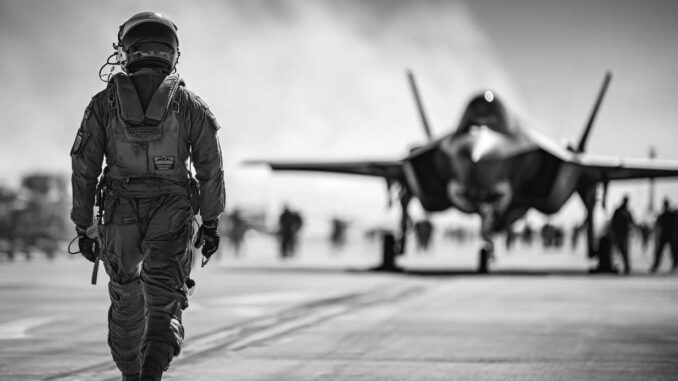
Demand is skyrocketing: the US Air Force is looking for contractors to train foreign pilots. Behind the sale of fighter jets lies a real bottleneck.
In summary
By issuing a request for information to recruit companies capable of training foreign pilots on demilitarized or civilian aircraft, the US Air Force is acknowledging a reality: delivering an aircraft brings no capability if the cockpit remains empty. Training is becoming a bottleneck, as sales of fighter jets and support aircraft skyrocket and US training bases aim to train 1,500 pilots per year. For purchasing countries, the impact is immediate: extended schedules, long detachments in the United States, aircraft grounded for training, and increased dependence on US availability. For Washington, the challenge is twofold: maintaining the credibility of alliances without drawing too many training resources away from domestic needs. Outsourcing via contractors can ease the burden, especially with simulators and synthetic training, but it also raises questions of sovereignty, data security, and long-term skill standardization.
The trigger came from a request for information that speaks volumes
At the end of January 2026, Defense News reported that the U.S. Air Force was looking for companies capable of providing training for foreign pilots in the United States. The document is not yet a contract. It is a Request for Information: a market tool designed to test supply, compare models, anticipate lead times, and frame what will actually be feasible.
This administrative detail has political significance. The United States is selling more aircraft and increasing capacity transfers. But these sales only create military capability if the crews follow suit. However, training is a bottleneck that is harder to overcome than a factory problem. An assembly line can be accelerated in a few quarters. It is not easy to compress hundreds of hours of instruction, nor the experience accumulated by instructors.
In this context, the use of service providers is not a whim. It is a symptom. The implicit message is simple: foreign demand is pulling on the same pipe as US needs, and that pipe has a finite diameter.
The scope of demand and the appeal of “civilian derivatives”
The demand is for training conducted on “demilitarized” or “commercially derived” aircraft. This is the key nuance. The Air Force is primarily seeking to outsource the least sensitive aspects: learning to fly on a simple platform, mastering IFR procedures, working on crew coordination, accumulating hours, and executing unclassified mission profiles.
The scope of application goes beyond fighter aircraft. It covers “light” combat needs, but also support missions where the industry is already structured: surveillance and reconnaissance, maritime patrol, medical evacuation, search and rescue, transport, and certain elements of electronic warfare or observation. In other words, Washington wants to increase the training throughput without consuming the same resources as training on modern combat aircraft.
The unspoken reason and the bottom line
A fighter jet sale makes headlines. A training chain does not make the news. Yet it is this chain that transforms a contract into power. If the supply of aircraft accelerates faster than the supply of pilots, the result is an illusory capability: airframes sitting in parking lots, insufficient flight hours, and a ramp-up that drifts off course.
It is also a matter of sovereignty. As long as a country depends on the US training schedule, it accepts strategic dependence. In times of tension, a schedule is already a form of vulnerability.
The American mechanics of international training
The system has been in place for a long time. Much of it goes through the Air Education and Training Command, which oversees the production of pilots and part of the training courses for partners.
According to figures cited in the trade press, the Air Force’s security assistance program trains more than 9,000 students from approximately 142 countries each year. This volume does not only concern pilots: it includes mechanics, systems specialists, and everything else that makes an aircraft truly operational on a daily basis.
This figure is significant for one simple reason: the United States does not only sell platforms. They sell an operational grammar: procedures, safety, standards, compatibility, and methods. And this grammar requires training time, not just deliveries.
The role of the Air Force Security Assistance Training Squadron
In this mechanism, the Air Force Security Assistance Training Squadron acts as a guide. It aligns the needs of client countries, security constraints, the availability of training bases, and industrial schedules. When several partners ramp up at the same time, the risk is mechanical: the system strains instructors, simulators, training aircraft, and flight slots.
This is precisely what the search for providers suggests. The Air Force wants to create additional capacity quickly in segments where industry can intervene without exposing the sensitive core of combat training.
The reality of the skills to be taught on a modern aircraft
Training a fighter pilot is no longer just about “knowing how to stay on course.” It involves integrating sensors, data links, mission procedures, and strict safety discipline. On an aircraft such as the F-35A, training focuses as much on systems and tactics as on pure piloting. As a result, flight hours remain essential, but they are no longer sufficient. High-fidelity simulators are becoming a central component, because they allow pilots to work on scenarios, cognitive load, and procedures without burning through precious flight hours.
The pressure of fighter jet sales and the reality of volume
The growth in demand is not abstract. Breaking Defense reports that Lockheed Martin claims a record 191 F-35 deliveries in 2025 and a global fleet of nearly 1,300 aircraft in service, operated by 12 countries. Even if some of these deliveries were related to catching up with the TR-3 standard, the effect is the same: more aircraft to integrate, therefore more crews to qualify, more instructors to train, and more training hours to finance.
On a more “traditional” note, The War Zone highlights the rise of recent F-16 models: an order book of around 111 aircraft for the F-16 Block 70/72 versions, and around 37 aircraft already delivered. These figures remind us that a wave of modernization can affect several generations of aircraft simultaneously. Training must absorb these volumes, country by country.
The trap of “everything is delivered, so everything is ready”
A new fighter jet is a promise. Capability, on the other hand, relies on qualified crews, instructors, mechanics, procedures, stocks, and a maintenance organization. For example, an F-16 Block 70/72 has a structural life of 12,000 hours and engines with a thrust of around 129 kN (29,000 lbf).
That’s solid. But what makes the difference in service is availability, safety, and the ability to operate sensors and weapons to demanding standards.
To put it more bluntly, delivering an aircraft without a training pipeline is tying up capital.
The constraint of training bases and the target of 1,500 pilots
The US Air Force is aiming to produce 1,500 pilots per year starting in fiscal year 2026. This target responds to a shortage of pilots and ongoing competition for skills. But a target does not magically add flight slots, housing, mechanics, or training aircraft.
Public data on training bases shows a stack of constraints. Some bases aim to produce more than 350 graduates per year. Others cite accommodation limitations or maintenance issues with the T-6 that reduce the number of days of activity. The conclusion is simple: even before adding foreign demand, the margin for maneuver is not infinite.
The mechanics of sortie generation capacity
A training base is a flight production line. To maintain a trajectory, the AETC indicates an average requirement of around 75 student sorties per day per base. This flight generation capacity depends on a rather unglamorous combination of factors: aircraft availability, spare parts, mechanics, weather, airspace congestion, and support rates. When one of the links breaks, throughput drops.
In this context, outsourcing part of the training to civilian-derived aircraft is a way of buying flexibility. The military is relieved of what can be standardized, in order to preserve what cannot.
The role of a multinational program such as ENJJPT
The Euro-NATO Joint Jet Pilot Training program, backed by NATO, already pools part of the effort. However, it produces a limited volume. It cannot absorb a generalized increase in demand on its own, especially if several countries simultaneously convert to demanding modern aircraft.
The effects on purchasing countries and the availability of allied fleets
For client countries, the first impact is a possible gap between delivery and actual capacity. Aircraft may be received, but there may be a shortage of pilots to operate them at a high tactical level. The second impact is the immobilization of resources: sending executives for training reduces the availability of experience at the home base. The third impact is dependence: until the country has created its own core of instructors and conversion center, it remains dependent on the American tempo.
This dependence also weighs on the availability of allied fleets. Training often means diverting aircraft, pilots, and mechanics to instruction. Meanwhile, daily missions continue: permanent alert, air policing, exercises, rotations, and national training. The system holds up, but it comes at a cost.
The Finnish case as an illustration of the transition window
Finland has published a detailed schedule. Eight aircraft (JF-501 to JF-508) are assigned to the practical training phase at Ebbing Air National Guard Base in Fort Smith, following an academic and simulator phase at Eglin Air Force Base. Approximately 150 personnel are involved, including about 80 mechanics, 20 pilots, and 50 specialists (data, logistics, mission support). The training is designed to continue until early 2028.
This type of organization is rational. But it illustrates a harsh reality: for several years, some of the aircraft and skills will be outside the national territory.
Countries are compensating for this by extending the life of old equipment, adjusting their postures, and relying more on interoperability with allies to get through the period.
The logic of contractors and the place of synthetic training
The use of contractors does not mean a decline in standards. On the contrary, it can reinforce the quality of the foundation, if the programs and controls are rigorous. The industry can industrialize the teaching of procedures, safety, navigation, coordination, and unclassified mission profiles. This frees up military instructors for what must remain sovereign: sensitive tactics, advanced combat training, and the qualification of future instructors.
The most powerful lever is synthetic training. On modern aircraft, simulators make it possible to rehearse rare, dangerous, or costly scenarios, correct errors without risk, and align standards between countries. They do not replace real aircraft. However, they reduce the pressure on flight hours and accelerate tactical maturity.
Ways to compensate without compromising combat training
The first approach is strict segmentation of courses. Basic piloting and flight discipline can be outsourced or shared. Advanced combat must remain a planned, protected, and controlled resource.
The second approach is the “train-the-trainer” model. Quickly train a core group of foreign instructors, then switch to repeating the training at the customer’s site. This is the only way to sustainably reduce dependence on the American tempo.
The third approach is to align deliveries with qualification schedules. Delivering too quickly results in underutilized fleets. Delivering at the pace of training results in a slower but more credible ramp-up.
The question remains: selling an aircraft or selling a capability?
The search for providers to train foreign pilots highlights an often overlooked reality: training is a strategic asset. Aircraft are counted in units. Pilots are counted in years. Until this discrepancy is acknowledged, aircraft sales and military aid risk producing a paradoxical effect: an impressive industrial showcase, and operational capacity that arrives later than expected.
In other words, the bottleneck is not just the assembly line. It is often in the school, in the simulator, and in the availability of instructors.
Sources
- Defense News, “US Air Force looking for contractors to train foreign pilots,” January 29, 2026
- Air Education and Training Command, “Boosting readiness: AETC’s plan to train 1,500 pilots annually,” June 4, 2025
- Secretary of the Air Force International Affairs / Air Education and Training Command, “First Finnish Air Force F-35 Lightning II Arrives at Ebbing Air National Guard Base,” January 22, 2026
- Lockheed Martin, “F-35 Breaks Delivery Record, Continues Combat Success in 2025,” January 7, 2026
- Breaking Defense, “Lockheed boasts record 191 F-35 deliveries in 2025,” January 8, 2026
- The War Zone, “A New-Generation Of F-16 Operations In Europe,” February 4, 2026
War Wings Daily is an independant magazine.