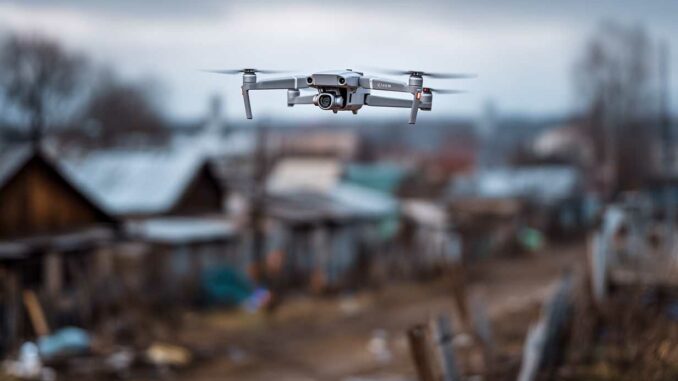
London joins five European partners to rapidly produce cheaper anti-drone defenses, drawing on lessons learned in Ukraine, and fill a capability gap.
In summary
The United Kingdom is joining forces with France, Germany, Italy, and Poland to launch LEAP, a program aimed at developing low-cost effectors capable of shooting down drones and, potentially, simple missiles, without burning scarce and expensive ammunition. The idea is straightforward: the war in Ukraine has made the exchange of “missiles costing millions for drones costing a few thousand” untenable. The Europeans therefore want to industrialize, in less than 12 months, a new generation of defenses: autonomous interceptors, light surface-to-air ammunition, and electronic warfare solutions. The schedule is aggressive: rapid production, then a first project announced for 2027. The exact budget for LEAP has not been publicly disclosed at this stage, but ministers are talking about a “multi-million” commitment in euros and pounds. Behind the announcement lies a strategic challenge: to regain control of short-range air defense, which has become the poor relation of European armies.
The logic behind the announcement, without pretense
Europeans are acknowledging a simple fact: the proliferation of drones has broken the traditional economics of air defense. When the adversary can saturate an area with dozens or even hundreds of expendable devices, responding with sophisticated missiles becomes a losing proposition.
The war in Ukraine serves as a full-scale laboratory. It demonstrates two things at once. First, cheap attack drones can create daily pressure on the rear: depots, infrastructure, bases, cities. Second, defense does not need to be technologically “perfect” to be effective; it must be dense, available, and financially sustainable. This is exactly the point that London and Warsaw are hammering home: the cost of interception must be aligned with the cost of the threat.
This shift is not theoretical. Europe has already experienced incidents of drone intrusions near its borders, with costly and unscalable responses. This reality is accelerating the political decision: produce quickly, produce in volume, and accept less “noble” but more numerous solutions.
The chosen European framework and what it changes
LEAP is supported by the “E5” (France, Germany, Italy, Poland, and the United Kingdom). This format is not insignificant: these are the biggest defense spenders in Europe, and therefore the ones that can turn an idea into orders and then into industrial production.
The stated principle is threefold: joint development, joint production, and joint procurement. In short, to avoid each country financing its own prototype in isolation, resulting in an overly expensive product delivered too late. The ministers have announced an ambitious goal: to bring solutions into production within 12 months, then deliver a first project in 2027.
The choice of words that reveals the industrial objective
Official vocabulary matters. We talk about “effectors” and “autonomous platforms.” An effector is not a radar or a command post. It is what actually destroys the threat: an interceptor, ammunition, a payload, a means of neutralization.
The obsession here is mass and repeatability.
And “autonomous” does not necessarily mean “AI that decides on its own to fire.” In practice, this often covers the automation of tracking, pursuit, and terminal interception, with a human validating the decision. The goal is to reduce reaction time and operator load when there are multiple attacks.
The announced budget, and especially what is not said
Let’s be frank: the precise budget for LEAP has not been published in detail. Officials speak of a “multi-million” commitment in euros and pounds. This is deliberate: at launch, a political course and a timetable are announced, then the amounts are locked in when industrial choices are made.
However, we can already see the financial constraints that frame British ambitions and lend credibility to a “low-cost” approach:
- The United Kingdom is proposing an increase in defense spending to 2.6% of GDP from 2027.
- The British government also indicates that British cooperation projects on long-range precision and hypersonic weapons exceed £400 million in the current fiscal year, which gives an idea of the intensity of investment in programs deemed to be priorities.
- Above all, London has already opened the floodgates on related technological building blocks: drones, autonomy, and directed energy, with a £5 billion package announced in 2025 (more than £4 billion for autonomous systems and nearly £1 billion for directed energy).
LEAP is therefore not an “isolated program.” It is part of a broader movement: relearning how to conduct short-range air defense in Europe and funding what has been lacking for years.
Targeted technologies and operational “how”
LEAP announces a first priority: a lightweight, affordable surface-to-air weapon designed to counter drones and “lower” threat missiles (typically slow attack drones or loitering munitions). This choice is consistent: the key issue today is not to shoot down a fighter jet. It is to prevent saturation by cheap aircraft.
In practice, an effective defense will resemble less a “super system” than a combination of layers:
- detection (short-range radars, electro-optical sensors, radio frequency detection)
- identification and tracking
- neutralization (kinetic, electronic, or directed energy)
- coordination (software, track sharing, rules of engagement)
The return of simple, but modernized solutions
The term “cheap drone defense” does not mean DIY. It means pragmatism. Against a small drone, a solution based on cannons, programmable ammunition, or light interceptors may be more rational than a high-end missile. Ukraine has popularized this logic: multiply “sufficient” means rather than keeping a few “perfect” ones.
British building blocks already on the table
The United Kingdom is not coming empty-handed. Two examples illustrate the approach:
- Directed energy weapons: the DragonFire laser, with a £316 million contract for naval deployment from 2027, and an announced cost per shot that is very low (around £10 per shot).
- Radio frequency (high-power microwave type): demonstrators have claimed to have tested against swarms, with very low firing costs and obvious benefits against multiple attacks.
These systems do not replace missiles. They prevent them from being wasted. This is precisely the economic core of LEAP: saving expensive ammunition for rare and critical threats, and dealing with drones in volume with sustainable means.
The types of drones concerned, and why Ukraine is the benchmark
The program is presented as “inspired by Ukraine” because Ukraine faces the entire spectrum, from homemade drones to industrial attack drones.
Long-range attack drones
The emblematic case is the Shahed-136 (and its derivatives). It is a relatively low-cost attack drone, used in large numbers, with a strategic effect: to exhaust defenses, force alerts, and strike infrastructure. Its military value lies as much in its quantity as in its precision.
Decoys and saturation drones
Russia has also used decoy drones and profiles designed to deceive defenses: multiplying tracks, diluting interceptions, and forcing the adversary to consume resources. In this scenario, a “low-cost” defense is not a luxury: it is the only way to hold out in the long term.
Tactical drones and contact warfare
At the tactical level, the dominant threat is the FPV drone and, more broadly, militarized commercial quadcopters: observation, artillery guidance, direct attack, or drop. They fly low, appear quickly, and are inexpensive. Countering them requires short-range detection, jamming when possible, and immediate destruction solutions when jamming fails.
This is where the Ukrainian lesson is most brutal: the modern battlefield has reintroduced “small” but omnipresent threats. Western armies were organized for other profiles. LEAP is an admission: we must catch up.
The risks of the “low cost” model and pitfalls to avoid
The approach is necessary, but it has blind spots.
The first risk is the illusion of “cheap” that ends up being expensive. A cheap interceptor loses its appeal if it requires heavy logistics, complex training, or costly maintenance. The cost must be measured “all-inclusive,” not just “per shot.”
The second risk is dependence on sensors. A cheap defense without robust detection is useless. However, detecting slow, low-flying, and sometimes discreet drones is a difficult problem. If Europe wants a credible solution, it will have to finance the entire chain, not just the effector.
The third risk is doctrinal: the management of firing in a civilian environment, security, rules of engagement, and inter-agency coordination (army, police, air security). Effective anti-drone defense in Europe will quickly affect national territory, not just external theaters.
The strategic significance for London and Europe
For the United Kingdom, LEAP serves three objectives.
First, to show that it remains a central player in European security, beyond institutional debates. Second, to accelerate an industrial shift: to produce systems in series, faster, with SMEs, not just large prime contractors. Finally, it aims to correct a very real vulnerability: short-range air defense is the Achilles heel when it comes to drones.
For Europe, the stakes go beyond drones. LEAP is a test of maturity: knowing how to move from observation to production, with a tight schedule. If the initiative fails to deliver quickly, it will be just another press release. If it delivers, it will change the way Europe thinks about its defense: fewer long programs, more short cycles, and an acceptance of “sufficient in mass.”
The end of an era when interception was pursued at any cost
The announcement does not say that missiles no longer have a future. It says that Europe can no longer defend its skies by burning premium ammunition on expendable targets. LEAP is, in essence, an industrial response to an operational reality: the next crisis will not allow time to launch a ten-year program. It will require high-volume solutions, delivered quickly, with a cost of use compatible with weeks or even months of alerts and interceptions.
If the program delivers on its promise, Europe will finally have a sustainable anti-drone shield. If it fails, it will continue to improvise: and improvisation, in the face of a mass threat, is rarely a strategy.
Sources
Reuters, “Europe’s main military powers to develop low-cost air-defense systems,” February 20, 2026.
GOV.UK, “UK and European allies to develop low-cost air defense weapons to protect NATO skies,” February 20, 2026.
Associated Press, “5 European nations pledge millions to use Ukrainian know-how to make cheap drone defenses,” February 20, 2026.
Reuters, “UK beefs up Royal Navy counter-drone tech with laser contract,” November 20, 2025.
GOV.UK, “Major £5 billion technology investment accelerates UK defense innovation,” June 3, 2025.
War Wings Daily is an independant magazine.