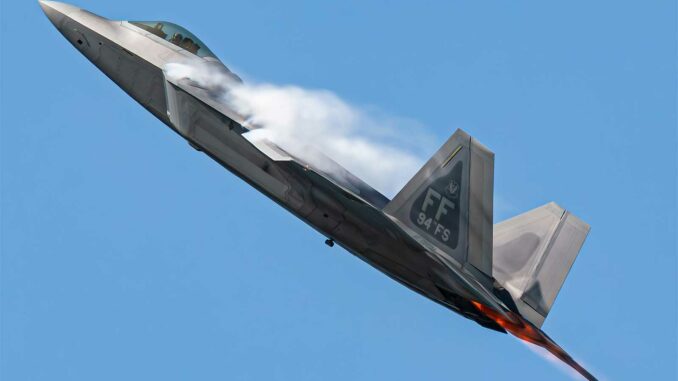
F-22s, F-35s, AWACS, and refueling tankers: in 72 hours, the United States has strengthened its position in the Middle East. Objectives, missions, and risks.
Summary
In three days, Washington accelerated the deployment of US aircraft to the Middle East: 18 F-35As from the 48th Fighter Wing left RAF Lakenheath on February 16, followed by six F-22 Raptors from Joint Base Langley-Eustis, which stopped over on February 17 before continuing on to the CENTCOM zone, accompanied by E-3 Sentry AWACS and KC-135 tankers. The message is twofold: to reassure partners and to remind Iran that the military option remains credible during discussions. This reinforcement is part of a deterrence strategy: to shorten the response time and complicate the enemy’s calculations. The available aircraft broaden the spectrum: base protection, air policing, strike package escort, intelligence, and pressure on ground-to-air defenses. The F-15E Strike Eagle and F-16 C/D complete this picture with their versatility, payload, and role in suppressing defenses. This type of build-up rarely prepares for a “symbolic gesture”: it establishes a lasting posture, but also increases the risk of incident and escalation.
The tempo of a reinforcement that is anything but insignificant
Between February 16 and 18, 2026, the United States carried out a series of rapid air movements from the United Kingdom and the US East Coast, in a clear sequence: first, a large number of stealth fighters already based in Europe, then the arrival of an air superiority fighter from the United States, and finally command and support assets.
On February 16, 18 F-35As based in the United Kingdom took off for the Middle East, with an in-flight refueling system. On February 17, six F-22s from Virginia landed at RAF Lakenheath for a stopover before continuing on. On the same day, surveillance and control aircraft were observed in transit to Europe, a classic sign that not only the “arrows” are being moved, but also the eyes and brain of the operation.
This sequencing is important. A reinforcement of fighters without refuelers, without airborne command, and without a robust logistics chain remains a limited demonstration. Here, on the contrary, we see a coherent package: fighters, C2 (command and control), and fuel. This is exactly what is needed to last over time, not just to take a photo.
The operational logic of a modern fighter “package”
The strength of a stealthy, but not redundant, duo
Combining the F-35 and F-22 is not a duplication. It is a complementarity.
The F-35A is a stealth multirole fighter designed to penetrate, observe, designate, and strike. The specifications published by the US Air Force give a maximum speed of approximately Mach 1.6 and an announced range of over 2,170 km (1,350 miles) on internal fuel, with a maximum payload of around 8,160 kg (18,000 lb). In a crisis situation, this translates into the ability to depart from a regional base, remain on patrol with refueling, collect and merge data (radar, electronic warfare, sensors), and then switch to precision strike.
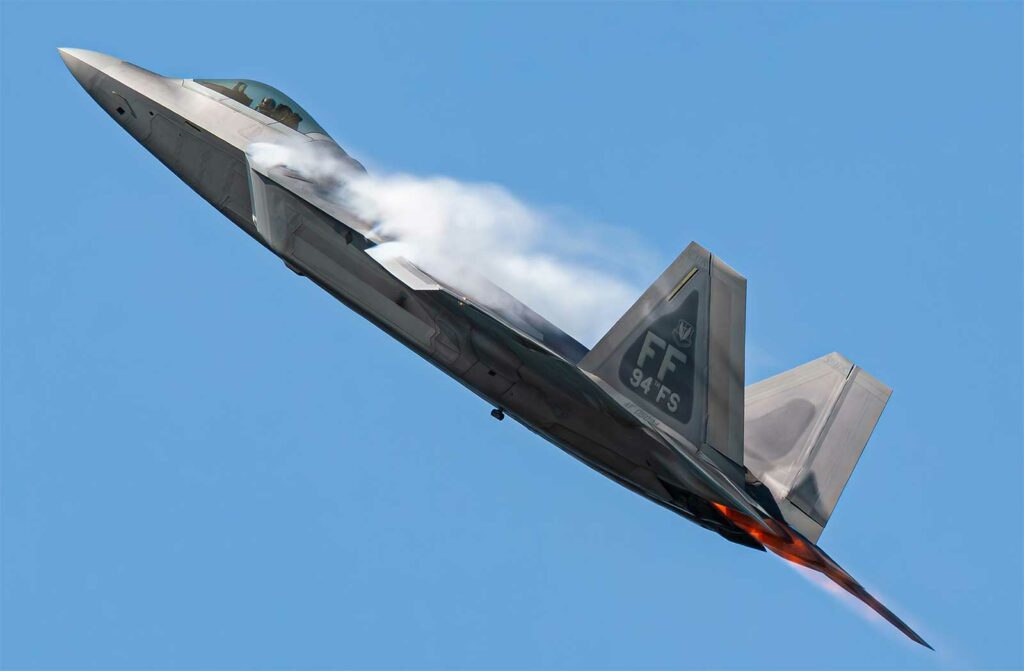
The F-22, on the other hand, is designed as an air superiority fighter, discreet and extremely effective at interception. Its value in the Middle East is not limited to “fighting aircraft” (Iranian aviation is not absent, but it is not the core of the problem). The F-22 also serves to open the way: it deters, it escorts, it imposes a cost on the slightest enemy engagement, and it protects slower and more exposed aircraft (refueling tankers, reconnaissance aircraft, command aircraft). According to the official specifications, it can fly at over Mach 1.5 without afterburners (supercruise) and has a ceiling of over 15 km (50,000 ft). Its range exceeds approximately 3,000 km (1,850 miles) with external fuel tanks. Its total inventory is 183 aircraft, with a unit cost of $143 million: it is a rare asset, and therefore sends a message.
The resources that make these fighters truly “deployable”
Two platforms make the whole thing credible: AWACS and the tanker.
The E-3 Sentry is a flying command post. Its role is not decorative: it organizes the air battle, coordinates identification, manages deconfliction, and distributes the tactical situation to aircraft that would otherwise be more “blind” or more dependent on ground networks. US Air Force documentation indicates that an E-3 can fly for more than eight hours without refueling, and can greatly extend its presence with in-flight refueling. It also highlights the allied dimension:
NATO has 17 E-3As, and several countries (the United Kingdom, France, Saudi Arabia) have operated variants. In a regional crisis, this facilitates interoperability, but it also highlights a stark fact: the E-3 capability is aging and precious.
The KC-135 Stratotanker is the invisible infrastructure. The official data sheet indicates a fuel capacity of approximately 90,700 kg (200,000 lb) and a typical range of around 2,419 km (1,500 miles) with 45,400 kg (100,000 lb) of transferable fuel. Simply put, without the KC-135, a fighter “plus-up” remains short-legged. With the KC-135, geography is transformed. The most telling example is distance: from RAF Lakenheath to Al Udeid (Qatar), it’s around 5,200 km (3,200 miles). This is no “short hop” for fighter jets without a well-oiled refueling chain.
The most likely missions if the crisis escalates
Defense missions, the most immediate and least spectacular
The first credible mission is defensive: protecting bases, ships, and partners from drones and missiles. It’s less “cinematic” than a strike, but it’s often the real driving force behind reinforcements.
The dominant threats in the region are asymmetric: low-cost drones, cruise missiles, ballistic missiles, saturation salvos, and attacks targeting infrastructure. A stealth aircraft on patrol does not “stop” everything, but it increases the probability of early detection, neutralization of airborne vectors, and protection of high-value assets (refueling aircraft, ISR aircraft, command centers).
The air control mission, even without a major air battle
A posture of air dominance also serves to impose rules. This can be achieved through interceptions, escorts, demonstrations of presence, and the ability to lock down certain airspaces.
In this regard, the F-22 is useful even if no air-to-air combat occurs. Its presence changes the enemy’s calculations: a ground-to-air operator, a pilot, or a chain of command will hesitate more if they know that a difficult-to-detect aircraft may appear in the wrong place at the wrong time.
The strike mission, which becomes plausible when the “missing pieces” are in place
When stealth, airborne command, and refueling are added, the strike becomes technically plausible on short notice. This does not mean that it has been decided, but it does mean that it is being prepared.
A typical scenario would be a series of precision strikes against capabilities deemed sensitive: storage, radars, surface-to-air batteries, command centers, missile deployment sites, or support infrastructure.
The F-35 provides first entry, detection, and discreet attack. The F-22 protects the whole and complicates retaliation. AWACS and refueling aircraft allow for longer windows of action, thus multiplying options.
The air defense suppression mission, a marker of a “serious” campaign
This is where previous-generation aircraft remain central.
The F-15E Strike Eagle is a smart bomb truck. According to the official spec sheet, it has a maximum speed of approximately 3,017 km/h (1,875 mph, Mach 2.5+), a ceiling of approximately 18.3 km (60,000 ft), and a ferry range of approximately 3,840 km (2,400 miles) with conformal tanks and three external tanks. This profile is valuable for striking far, hard, at night, and in bad weather, with a variety of weapons.
The F-16C/D, for its part, remains a versatile tool, particularly in air-to-ground and escort missions. The official data sheet gives a ferry range of over 3,220 km (2,002 miles) and a ceiling of over 15 km (50,000 ft). In the region, the F-16 is often used for air defense, drone hunting, and suppression or destruction of defenses (SEAD/DEAD) missions, depending on the units involved and their configuration.
The US strategy behind the acceleration
Deterrence through delay, not rhetoric
The most telling point is this: moving stealth fighters and command assets is not a “comfort” reaction. It is a way of reducing the delay between political decision and military action.
In a crisis, time is a strategic factor. Moving from “we could” to “we can now” changes the posture. And when the adversary knows that the window of opportunity is closing, they can either back down or rush into action. Both are possible. This is the ambivalence of deterrence.
Diplomatic leverage that works as long as it remains credible
Several signals published in recent days link this build-up to diplomatic exchanges and the Iranian nuclear issue. The principle is classic: strengthen militarily to exert political influence.
But there is a limit: if the demonstration becomes routine, it loses its force. Hence the interest in using rare (F-22) and visible (group departures, known stopovers, tracked transits) assets to “mark” a specific sequence. It’s brutal, but it’s clear.
Reassuring allies, which is also an American insurance policy
The reinforcement is not only aimed at the adversary. It is also aimed at partners: host countries, neighboring states, naval forces at sea, and European allies that serve as hubs. RAF Lakenheath, in this story, is not just a base: it is a logistical and political hub.
The decision to transit through the United Kingdom, rather than projecting everything directly, shows two things: dependence on allied access and the desire to display a de facto coalition, even if the operation remains American.
Constraints and risks that should not be minimized
The vulnerability of bases, the Achilles heel of the system
The more aircraft are concentrated in one place, the more of a target they become. Bases in the Middle East are exposed to drone and missile attacks. This leads to a sometimes counterintuitive logic: moving certain intelligence or support resources to sites considered less vulnerable, or dispersing aircraft across several airfields.
Increased air power therefore requires, in parallel, increased defensive capabilities: missile defense, infrastructure protection, runway redundancy, and rapid repair capabilities.
Logistical stress, the reality that determines whether we can hold out for “weeks”
A modern fighter jet is not just an airplane. It requires parts, teams, tools, safety equipment, data links, and massive fuel planning. A package of 24 fighter jets does not consume “a little more”: it changes the in-flight refueling regime, the hangar load, the maintenance schedule, and ammunition stocks.
That’s why refueling and command aircraft are just as important as fighter jets. And that’s also why a 72-hour reinforcement is often the beginning of a longer effort, not an epilogue.
The risk of accidental escalation, which increases with traffic density
When many aircraft are operating in the same theater, the risk of incidents rises: misinterpreted interception, misidentification, air defense fire, collision, or simple confusion in a saturated area. AWACS reduces this risk, but does not eliminate it.
And there is another, more political risk: if the adversary believes that a strike is imminent, they may decide to strike first, or to test the red lines. This is the paradox of the “ready” posture.
The most likely scenario for the coming days
This movement does not automatically portend an attack. It is the establishment of a credible military option, ready to be activated, while strengthening defenses against retaliatory strikes.
Three markers will be decisive in understanding what happens next.
First, the duration: if the resources remain, rotate, and are reinforced, it is a potential campaign posture, not a passing phase.
Next, the nature of the resources that follow: more ISR (U-2, RC-135), electronic warfare, or guided munitions will signal a more offensive preparation.
Finally, the naval posture and the protection of bases: if missile defense and the dispersal of aircraft intensify, it means that the retaliation scenario is considered likely.
The truth is simple: these deployments give Washington more leverage, but they also lock it into a logic of credibility.
When you put rare and expensive resources on the table, you can’t afford to appear to hesitate for too long. That’s where the balance comes in: achieving a political effect without triggering a military spiral.
Sources
- Air & Space Forces Magazine, “US Amasses More Airpower in Middle East with Dozens of Fighters,” February 17, 2026.
- The War Zone (TWZ), “Final Pieces Moving Into Place For Potential Attack On Iran,” February 17, 2026.
- The Aviationist, “Middle East Buildup Continues as Six F-22 Raptors Stopover at RAF Lakenheath,” February 17, 2026.
- Forces News, “Strikes on Iran could last for weeks as more F-35s fly into the region, US says,” February 17, 2026.
- U.S. Air Force, Fact Sheet “F-22 Raptor,” official AF.mil website (accessed February 2026).
- U.S. Air Force, Fact Sheet “F-35A Lightning II,” official AF.mil page (accessed February 2026).
- U.S. Air Force, Fact Sheet “F-15E Strike Eagle”, official AF.mil page (accessed February 2026).
- U.S. Air Force, Fact Sheet “F-16 Fighting Falcon”, official AF.mil page (accessed February 2026).
- U.S. Air Force, Fact Sheet “KC-135 Stratotanker”, official AF.mil website (accessed February 2026).
- U.S. Air Force / 552nd Air Control Wing, Fact Sheet “E-3 Sentry (AWACS)”, official website (accessed February 2026).
War Wings Daily is an independant magazine.