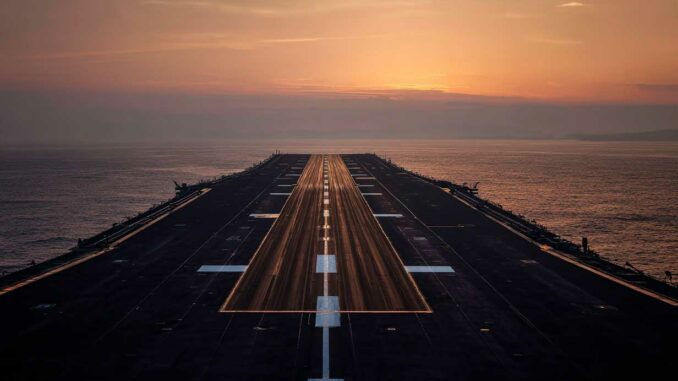
The Marine Corps aims to automate the construction of expeditionary runways with robots capable of laying aviation matting in austere terrain.
In Summary
The U.S. Marine Corps wants to develop military robots capable of laying the matting used to build Expeditionary Airfields—temporary runways installed on beaches, islands, forward bases, or isolated terrain. Today, this task still relies largely on Marines manually handling heavy panels, often on unstable ground, under intense heat, in dust, or under enemy threat. The program, called Automated Expeditionary Airfield Assembly, aims to reduce fatigue, physical risks, required personnel, and deployment time. It is part of a broader evolution: the Marine Corps wants forces that are more mobile and capable of operating from dispersed bases in the Indo-Pacific or on contested coastlines. The stakes, therefore, go beyond simple logistics. They affect the survival of forward bases, the speed of aerial projection, and the credibility of modern amphibious operations.
The Marine Corps seeks to automate a heavy and low-visibility task
The news may seem technical, yet it is significant. The U.S. Marine Corps is looking to develop robots capable of assembling the metal matting used to rapidly build expeditionary airfields. These runways, known as Expeditionary Airfields or EAFs, allow aircraft, tiltrotors, and helicopters to operate from areas that lack traditional aviation infrastructure.
The need is easy to understand. An amphibious force landing on a beach or establishing itself on an isolated island must be able to receive supplies, evacuate the wounded, launch aircraft, repair a damaged runway, or create an aerial support zone. To achieve this, it can deploy prefabricated aluminum surfaces. This matting transforms raw ground into an area usable by aircraft.
The problem is that this construction remains highly physical. Marines must carry, align, lock, and sometimes anchor these panels. They often work in difficult conditions. The ground can be soft, wet, rocky, or sandy. The site may be exposed to gunfire, drones, missile strikes, or bad weather. The task demands strength, precision, and time.
The American project therefore aims to replace part of this manual labor with robotic systems. The goal is not to remove Marines from the site entirely. Rather, it is to provide them with machines capable of performing the most repetitive and grueling tasks. It is a very pragmatic logic: less fatigue, fewer injuries, fewer personnel exposed, and an operational runway delivered faster.
AM2 matting remains at the heart of expeditionary runways
The subject revolves around a piece of equipment that is old but still strategic: AM2 matting. This is a system of aluminum panels used since the 1960s to create temporary aviation surfaces. This matting is used to build runways, taxiways, aircraft parking areas, and maintenance zones.
The figures provide an idea of the constraints. An AM2 F-72 set includes 18 panels measuring 0.61 meters by 1.83 meters (2 feet by 6 feet), two end frames, and locking bars. The entire set covers approximately 20.1 m² (216 ft²) and weighs about 669 kg (1,475 lb). Each individual panel can weigh close to 68 kg (150 lb). This is not just a simple construction tile; it is a heavy, rigid component designed to withstand aeronautical stresses.
The system is also technically demanding. The panels must be laid in a precise pattern, often staggered to offset joints and improve load distribution. Anchoring depends on the nature of the soil. An installation intended for vertical takeoff aircraft or tactical jets is not treated the same way as a light parking area. Soil type, bearing capacity, joint fatigue, surface friction, and engine effects all enter the calculation.
For this reason, the robot sought by the Marine Corps cannot be a simple motorized cart. It must handle heavy elements, place them with precision, manage alignment, assist with interconnection, and function on irregular terrain. It must also remain compact enough to be transported during operations. A machine that is too heavy or too fragile would lose much of its military utility.
The robotic program targets autonomy, not just mechanization
The project is named Automated Expeditionary Airfield Assembly. It was launched as part of a Small Business Innovation Research proposal, with a dynamic application deadline set for June 3, 2026. The specifications indicate that solutions must function on unstable or irregular surfaces, handle heavy sections with precision, and withstand harsh operational conditions.
The nuance is important. The Marine Corps is not just looking for a miniature crane or a handling vehicle. It wants to explore military robotics configurations capable of providing autonomy: navigation without direct assistance, obstacle avoidance, trajectory planning, gripping, positioning, and control. This could take the form of mobile manipulators, semi-autonomous platforms, or robotic assistance systems.
The first phase must demonstrate technical feasibility. The second should lead to a functional prototype capable of operating in automated or semi-automated modes. The third phase is intended to prepare a deployable system hardened against electrical, environmental, and cyber threats. This last point is essential. A civilian construction robot can break down without major strategic consequences. A robot building a forward runway under enemy threat must resist dust, water, shocks, interference, and digital compromise attempts.
The evaluation criteria are revealing: load capacity, arm reach, handling precision, power consumption, endurance, mass, footprint, ease of use, and the time required to assemble the surface. In other words, the Marine Corps wants a useful machine, not a laboratory demonstration.
Robotization addresses a very concrete human constraint
Building an expeditionary runway is not spectacular on screen. It does not carry the image of a stealth aircraft or a hypersonic missile. Yet, it directly dictates combat capability. An aircraft cannot take off based on strategic intent alone; it requires a surface, fuel, ground crews, guidance means, and logistics.
The work of laying matting is hard. It strains the back, shoulders, hands, and knees. It requires repetitive motions and fine coordination between several people. An alignment error can slow down the entire chain. An injury can reduce the pace. High heat or a drone threat can turn a construction site into a point of vulnerability.
In high-intensity warfare, time spent building a runway is also time during which the unit can be detected. Observation drones, satellites, electromagnetic sensors, and precision weapons make fixed bases more dangerous. A large team working for a long time in the same place increases the force’s signature. Robotization can therefore reduce human exposure and shorten the window of vulnerability.
One must remain realistic. A robot will not eliminate all risks. It will still be necessary to prepare the ground, transport the matting, secure the area, verify the installation, and certify it for aeronautical use. But if the machine reduces the number of Marines required or accelerates assembly, the operational gain becomes real.
Expeditionary runways have become strategic once again in the Indo-Pacific
This project is part of a broader transformation of the Marine Corps. For several years, the American institution has been reorienting its forces toward more mobile, dispersed operations adapted to contested littoral zones. The concept of Expeditionary Advanced Base Operations rests on a simple idea: small units must be able to temporarily establish themselves on islands, coasts, or forward points to support the fleet, monitor an area, strike, resupply, or contest adversary maritime access.
In this framework, aviation plays a central role. F-35Bs, MV-22 Ospreys, CH-53Ks, KC-130s, and drones need support points. However, large airbases are vulnerable. They are known, mapped, and often targeted as a priority. Smaller, temporary, and dispersed bases offer a different logic. They complicate adversary targeting. They give depth to the deployment. They allow aircraft to be moved before a strike destroys an infrastructure.
Expeditionary Airfields thus become a building block of distributed warfare. They do not replace large bases; they complement them. Their value is measured by their speed of creation, their discretion, their resilience, and their ability to be dismantled or moved.
In the Indo-Pacific, this issue takes on an obvious dimension. Distances are immense. Islands are numerous. Available runways are not always sufficient. Civilian infrastructures may be saturated, fragile, or politically sensitive. The ability to create a temporary aerial surface becomes an advantage. This is precisely the type of problem the Marine Corps is seeking to address.
New lighter matting shows the same logistical obsession
The robotic project does not emerge from nowhere. The Marine Corps is already working to make its expeditionary runway systems lighter and easier to deploy. NAVAIR has notably tested lighter matting, including the Prefabricated Surfaced Aluminum Flat Top Nested system. The goal was to replace or supplement AM2 for certain operations, particularly zones intended for vertical takeoff aircraft.
Trials conducted with the MV-22 Osprey have shown the value of lighter matting. According to NAVAIR, the old AM2 remains viable, but it is heavy, time-consuming to install, and difficult to transport to austere environments. New solutions seek to reduce mass, logistical volume, and workload. In some cases, panels can be handled by a single service member, whereas traditional AM2 matting poses heavier handling constraints.
The logic is clear. A forward base is not judged solely by its solidity. It is also judged by the number of containers required, the volume transported by ship or aircraft, the unloading time, and the number of personnel mobilized. A lighter panel facilitates the maneuver. A robot facilitates the laying. Both evolutions move in the same direction: making expeditionary aviation less dependent on heavy logistics.
This trend also concerns maintenance. The non-skid coatings on AM2 matting must be refurbished after several years of exposure to UV rays, weather, and air traffic. Recent work has studied resurfacing kits capable of treating the matting on-site without dismantling everything or sending the panels back to a manufacturer. Again, the logic is the same: reduce downtime and bring maintenance closer to the field.
Technical limits of the robot will be difficult to bypass
The idea is appealing, but its realization will be complex. The first challenge concerns the terrain. An expeditionary runway is rarely built on perfect ground. The robot will have to work on sand, compacted earth, gravel, sloped surfaces, or partially prepared areas. The machine’s stability will therefore be critical. An arm handling a panel weighing dozens of kilograms can unbalance the platform if it is too light.
The second challenge concerns precision. The panels must interlock correctly. Joints must be aligned. Locking bars must be engaged. An error repeated over several meters can produce an unusable or dangerous surface. Autonomy must therefore be reliable, but also controllable by Marines. A semi-automatic mode seems more realistic than full autonomy at the start of the program.
The third challenge concerns power. A robot powerful enough to carry and position matting must have a robust power supply. Batteries add mass and require charging cycles. Internal combustion engines add noise, an infrared signature, and fuel dependency. In a contested zone, these choices are never neutral.
The fourth challenge is maintainability. A forward unit cannot depend on a specialized technician coming from the rear. The robot must be repairable with limited tools. Its components must resist salt, sand, humidity, and the shocks of transport. Otherwise, it will become an additional burden.
The real breakthrough lies in the speed of restoration
This program should not be reduced to the construction of new runways alone. It can also play a role in repair after an attack. Airbases are priority targets. A strike can crater a runway, destroy a parking area, scatter debris, and block operations. In this context, the ability to repair quickly becomes as important as the ability to build.
American forces have long worked on airfield damage repair. The challenge involves clearing, filling, stabilizing, and returning aviation surfaces to service after an attack. Robots capable of handling matting could accelerate certain phases. They could also limit the exposure of human teams to unexploded ordnance, persistent drones, or indirect fire.
The question is therefore not just: how long does it take to build a runway? The real question is: how long can a force remain airborne after being hit? In a war against an adversary equipped with precision missiles, this difference can decide the survival of a deployment.
The runway robot reveals a profound evolution of warfare
This program demonstrates a fundamental trend. Military robotization is no longer limited to reconnaissance drones or remote-controlled weapons. It is moving into logistical tasks, engineering work, handling, maintenance, and construction. This is less spectacular, but often more decisive.
A modern army depends on thousands of concrete actions: moving matting, pulling cables, refueling aircraft, repairing surfaces, erecting shelters, clearing runways, and securing fuel points. These tasks consume personnel and time. They expose soldiers without always producing a visible effect. Partially automating them can free up personnel, reduce fatigue, and improve operational tempo.
The Marine Corps is therefore moving onto very realistic ground. It is not promising an airbase built by magic. It is seeking to relieve Marines of some of the heaviest labor. This is an approach consistent with distributed warfare. Smaller units will have to do more, faster, with less immediate support. In this context, a machine capable of laying matting becomes a strategic tool.
The bet remains risky, but it meets a real need
The project has limits. The robots will have to prove their utility outside the lab. They will have to function under rain, heat, dust, salt, and transport constraints. They must remain simple to use. They must be robust enough to follow an expeditionary unit, yet precise enough to meet aeronautical requirements. This is a difficult balance.
The risk is producing a system that is too heavy, too expensive, or too fragile. A machine that requires too much maintenance can slow down the unit instead of helping it. Overly ambitious autonomy can lead to software failures. A platform that is too specialized may lack versatility. The Marine Corps will therefore need to prioritize a sober, reliable, and modular solution.
But the need is real. Forward bases, expeditionary airfields, and amphibious operations are becoming central to American strategy again. Large infrastructures are no longer enough. Forces must be able to move, disperse, and rebuild quickly. In this logic, the robot that lays matting is not a gadget. It is a concrete response to a war where visible logistics become a target.
The next stage will tell if the industry can transform this idea into field equipment. If the program succeeds, it will not just save time for Marines. It will change the way an expeditionary air force establishes itself, survives, and redeploys under threat.
War Wings Daily is an independant magazine.