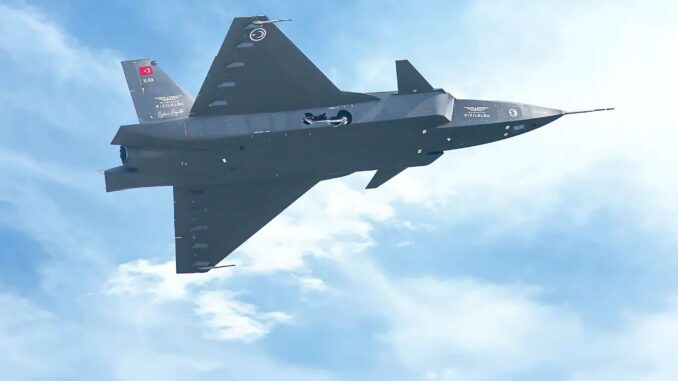
The Kızılelma fired two bombs from its internal weapons bay—a test that brings Turkey closer to a truly penetrating combat drone.
Summary
Baykar announced on July 30, 2026, that its Bayraktar Kızılelma jet-powered combat drone had successfully completed its first live firings from an internal weapons bay. The S2 series model dropped a TEBER-82 on July 25, followed by a TOLUN on July 28, from the Çorlu flight test center. Both munitions reportedly scored direct hits on their targets. This milestone is significant because carrying weapons inside the fuselage reduces both drag and, more importantly, the radar cross-section created by pylons and external stores. It also validates a complex technical chain: bay door operation, safe weapon separation, mission data transfer, aerodynamic compensation, and bay door closure. However, the test alone does not demonstrate stealth comparable to a fifth-generation fighter. Rather, it confirms that Turkey is step-by-step building an autonomous, exportable aerial combat system integrated with its domestic defense industry.
The Kızılelma Crosses a Far More Serious Threshold Than a Simple Drop
Baykar presented the event as the Kızılelma’s first live firings from an internal bay. The tests were conducted at Çorlu, in Tekirdağ province. The first, carried out on July 25, 2026, involved a TEBER-82 produced by ROKETSAN. The second, on July 28, used a TOLUN munition manufactured by ASELSAN. Baykar asserts that both weapons achieved direct hits on designated targets.
The key phrase here is not just “live firing.” It is internal bay.
A drone can carry a bomb under a wing using relatively conventional integration. Engineers must verify mechanical, electrical, and aerodynamic constraints, then qualify the separation. Encasing a weapon inside the fuselage imposes a far higher level of difficulty. It must remain invisible to radar as long as the doors are closed. It must then be released into a heavily disturbed airflow without striking the airframe, the bay doors, the air intake, or another munition.
The test therefore validates a complete operational sequence. The mission computer transmits targeting data to the weapon. The doors open. The ejection or release mechanism frees the munition. The flight control system instantly corrects for changes in mass, center of gravity, and drag. The bomb must separate cleanly before deploying its lift surfaces or activating its guidance. Finally, the doors close to restore the aerodynamic configuration and reduce the radar signature once again.
This process seems brief, yet it encapsulates years of calculations, ground testing, simulations, and instrumented test flights.
The Internal Bay Reduces the Signature Without Rendering the Aircraft Invisible
Pylons, rails, bombs, and missiles mounted under wings create multiple radar reflections. Their cylindrical shapes, tail fins, and hardpoint junctions return electromagnetic energy in numerous directions. They also increase drag, a penalty that reduces speed, range, or acceleration capability.
Internal carriage eliminates a large portion of these exposed elements, allowing the fuselage to maintain a cleaner geometry. It also shields munitions from aerodynamic heating, vibration, and certain environmental stresses. For an aircraft designed to penetrate defended airspace, this architecture is essential.
However, nuance is required. An internal bay alone does not create a stealth aircraft.
Low observability relies on the entire airframe. It depends on edge alignment, air intake treatment, engine compressor masking, nozzle shaping, radar-absorbent materials, coating conditions, seams, antennas, and electronic emissions management. The bay doors themselves can become highly reflective when opened; thus, opening times must be kept short and timed for the least tactically adverse moment.
Baykar describes the Kızılelma as an aircraft with a low radar cross-section. However, no public figures—measured under independent protocols—exist to establish its true level of stealth. It would therefore be premature to automatically rank it alongside an F-35, a B-21, or other systems designed from the ground up around extreme low-observability requirements.
The July milestone proves a functional capability. It does not yet prove survivability against a modern integrated air defense network combining low-frequency radars, target engagement radars, infrared sensors, electronic warfare, and interceptor fighters.
Turkish Munitions Give the Test Industrial Weight
The TEBER-82 is based on a general-purpose MK-82 bomb fitted with a ROKETSAN guidance kit. The system combines inertial navigation, satellite positioning, and a semi-active laser seeker. According to the manufacturer, the assembly weighs approximately 270 kg, measures 2.6 meters, and has an advertised maximum range of 28 km. ROKETSAN claims a circular error probable of less than 3 meters under standard operational conditions.
The TOLUN operates on a different logic. This 139 kg glide munition uses GPS and inertial guidance, with wings that deploy after release. ASELSAN advertises a maximum range of 102 km (55 nautical miles), an accuracy of under 10 meters, and the capability to penetrate one meter of reinforced concrete after a 56 km (30 nautical mile) flight. These values represent manufacturer specifications and vary depending on altitude, speed, launch profile, weather, and satellite navigation availability.
The decision to test two distinct weapons is telling. The TEBER-82 represents a heavier payload suited for precision strikes against fixed or mobile targets, particularly via laser designation. The TOLUN offers greater stand-off range, allowing the engagement of hardened targets with a more compact munition.
This success demonstrates that the Kızılelma is not merely a flying airframe. It is progressively becoming a national weapon system, linking Baykar, ROKETSAN, ASELSAN, and TÜBİTAK SAGE. Such integration reduces reliance on foreign supplier approvals for bombs, sensors, radar systems, or mission software.
This is likely the most vital dimension for Ankara. An exportable aircraft that remains dependent on foreign-sourced components or weapons subject to external vetoes remains politically vulnerable. An end-to-end national supply chain affords far greater latitude to tailor the product, support customers, and clear exports.
The Kızılelma Approaches a True Unmanned Combat Aircraft
The Kızılelma measures 14.5 meters in length with a 10-meter wingspan. Baykar quotes a maximum takeoff weight of 8.5 metric tons and a payload capacity of 1.5 tons. The claimed combat radius is approximately 926 km (500 nautical miles). The advertised cruise speed is Mach 0.6, with a top speed of Mach 0.9 for the current variant. Endurance exceeds three hours, and the published operational altitude is 7,620 meters (25,000 feet), with a service ceiling of 13,716 meters (45,000 feet).
These performance metrics place it above conventional MALE (Medium-Altitude Long-Endurance) drones in speed and responsiveness, though still below a supersonic fighter in its current configuration. Baykar plans subsonic, transonic, and supersonic variants. The program’s progression reflects a methodical, step-by-step strategy: fly the airframe, stabilize it, integrate sensors, employ external stores, test air-to-air engagements, coordinate multiple aircraft, and finally qualify internal weapons release.
The maiden flight took place in December 2022. A near-production prototype flew in September 2024. In November 2025, Baykar announced the destruction of a jet-powered target drone using a beyond-visual-range GÖKDOĞAN missile guided by ASELSAN’s MURAD AESA radar. In December 2025, two Kızılelmas performed a coordinated formation flight driven by fleet autonomy algorithms.
By May 2026, the K-SWARM program integrated the Kızılelma with Leonardo M-346 trainers. The unmanned aircraft joined the formation autonomously, executing position changes and breakaways commanded from the crewed plane. In July, it also launched a JET-230 supersonic air-to-ground missile from an external hardpoint.
The internal bay firings complement this sequence, bringing the aircraft closer to the multifaceted role Baykar envisions: strike, air defense, reconnaissance, crewed-uncrewed teaming, and operations from short runways or naval vessels.
The Drone Can Become a Combat Teammate Rather Than a Disposable Asset
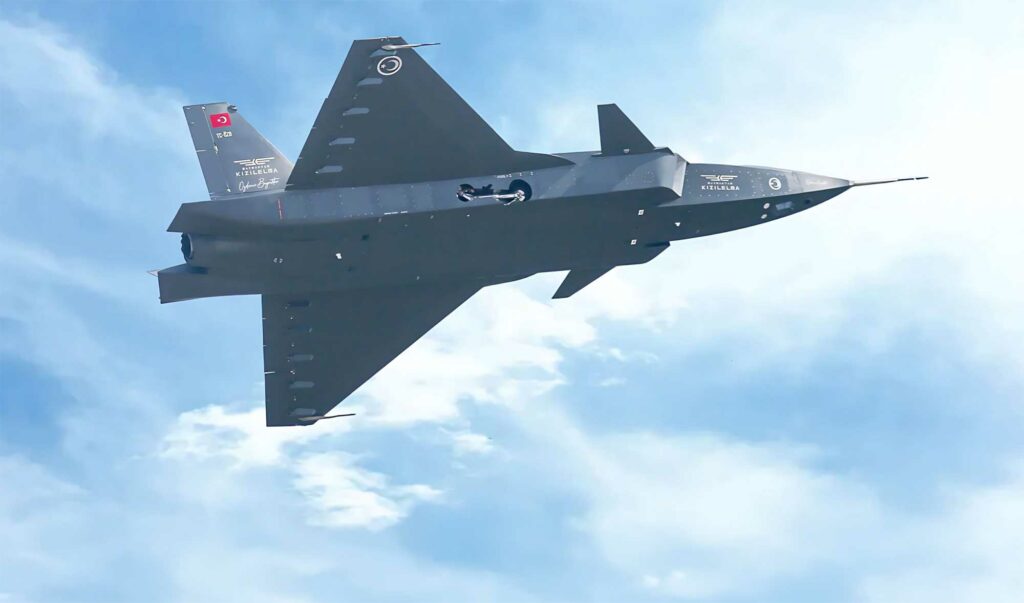
The Kızılelma is frequently described as a “loyal wingman”—an uncrewed teammate operating under the control of a piloted aircraft or command network. The term can be misleading; this is not necessarily a low-cost drone meant to be sacrificed.
A jet-powered aircraft equipped with an AESA radar, electro-optics, secure data links, an internal bay, guided weapons, and autonomous architecture can quickly become expensive. While its exact price tag is not public, its military utility will depend heavily on the balance between performance, procurement cost, maintenance burden, and production rate.
Its primary value lies elsewhere: it can be more attritable than a piloted fighter. Air forces can push it forward to detect threat radars, provoke enemy reactions, designate targets, jam signals, launch weapons, or shield crewed assets. Losing the aircraft remains a significant loss, but it involves neither the death nor the capture of a pilot.
In a suppression of enemy air defenses (SEAD) mission, multiple Kızılelmas could advance as a networked package. Some would carry sensors, others strike weapons, while others could act as communications relays or decoys. An F-16, a future KAAN fighter, or a ground command post could dynamically assign tasks as the threat environment evolves.
The internal weapons bay reinforces this exact concept. It allows the drone to approach more covertly before revealing its presence, all while maintaining better flight performance than a drag-heavy configuration laden with external bombs.
Turkey Builds an Offering Bridging Armed Drones and Fighter Jets
The Turkish defense industry initially built its reputation on propeller-driven platforms like the Bayraktar TB2. Their market success relied on a clear formula: contained cost, endurance, guided weapons, ease of deployment, and rapid availability. The Kızılelma targets a far more demanding segment, seeking to fuse jet speed, reduced signature, advanced sensors, and growing autonomy.
This evolution alters Turkey’s standing in the defense market. Ankara is no longer merely offering observation or strike drones for low-threat environments. It aims to compete in the domain of collaborative combat aircraft—a field currently pursued by the United States, Europe, China, Russia, Australia, and South Korea.
Industrial trends favor this ambition. According to Reuters, Turkish defense exports have more than tripled since 2021, reaching approximately $10 billion in 2025. Sales to Europe and the United States nearly quadrupled to $5.6 billion. For its part, Baykar claims to have exported $2.2 billion in 2025 alone, securing contracts across 39 countries for its various drone families.
The Kızılelma already boasts international traction. An agreement announced in May 2026 outlines the delivery of 12 aircraft to Indonesia starting in 2028, with options to expand the fleet up to 48 units. The program is no longer solely reliant on future domestic orders from the Turkish armed forces.
This momentum accords Ankara an unusual position: a nation capable of supplying advanced technologies to clients seeking alternatives to exclusive reliance on the United States, China, or Russia.
The Leonardo Partnership Opens the Door to the European Market
The Kızılelma’s strategic positioning does not rely solely on Baykar’s traditional export routes. LBA Systems, a 50/50 joint venture between Leonardo and Baykar, became fully operational in July 2026. Headquartered in Italy, it combines Baykar’s platforms and manufacturing capacity with Leonardo’s expertise in sensors, avionics, integration, and European airworthiness certification.
The Kızılelma is officially included in the joint portfolio. Leonardo indicates that industrial activities for the platform will take place at its own production facilities. This cooperation gives Baykar more credible access to European industrial supply chains and NATO standards, while providing Leonardo a shortcut in a sector where Europe has lagged: producing combat drones at scale.
The relationship remains politically delicate. Italy attached conditions to its approval, notably restricting sales to countries aligned with Europe and NATO and stipulating that core technologies remain classified. The partnership does not eliminate diplomatic friction between Ankara and certain European capitals, but it creates an industrial interdependence that diplomatic rhetoric can no longer ignore.
For Turkey, the Kızılelma serves as an instrument of leverage. It provides a platform to negotiate partnerships, localized production, technology transfers, and broader bilateral agreements spanning munitions, radar systems, maintenance, and operational training.
Subsequent Steps Will Prove Harder Than the Initial Milestone
Baykar must now demonstrate that this release sequence functions across a broader flight envelope. A successful drop at a single speed and altitude is insufficient. Qualification requires testing across varying speeds, g-loads, angles of attack, gross weights, fuel states, and environmental conditions.
Engineers must also integrate additional weapons. An internal bay delivers true operational value only if it accommodates a diverse array of stores: precision-guided bombs, air-to-air missiles, anti-radiation missiles, and stand-off weapons. Each new payload demands rigorous mechanical, electrical, software, and aerodynamic validation.
Furthermore, survivability under heavy electronic jamming remains to be proven. GPS-guided munitions and data links are vulnerable in high-intensity conflicts. The aircraft must demonstrate it can execute its mission when communications are degraded, satellite navigation is denied, or adversaries attempt spoofing.
Finally, the program must prove its industrial maturity. Demonstrators can deliver impressive test flight videos; an air force, however, requires dozens of available aircraft, reliable engines, robust supply chains, validated software, trained operators, and predictable maintenance schedules.
The ultimate test will not be the next weapon test video. It will be the capability to mass-produce a fleet, sustain it in the field, network it with other assets, and employ it within a coherent operational doctrine.
Turkish Success Redefines the Balance Between Autonomy and Airpower
The July 2026 weapons drops do not instantly transform the Kızılelma into an operational stealth fighter. However, they demonstrate that Baykar is clearing technical hurdles in a logical, rapid sequence. The airframe flies, the weapons hit targets, the radar has been paired with air-to-air engagements, formation autonomy has been flight-tested, crewed-uncrewed teaming has been demonstrated, and the internal bay now operates with domestic munitions.
Turkey is thus positioning itself along a clear strategic line: building systems advanced enough to operate in contested airspace, yet scalable enough to be manufactured, exported, and fielded in volume. This balance remains rare.
The risk lies in confusing strategic communications with frontline combat capability. The platform’s true radar cross-section remains unmeasured publicly, its unit cost is unknown, its electronic warfare resilience is undisclosed, and its carrier-compatibility remains under development. These caveats are substantial.
Nevertheless, they should not obscure the underlying momentum. Ankara is no longer merely attempting to catch up with legacy defense giants. It is striving to define a segment whose operational rules are still being written. The Kızılelma has the potential to serve as an uncrewed combat aircraft, a loyal wingman for manned fighters, a naval asset, and a lucrative export product. The internal bay firing does not guarantee this future, but it renders it vastly more credible.