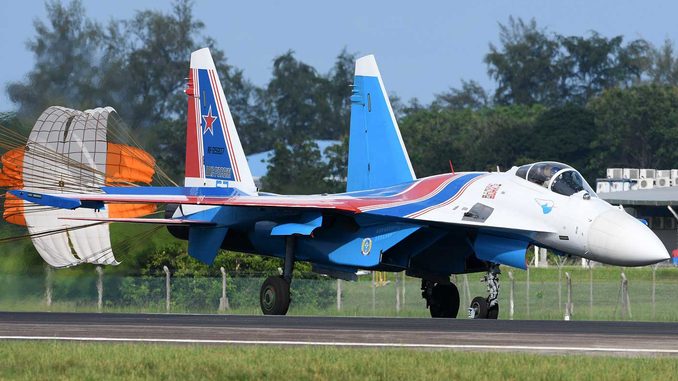
The Su-35’s Irbis-E radar promises detection up to 400 km. An analysis of its power, real-world capabilities, and limitations against stealth fighters.
Summary
The N035 Irbis-E radar is one of the main assets of the Sukhoi Su-35, a Russian 4++ generation fighter. Developed by Tikhomirov NIIP, this passive electronically scanned array (PESA) radar combines a 900 mm antenna, an advertised peak power of 20 kW, and a theoretical range of up to 350 to 400 kilometers. It can simultaneously track 30 airborne targets and assist in engaging up to eight of them. Its antenna, mounted on a hydraulic mechanism, also provides a particularly wide field of view, up to 120° on either side of the aircraft’s axis. These characteristics make it a powerful detection system, but they do not guarantee superiority over Western AESA radars. Its ability to spot F-22 and F-35 fighters depends notably on their radar cross-section, orientation, and engagement conditions. Detecting a stealth aircraft does not necessarily mean being able to shoot it down.
The Irbis-E Radar Relies on a Particularly Powerful PESA Architecture
Developed by the Russian institute Tikhomirov NIIP, the N035 Irbis-E equips the Sukhoi Su-35S. It is an evolution of the N011M Bars radar, installed notably on certain versions of the Su-30.
The Irbis-E uses a passive electronically scanned array antenna, known as PESA. Unlike traditional radars whose antenna must rotate to scan space, it steers its beam electronically using phase shifters.
The term “passive” here refers to the antenna’s architecture. The radar does emit electromagnetic waves.
Its uniqueness lies in its centralized transmitter. Two 10 kW traveling-wave tubes provide a total peak power of 20 kW, compared to an advertised average power of about 5 kW.
This difference is essential. Peak power corresponds to the maximum reached during a pulse. It does not represent a continuous 20 kW emission.
The antenna has a diameter of 900 mm, representing a geometric surface area of approximately 0.64 m². This large aperture improves the directivity of the beam and the concentration of energy toward a distant target.
The radar operates in the X band, within a frequency range situated roughly between 8 and 12 GHz. These frequencies offer a compromise between angular resolution, range, and antenna dimensions.
The 400-Kilometer Range Corresponds to Highly Favorable Conditions
United Aircraft Corporation officially announces a maximum range of 350 km for the Su-35. Tikhomirov NIIP puts forward values between 350 and 400 km against a target with a radar cross-section of 3 m².
This performance relies on several conditions: an approaching target, favorable altitude, a mildly disturbed electromagnetic environment, and a restricted search sector.
Radar Cross-Section Determines Detection Distance
The radar cross-section, or RCS, measures an object’s ability to reflect electromagnetic energy back toward the radar. It does not correspond to its physical surface area.
An aircraft with an RCS of 3 m² reflects, under the considered conditions, more energy than an aircraft whose RCS reaches 0.01 m².
According to data attributed to Tikhomirov NIIP, the Irbis-E could detect a 0.01 m² target at about 90 km.
These values must remain theoretical references. They are not accompanied by independent test results confirming performance across all configurations.
Maximum range notably requires concentrating searches on a reduced sector. Extended surveillance requires distributing observation time among more directions, which generally reduces the distance at which weak echoes can be detected reliably.
The range of about 200 km sometimes cited for a broader search illustrates this trade-off.
Electronic and Mechanical Scanning Offers an Exceptional Field of View
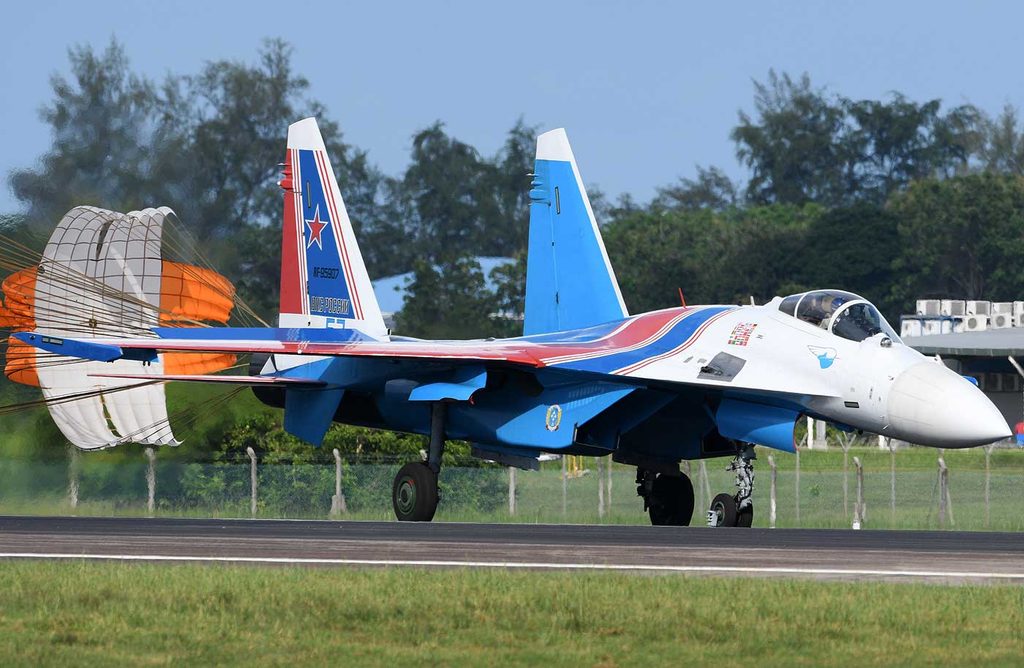
One of the remarkable characteristics of the Irbis-E lies in its hybrid orientation system.
Its PESA antenna can electronically deflect the beam up to about 60° relative to its axis. An electro-hydraulic mechanism allows the entire assembly to be physically reoriented.
The combination of both devices brings the claimed field of view to ±120° in azimuth, yielding total coverage of 240°.
This setup presents considerable tactical interest.
When a Su-35 launches a long-range missile, its pilot can significantly alter their trajectory while maintaining the target within the radar’s field. This maneuver reduces the closing speed with the adversary and can complicate a response.
However, the maximum field of view does not guarantee maximum range in all directions.
As the beam moves away from the antenna’s axis, performance can decrease. Mechanical displacement also introduces constraints regarding speed, wear, and maintenance.
Tracking 30 Targets Does Not Mean 30 Simultaneous Engagements
The Irbis-E can track up to 30 airborne targets in Track While Scan (TWS) mode.
This operation allows the radar to retain multiple tracks while continuing surveillance. Its computer regularly updates the position, speed, and direction of the objectives.
The system can support up to eight simultaneous engagements with missiles using active radar homing seekers, such as certain versions of the R-77.
With missiles requiring semi-active radar illumination, such as the R-27R, the number of simultaneous engagements is generally limited to two.
A distinction must also be made between the radar’s capacity and that of the armament.
Maximum detection range does not correspond to the effective range of a missile. The latter depends on its energy, launch altitude, aircraft speed, and target maneuvers.
The Irbis-E also possesses air-to-ground and air-to-sea modes, including radar mapping and ground target tracking. The system can notably use synthetic aperture imaging to improve terrain representation.
The Detection of F-22s and F-35s Remains the Most Controversial Point
Russian engineers present the Irbis-E as a radar capable of detecting aircraft with a low radar signature. In 2015, Tikhomirov NIIP director Yury Bely even asserted that its performance would allow the Su-35 to face fifth-generation fighters.
This assertion deserves examination.
Stealth does not make an aircraft invisible. It reduces the electromagnetic energy reflected in certain directions and frequency bands.
The RCS of the F-22 Raptor or F-35 Lightning II depends on the observation angle, frequencies used, and aircraft configuration. Their exact operational signatures remain classified.
Radar Power Does Not Fully Offset Stealth
The radar equation shows that, all else being equal, detection range evolves approximately as the fourth root of the RCS.
Thus, if a radar detects a 3 m² target at 400 km, a reduction of its signature to 0.01 m² would theoretically reduce the distance to about 96 km.
This simplified calculation illustrates the importance of stealth. It does not predict the actual performance of the Irbis-E against an F-35.
The range reduction gives the stealth aircraft more opportunities to detect its adversary, fire, or alter its trajectory before being sufficiently localized to undergo an engagement.
The Su-35 does, however, possess another detection means: its OLS-35 infrared sensor, which complements the radar. Infrared and electro-optical sensors allow for searching targets without radar emission, but their effectiveness depends on atmospheric conditions and the adversary’s thermal signature.
This complementarity improves detection capabilities. It does not eliminate the difficulty of obtaining a reliable firing solution against a stealth aircraft.
Western AESA Radars Prioritize Flexibility and Electronic Discretion
The Irbis-E belongs to a different technological generation than modern AESA radars.
The AN/APG-77 of the F-22, AN/APG-81 of the F-35, AN/APG-79 of the Super Hornet, and RBE2 AESA of the Rafale use active electronically scanned array antennas.
Each AESA radar possesses numerous transmit-receive modules, instead of relying on a single main transmitter.
This architecture facilitates the production of complex waveforms, frequency agility, and the distribution of operating time among multiple tasks.
It also favors low probability of intercept (LPI) modes, designed to make radar emissions more difficult to detect and identify.
An AESA can also retain certain capabilities despite the failure of several modules. Conversely, its power, cooling, and digital processing impose significant constraints.
AESA is not automatically superior in every domain. The Irbis-E retains high emission power and a large aperture.
On the other hand, raw range is not enough to measure a radar’s superiority.
Resistance to jamming, track precision, mode switching speed, and integration with other sensors play a decisive role.
The French development of the RBE2-XG, intended for the future Rafale F5, illustrates this evolution toward increased power, better detection of low signatures, and collaborative combat.
Modern Air Combat Demands Going Beyond Radar Range Alone
The operational value of the Irbis-E cannot be separated from its environment.
A Su-35 can receive information originating from other aircraft, ground stations, or airborne early warning aircraft. This data allows it to concentrate its searches in a particular sector rather than continuously scanning the entire airspace.
Conversely, a powerful radar can reveal its presence to adversary electronic warning systems. The emission itself then becomes a source of intelligence for the enemy.
The main challenge for the Su-35 against stealth aircraft is therefore not solely obtaining a first radar echo. It must transform that information into a sufficiently precise track, maintain that track, and provide the necessary data to a missile.
The Irbis-E remains a particularly high-performing PESA radar on paper. Its 20 kW of peak power, wide field of view, and multi-target capabilities are significant characteristics.
Yet the competition among modern fighter jets now plays out across the entire detection and engagement chain. The true advantage belongs to whoever obtains actionable information first, without offering their adversary the same possibility.