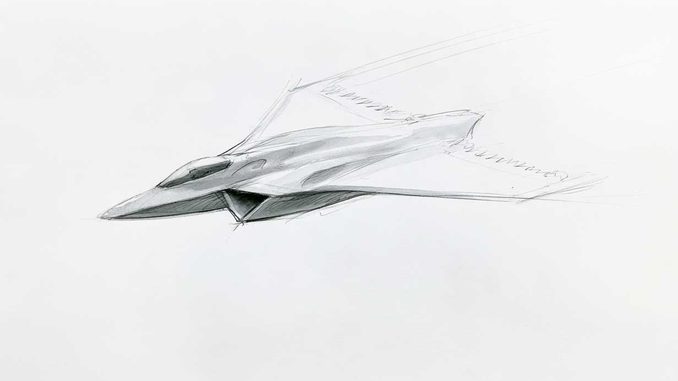
Following the collapse of the FCAS, France is preparing its ACF. Budget, sovereign AI, European alliances: the choices that will determine the future of air combat.
In Summary
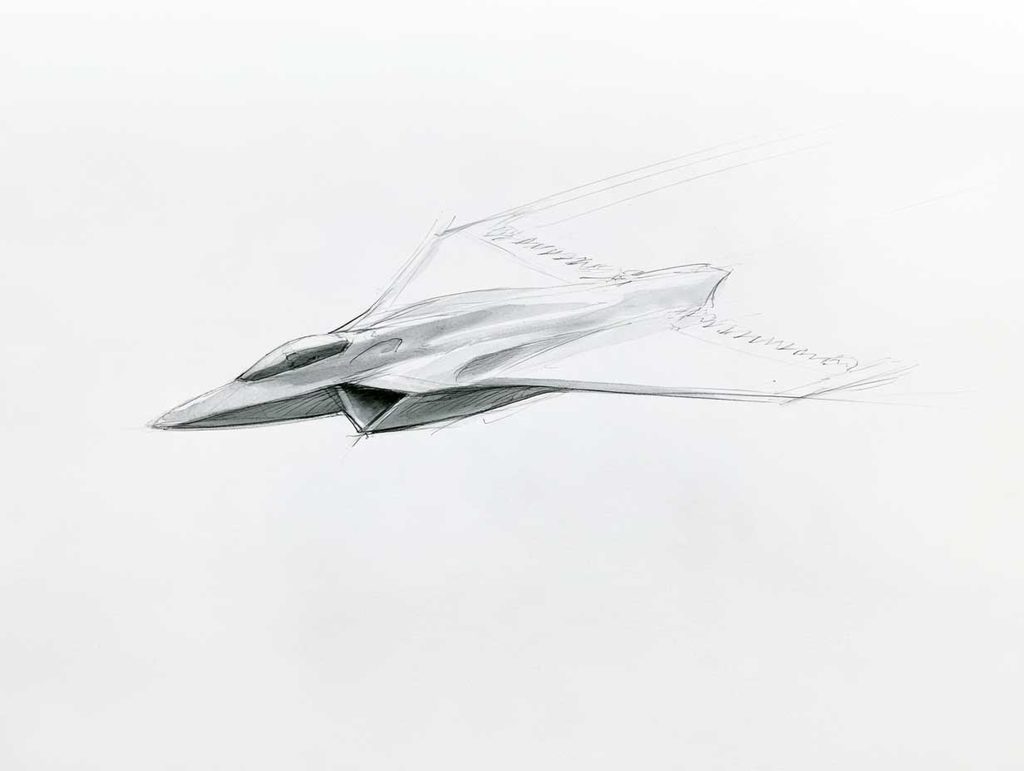
The Future Combat Aircraft (ACF) is becoming a French project following the abandonment, in June 2026, of the joint fighter previously planned within the FCAS with Germany and Spain. Presented to members of parliament on October 14, it must ensure the succession of the Rafale starting in 2040 and eventually meet the requirements of nuclear deterrence.
France has the necessary industrial base to design it, but not an unlimited budget. No complete financing has yet been finalized, despite the increase in military appropriations. A development effort spread over some fifteen years will therefore have to coexist with the Rafale F5, munitions, and air defense.
The sovereignty of software and artificial intelligence will constitute a challenge as decisive as the engine or stealth. The most credible solution combines national control of the aircraft with targeted cooperation on European drones and networks.
The Breakdown of the FCAS Confronts France Once Again with Its Industrial Choices
On October 14, 2026, before members of parliament, General Jérôme Bellanger confirmed the choice of a nationally designed Future Combat Aircraft (ACF). The successor to the Rafale will no longer depend on the Franco-German partnership. In June, Paris and Berlin abandoned the New Generation Fighter (NGF), the core of the Future Combat Air System (FCAS), in which Spain was also participating.
The failure concerns a joint aircraft, not necessarily all the technologies of the FCAS. Work on drones and the combat cloud can continue.
The ACF will have to carry out conventional missions around 2040 and carry the future ASN4G nuclear missile around 2050. France must therefore master armaments integration and the schedule.
The ACF Budget Must Be Distinguished from Political Promises
The military programming law revised in August 2026 added 36 billion euros to the 2026–2030 trajectory. It brings the appropriations for the Defense mission over 2024–2030 to approximately 436 billion euros. The 2027 draft budget provides 63.4 billion euros for this mission, excluding pensions. But at this stage, there is no officially voted complete funding envelope for the ACF.
France forecasts a public deficit of 5.4% of GDP in 2026, then aims for 5% in 2027. Interest payments could reach 91.2 billion euros in 2027. Every billion allocated to the aircraft will therefore have to be defended against expenditures for munitions, air defense, and operational readiness.
The Amount to Program to Avoid a Financial Impasse
Éric Trappier, head of Dassault Aviation, estimates he can develop a future fighter for significantly less than 50 billion euros. This is an industrial assessment, not an estimate validated by the State.
A financing hypothesis would consist of provisioning 25 to 35 billion euros in development between 2027 and 2040, or 1.8 to 2.5 billion per year on average. This proposal, which does not constitute an official estimate, should cover demonstrators, tests, software, engines, and initial industrialization, with independent cost reviews.
The purchase of series-produced aircraft, their maintenance over several decades, and certain infrastructures would follow.
French Know-How Exists, but the Scale is Vastly Different
France is not approaching this project without an industry. Dassault masters architecture and flight controls, Safran propulsion, Thales radars and electronic warfare, and MBDA missiles.
The Dassault Rafale constitutes a solid operational and industrial base, but its successor will not simply be an enlarged version.
A new generation aircraft will have to combine radar stealth, internal weapons bays, distributed sensors, electronic warfare, and cooperation with drones. Stealth notably requires controlling shapes, materials, emitted heat, and electromagnetic signatures.
France will also have to preserve nuclear payload capacity and, if the need is confirmed, operation from an aircraft carrier: two constraints that complicate design.
The Rafale F5 will serve as a testbed. The DGA has initiated work on the RBE2-XG radar, the IVDL discrete data link, and the M88 T-REX engine, whose targeted thrust increases from 7.5 to 9 tons. HypAIRion, launched in July 2026, explores cooperation between fighters and AI-assisted drones.
Artificial Intelligence Sovereignty Matters as Much as Engine Sovereignty
In future air combat, AI does not consist of letting an algorithm decide to fire on its own. It is used to fuse radar and infrared data, prioritize threats, propose routes, and distribute tasks among aircraft. These functions must remain usable without permanent connection, despite jamming and cyberattacks.
The sovereign challenge lies in training data, models, onboard computers, cryptographic keys, and the ability to modify software without foreign authorization.
Dassault works notably with the Ministerial Agency for Defense Artificial Intelligence and Thales. Software mastery does not, however, eliminate potential dependencies on electronic components, computing capabilities, and supply chains.
European Cooperation Remains Necessary, but on Different Foundations
The FCAS dispute concerned the management of studies, access to technologies, and task-sharing between Dassault and Airbus. With different needs, notably French deterrence and naval aviation, building a single fighter became politically and industrially too costly.
European Partners That Still Have a Strategic Interest
It remains rational to cooperate with Germany and Spain on the combat cloud and drones. These interfaces would allow the ACF, Eurofighter Typhoon fighter jets, and other allied platforms to exchange data without sharing all their industrial secrets.
Sweden offers another path. Saab secured a 2.9 billion Swedish krona contract in September 2026 to continue demonstrators for manned and unmanned fighters. Targeted cooperation on autonomy or electronic warfare would be feasible, without immediately assigning it the design of the ACF.
The United Kingdom, Italy, and Japan are already developing the GCAP, which Germany is considering joining. Their participation in the ACF seems unlikely in the short term.
The search for external financing also deserves to be examined. Discussions resumed on October 23 between Paris and Abu Dhabi regarding the Rafale F5 demonstrate the interest in cost-sharing. The program was evaluated at around 5 billion euros in the press, with the United Arab Emirates potentially financing a significant portion. However, no definitive financial agreement has been secured.
A foreign contribution often comes with requests for technology transfers. France would gain nothing by funding its sovereignty by surrendering its most sensitive technologies.
American and Chinese Competition Dictates a Credible Schedule
Boeing has been developing the American F-47 since March 2025. Targeted first flight: 2028. The requested budget for 2027 exceeds 5 billion dollars.
In China, the demonstrators designated J-36 and J-50 testify to sustained investments, even if their performances and operational schedule remain largely unknown.
France cannot match American financial power or Chinese industrial cadence on its own. On the other hand, it can build an aircraft tailored to its missions, accompanied by lower-cost drones, rather than trying to replicate its competitors identically.
The history of fighter jets shows that the coherence of requirements matters just as much as the size of a program.
The real risk is not financing a national aircraft. It is delaying decisions, only to discover in fifteen years that the skills, budgets, and time necessary for testing have disappeared. Sovereignty is measured by the ability to meet a deadline, not by the ability to announce a project.
Sources
- National Assembly, hearing of General Jérôme Bellanger before the Committee on National Defense and Armed Forces, October 14, 2026.
- Defense News, “France to go it alone on next-gen combat aircraft after FCAS collapse”, October 15, 2026.
- Aviation Week & Space Technology, “FCAS Collapse Reshapes Europe’s Future Fighter Plans”, October 21, 2026.
- Légifrance, Law No. 2026-791 of August 16, 2026 updating military programming 2024-2030.
- Ministry of the Armed Forces, “Draft Armed Forces Finance Bill 2027: LPM Year 4”, October 2026.
- Directorate General of the Treasury, “Economic, Social and Financial Report 2027”, October 6, 2026.
- Ministry of the Armed Forces, Directorate General for Armaments, “DGA orders preliminary work ahead of the upcoming launch for realization of the F5 standard of the Rafale”, September 10, 2026.
- Ministry of the Armed Forces, “HypAIRion: AI at the service of French air combat”, October 1, 2026.
- Reuters, “France, UAE revive Rafale warplane development amid French budget woes”, October 23, 2026.
- Saab, “Saab receives order from FMV for further work on future concept”, September 9, 2026.
- Defense News, “F-47 program producing test aircraft, on schedule for 2028 flight”, July 30, 2026.
- South China Morning Post, “New images point to fifth prototype for China’s J-36 fighter jet in air power race with US”, July 30, 2026.