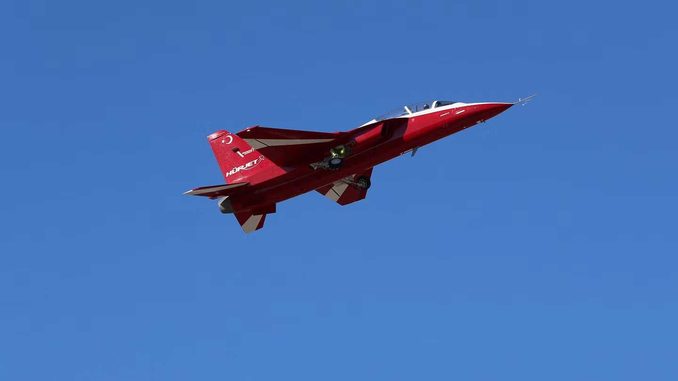
Spain is considering acquiring 45 Turkish Hürjets to replace its aging F-5 fleet. Why Madrid favors the Saeta II over European options like the M-346 and L-39 Skyfox.
In Summary
Spain is considering expanding its planned fleet of TAI Hürjet advanced trainer aircraft from 30 to 45 units. On October 14, 2026, Turkish Aerospace confirmed Madrid’s interest in an additional 15 airframes. However, no supplementary order has been formally signed.
The Saeta II program aims to replace Spain’s aging F-5M fleet with supersonic aircraft tailored to national requirements. The initial contract represents approximately 2.6 billion euros, while the Spanish government authorized a maximum budget envelope of 3.12 billion euros.
The decision to select a Turkish aircraft over European alternatives—such as Italy’s Leonardo M-346 or the Czech Republic’s L-39 Skyfox—hinges on several key factors: supersonic performance, delivery timelines, and substantial Spanish industrial participation.
Airbus Defence and Space is leading the domestic program, with 60% of industrial workshare slated for Spanish defense contractors. For Turkey, this deal marks a major breakthrough into the European military aircraft market.
Spanish Order Could Expand from 30 to 45 Aircraft
On October 14, 2026, Mehmet Demiroğlu, CEO of Turkish Aerospace, confirmed that Spain was evaluating the acquisition of 15 additional Hürjet trainers, which would bring its total fleet to 45 aircraft.
This prospect does not yet constitute a firm contract extension. According to reports by El Español, no formal request for an extension has been officially submitted by defense officials.
Nevertheless, the Spanish government had anticipated this option. In October 2025, it approved an expenditure framework of 3.12 billion euros for a program accommodating up to 45 aircraft.
The initial contract—awarded in December 2025 and finalized via an industrial agreement in April 2026—covers 30 aircraft and a comprehensive training system for approximately 2.6 billion euros.
These figures cover airframes, custom adaptations, flight simulators, ground infrastructure, and technical support. They should not be divided simply by the number of aircraft to determine individual unit costs.
Saeta II Will Replace Aging F-5M Fleet
The Spanish Air and Space Force currently operates Northrop F-5M aircraft for advanced fighter jet pilot training at Talavera la Real Air Base, near Badajoz.
These aircraft, derived from a 1960s design, have undergone modernizations but are rapidly approaching retirement. A fleet of approximately 19 units was still carrying out this training mission in 2026.
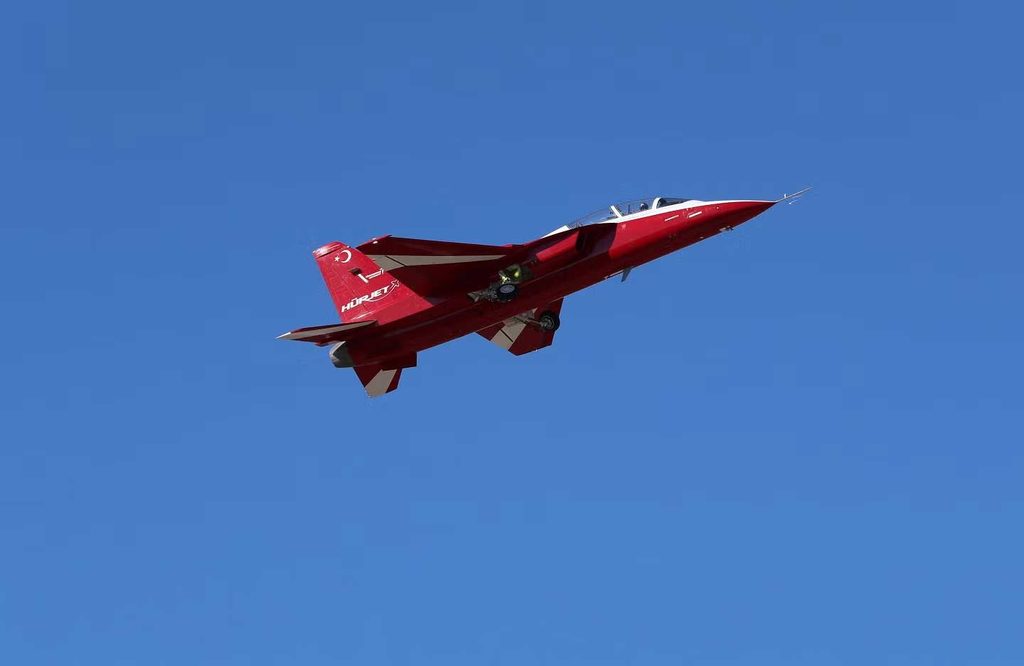
The TAI Hürjet, which completed its maiden prototype flight in April 2023, represents a completely new generation of aircraft.
The aircraft measures 13.6 m (44.9 feet) in length with a wingspan of 9.5 m (31.2 feet). Its General Electric F404-104 turbofan engine generates 78.7 kN (17,700 lbf) of thrust with afterburner.
Turkish Aerospace cites a top speed of Mach 1.4, a service ceiling of 13,716 m (45,000 feet), and a range of 1,963 km (1,060 nautical miles). The airframe is rated for load factors ranging from +8 to −3 G.
These performance characteristics allow student pilots to practice intercepts, high-speed flight profiles, and high-G tactical maneuvers close to those of frontline operational fighters.
The Saeta II program is specifically designed to prepare trainees for the digital cockpits and advanced systems of frontline platforms like the Eurofighter Typhoon.
European Aircraft Presented Credible Alternatives
The Leonardo M-346 Master Features Greater Operational Experience
The primary European competitor was the Leonardo M-346 Master, developed in Italy.
This twin-engine jet is powered by two Honeywell F124-GA-200 engines, each delivering approximately 28 kN (6,280 lbf) of thrust. It reaches a maximum true airspeed of around 1,093 km/h (590 knots) with a maximum speed limit of Mach 1.2. Unlike the Hürjet, it is not designed for sustained supersonic level flight.
Its airframe also supports +8 to −3 G load limits.
The M-346 holds a significant advantage: its integrated training system is already active across multiple air forces. It seamlessly connects ground simulators, virtual tactical scenarios, and live flight exercises.
This operational track record reduces technical risk. Therefore, Spain’s choice does not imply the Italian platform is inferior for core pilot training duties.
The L-39 Skyfox Prioritizes Reduced Operating Costs
Czech manufacturer Aero Vodochody offered the L-39 Skyfox, a modern evolution of the proven Albatros platform.
Measuring 11.83 m (38.8 feet) in length, it reaches a top speed of 907 km/h (490 knots) and has a maximum takeoff weight of 5,600 kg (12,346 lbs).
Its Williams FJ44-4M engine produces 16.86 kN (3,791 lbf) of thrust, making it lighter and less powerful than the Hürjet.
While the Skyfox provides a cost-effective solution for tactical lead-in training, its subsonic performance limits its ability to replicate high-speed combat maneuvers.
The British BAE Systems Hawk also represents a battle-tested option, albeit an older design. Meanwhile, the proposed Airbus Future Jet Trainer concept was not available within the required near-term timeframe.
The Turkish Selection Aligns with Spanish Industrial Strategy
Why did Madrid choose an aircraft developed outside the European Union over established local options?
The decision extends far beyond pure aerodynamic performance.
Spain sought a complete training system that would allow domestic defense firms to control future software updates, maintenance, and core technologies.
Turkish Aerospace agreed to a framework where Airbus Defence and Space serves as the primary Spanish contractor, guaranteeing 60% national industrial participation.
This percentage applies to the overall industrial workshare rather than strictly 60% of physical aircraft components.
Under this agreement, Indra will develop identification systems and simulator software, GMV will focus on mission computers, and Sener will participate in tactical data link integration.
As a result, Spain gains more than new airframes: it builds local expertise in systems integration, specialized training, and long-term fleet support.
However, the Hürjet’s American engine serves as a reminder that this industrial sovereignty remains partial, as components subject to US export regulations could still introduce external dependencies.
Production Will Progressively Transition to a Spanish Configuration
First aircraft deliveries are expected between 2028 and 2029.
The program initially calls for 21 aircraft built in a baseline Turkish configuration. A second batch of nine aircraft will follow, featuring progressive integration of Spanish avionics and systems.
Airbus will perform initial conversions at its Getafe facility before transferring operations to its future center in Albacete.
Between 2031 and 2035, the entire fleet of 30 aircraft is scheduled to be upgraded to the full Saeta II standard.
In parallel, Talavera la Real Air Base will receive modern simulators and instructional systems.
This architecture will allow a larger portion of syllabus training to shift toward virtual environments, reducing operational costs while enabling trainees to practice complex scenarios that are difficult to arrange in live flight.
While the Hürjet possesses light attack capabilities, this feature represents a potential future upgrade path rather than an immediate operational requirement for Spain’s Saeta II fleet.
Turkey Achieves Strategic Milestone in European Market
For Turkish Aerospace, the Spanish contract represents a major commercial victory and reference point.
The Hürjet becomes an advanced platform selected by a European Union and NATO member state, backed by the industrial partnership of Airbus.
This endorsement grants the Turkish manufacturer renewed credibility alongside established defense giants like Leonardo, Boeing, and Korea Aerospace Industries.
However, long-term commercial success will depend on meeting delivery schedules, achieving military flight certifications, and maintaining high operational readiness rates.
A potential follow-on order for 15 additional aircraft would further boost production volumes and help amortize underlying industrial investments.
This choice highlights a notable dynamic: Spain selected an airframe designed outside the European Union to build up its domestic training and aerospace integration industry. This procurement model could prove attractive to other nations seeking to modernize their military aviation capabilities without bearing the full financial burden of developing an entirely new combat drone or jet program from scratch.