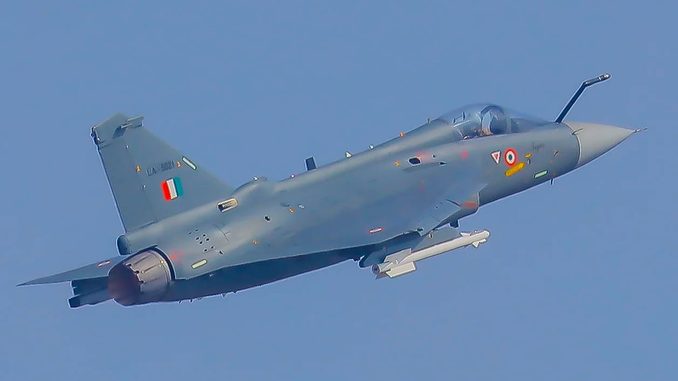
HAL promises to deliver up to 18 Tejas Mk-1A jets by March 2027. A major industrial and military challenge for an air force facing a fighter shortage.
Summary
Hindustan Aeronautics Limited (HAL) has committed to delivering between 16 and 18 Tejas Mk-1A aircraft to the Indian Air Force before March 31, 2027. This delivery is intended to allow the formation of the first full squadron equipped with this upgraded version of the Indian light fighter. According to information published on November 24, 2026, hardware issues, particularly those involving armaments, have reportedly been resolved. Final software fixes, especially those linked to the radar, remain to be completed. Originally scheduled for March 2024, initial deliveries have suffered considerable delay. This stems mainly from supply bottlenecks for American General Electric F404 engines and the complexity of integrating new electronic systems. Equipped with an active electronically scanned array radar, enhanced electronic warfare capabilities, and beyond-visual-range air-to-air missiles, the Tejas Mk-1A is meant to help renew India’s military aviation. The service now has only 29 fighter squadrons, against a target of 42.
The Tejas Mk-1A must finally enter service with the Indian Air Force
Hindustan Aeronautics Limited (HAL) is trying to emerge from an industrial crisis undermining the modernization of India’s military aviation. The state-owned manufacturer has pledged to deliver between 16 and 18 Tejas Mk-1A aircraft before March 31, 2027, the close of the Indian fiscal year. This commitment follows a meeting held on November 16, 2026, between HAL leadership and the Indian Air Force command.
The Indian military leadership nonetheless refuses to relax its operational requirements to speed up deliveries. HAL must still obtain service-entry clearances from the Centre for Military Airworthiness and Certification (CEMILAC) and the necessary industrial compliance certifications.
Receiving the first aircraft will not mean the squadron is immediately operational either. Pilot qualification, technician training, and setting up logistics support will take time.
The stakes go well beyond this initial delivery. India has ordered 180 aircraft, including 141 single-seat fighters and 39 two-seat trainers, under two contracts signed in 2021 and 2025. Their combined value exceeds 1,100 billion rupees.
Operational capabilities of the Tejas Mk-1A
Designing a multirole light fighter
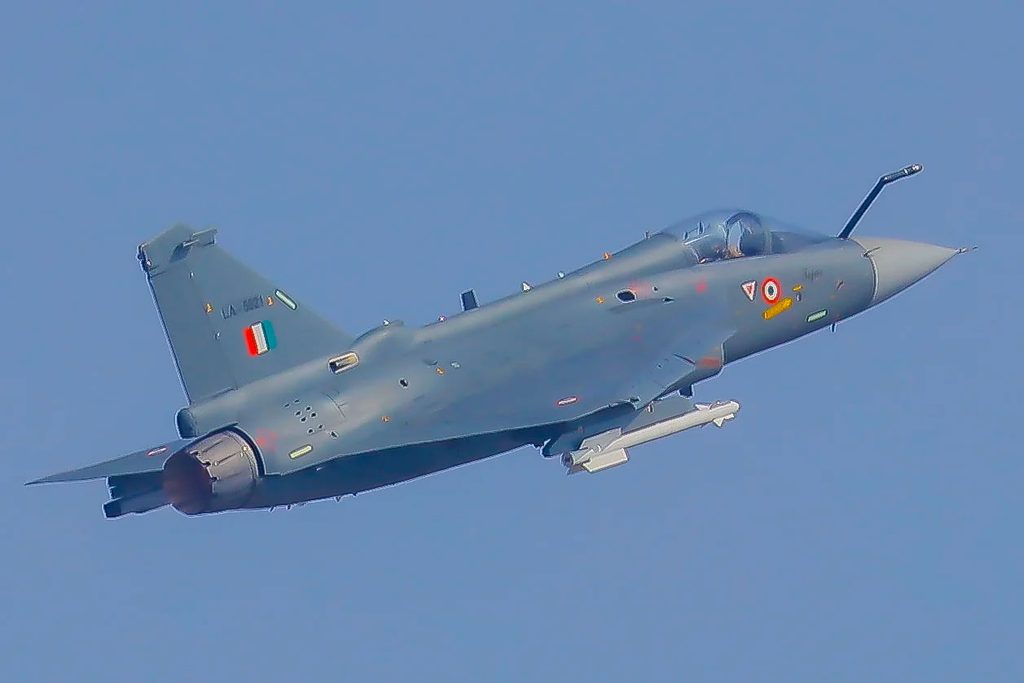
The Tejas Mk-1A belongs to the 4.5-generation combat aircraft category. Developed by the Aeronautical Development Agency (ADA) and built by HAL, it is an evolution of the Tejas Mk-1, already operated by two Indian squadrons.
The aircraft measures 13.2 meters in length with an 8.2-meter wingspan. Its maximum takeoff weight reaches 13,500 kg. Its General Electric F404-IN20 turbofan engine produces 85 kN of thrust with afterburner.
The fighter reaches Mach 1.6, or roughly 1,700 km/h at high altitude, with an operational ceiling of 15,240 meters (50,000 feet).
Its tailless delta wing and quadruplex fly-by-wire flight controls manage an airframe designed for high maneuverability. Using composite materials helps limit structural weight and corrosion.
The Tejas also features inflight refueling capability, expanding its mission options beyond territorial air defense.
AESA radar and avionics modernization
The main upgrade of the Mk-1A lies in its electronic architecture. Integrating an AESA radar is a major improvement over equipment on earlier versions.
Unlike mechanically scanned radars, an active array uses numerous electronic modules to steer its beam without physically moving the antenna. This technology improves detection speed, simultaneous tracking of multiple targets, and resistance to electromagnetic interference.
The program relies in particular on the Israeli EL/M-2052 radar developed by ELTA Systems. India also plans to progressively integrate the indigenous Uttam radar, developed by the Defence Research and Development Organisation (DRDO).
The Mk-1A gains new mission computers, multifunction displays, digital communications gear, and an upgraded identification friend-or-foe system.
Electronic warfare and armament capabilities
Electronic warfare is another modernization pillar. The Tejas Mk-1A carries equipment to detect radar emissions, warn the pilot of certain threats, and provide electronic self-protection.
The program also includes integrating the Indian Astra Mk-1 air-to-air missile, designed for beyond-visual-range combat, along with various air-to-ground munitions.
This diversification is meant to let the Tejas perform interception, air defense, close air support, and ground attack missions.
Modernization also covers maintenance. HAL wants to simplify technical servicing and boost aircraft availability. For an air force facing a fighter deficit, the number of jets actually available matters as much as the number delivered.
Reasons behind the Tejas Mk-1A program delay
Reliance on American engines
The first obstacle involves propulsion. In 2021, HAL ordered 99 F404-IN20 engines from GE Aerospace for $716 million.
The production line for this F404 variant had been idle for five years. The American engine maker therefore had to reorganize its supplier network and restart manufacturing. Pandemic-related industrial disruptions complicated the effort.
GE Aerospace delivered the first engine from this new order only on March 25, 2025, whereas the Indian Air Force was supposed to receive its first Tejas Mk-1A aircraft as early as March 2024.
This situation illustrates the limits of Indian industrial sovereignty. HAL can build the airframes, yet remains dependent on a foreign supplier for a component essential to delivering them.
In November 2025, HAL nonetheless contracted to buy 113 additional engines to support the second fighter order, with deliveries scheduled between 2027 and 2032.
Complexity of electronic systems integration
Propulsion does not explain the entire delay.
HAL also ran into difficulties validating mission software, integrating the radar, and qualifying weapons.
A modern combat aircraft relies on interoperability among numerous systems, sometimes from different manufacturers. Every modification must undergo testing and validation to ensure safety and overall compliance.
Information released in November 2026 indicates that hardware issues have been overcome. Software fixes remain to be finished, however. The March 2027 deadline therefore remains an industrial target rather than a guaranteed delivery.
Consequences of the delay for India’s military aviation
Worrying fighter squadron shortfall
The Indian Air Force currently fields 29 fighter squadrons, against an authorized strength generally cited as 42 squadrons. Its shortfall represents roughly 31% of theoretical requirements.
The permanent retirement of the MiG-21 in September 2025 worsened the situation. India must simultaneously prepare to gradually replace its Jaguar, MiG-29, and Mirage 2000.
The Tejas Mk-1A is meant to complement the capabilities of the Sukhoi Su-30MKI and the Dassault Rafale, heavier twin-engine fighters with greater payload capacity and range.
This complementarity is vital for a military power that must monitor territory of nearly 3.3 million square kilometers and account for Chinese and Pakistani air capabilities.
The challenge of serial production
HAL inaugurated its third Tejas Mk-1A production line at Nashik in October 2025. The manufacturer aims for an industrial output of around 24 aircraft per year.
At that rate, building 180 aircraft represents theoretically seven and a half years of production, excluding industrial hiccups.
India is concurrently developing the Tejas Mk-2, a heavier fighter, as well as the Advanced Medium Combat Aircraft (AMCA), its future stealth combat jet.
The credibility of those programs will depend partly on HAL’s ability to industrialize the Mk-1A. Delivering a first squadron in March 2027 would be a significant milestone. Sustaining steady production, controlling costs, and ensuring operational availability of the aircraft will then represent a far more decisive test for the future of India’s military aviation.