
How MUM-T drones, artificial intelligence, and tactical data links are transforming American, European, and Chinese fighter jets.
In Brief
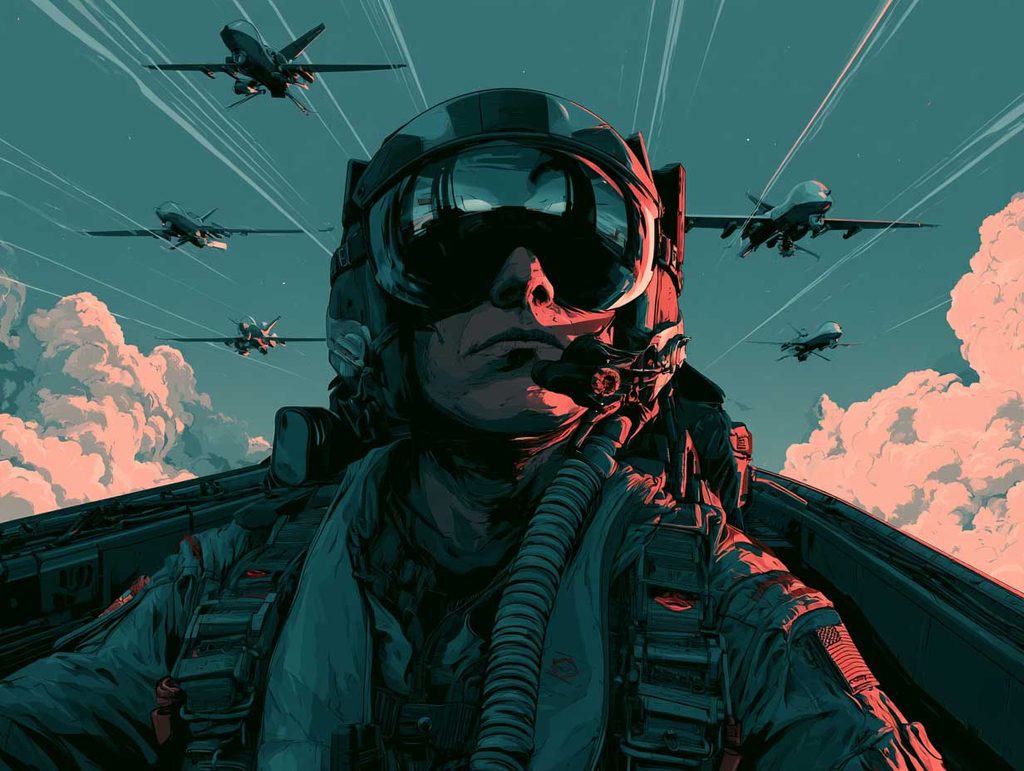
Manned-Unmanned Teaming (MUM-T) enables a fighter jet to cooperate with drones capable of executing missions under human supervision. The goal is no longer to remotely pilot each aircraft, but to share reconnaissance, jamming, and strike roles across multiple connected platforms.
In the United States, General Atomics, Anduril, and Shield AI reached new milestones in 2026: an F-22 directed a Fury in flight, and two Furys subsequently performed coordinated maneuvers. As early as December 2025, Australia demonstrated a live air-to-air missile shot from its MQ-28 Ghost Bat.
In Europe, Airbus, Dassault Aviation, Thales, Saab, and Helsing are developing complementary architectures. China already possesses a credible stealth drone, the GJ-11, publicly paired with the J-20 and J-16D. However, Beijing remains far less transparent regarding its software and communications. At this stage, the Western advantage rests more on verifiable performance than on the sheer number of drones unveiled.
MUM-T Turns the Fighter Jet Into the Conductor of a Formation
MUM-T, or cooperation between manned and unmanned aircraft, relies on three distinct functions: sharing information, assigning tasks, and allowing each drone to execute its own maneuvers. The Americans call their new collaborative combat drones Collaborative Combat Aircraft (CCA); the term loyal wingman refers more broadly to an accompanying drone.
A pilot can instruct a drone to scout an area without manually controlling its speed, altitude, or every turn. The software calculates a flight path within safety constraints. This mission autonomy differs from automated authorization to deploy a weapon.
Sensor Fusion Builds a Common Tactical Picture
An AESA radar provides ranges and relative speeds; an infrared sensor detects thermal signatures; an electronic warfare receiver picks up radar emissions. Computers merge these observations, correct for timing discrepancies, and estimate the uncertainty of each track.
A target tracked by a drone can thus be designated to another aircraft without the fighter emitting with its own radar.
The problem becomes more difficult when sensors do not see the same target or transmit outdated coordinates. Faulty fusion can generate a false track: data quality matters just as much as computing power.
Data Links Determine Jamming Resistance
Link 16 exchanges tracks and tactical messages among allied aircraft. The F-35’s MADL prioritizes covert communications between compatible aircraft. Neither network alone constitutes a universal command system for CCAs. Dedicated interfaces, gateways, and strict encryption management are required.
Directional transmissions, mesh networks, and low-probability-of-intercept waveforms limit electromagnetic exposure.
If the link drops, the drone must continue an authorized task, avoid collisions, or return to a recovery zone. Resilience in a contested environment remains the decisive test.
The United States Has the Most Publicly Advanced Ecosystem
The U.S. Air Force is developing General Atomics’ FQ-42 Vengeance and Anduril’s FQ-44 Fury. In June 2026, it announced contracts targeting more than 150 CCAs by the end of the decade, with an eventual fleet objective of around 1,000 aircraft.
Six vendors are competing on autonomy software: Anduril, General Atomics, Lockheed Martin, Northrop Grumman, RTX Collins Aerospace, and Shield AI.
On October 8, 2026, an F-22 Raptor pilot transmitted tactical instructions to a Fury in flight. Shield AI’s Hivemind software converted them into maneuvers.
On October 26, two Furys coordinated their flight paths to simulate beyond-visual-range air combat under the supervision of a ground operator. The engagement was conducted against a virtual threat.
Open Architecture Allows Switching Software Pilots
The Autonomy Government Reference Architecture (A-GRA) separates tactical autonomy from each airframe’s specific flight controls. In February 2026, a Fury even switched mid-flight between Hivemind and Anduril’s Lattice software.
This decoupling streamlines upgrades and prevents locking the military into a single vendor.
In July, the Fury live-fired an AIM-120 against a digital target. The test validated part of the kill chain, though not the destruction of a real aircraft.
Australia Demonstrated a Complete Engagement Chain
On December 9, 2025, Boeing’s MQ-28 Ghost Bat destroyed a target drone with an AIM-120 missile over Woomera.
An F/A-18F Super Hornet detected and tracked the target; an E-7A Wedgetail supervised the drone and authorized the shot. The MQ-28 repositioned prior to the engagement. Boeing had already announced 100 test flights by March 2025.
This sequence proves that a MUM-T system can link detection, transmission, human decision-making, and interception. It does not yet prove resilience against a prolonged electronic warfare campaign.
Europe Advances With Less Integrated Systems
In 2022, Airbus linked two fighters, a helicopter, and five drones during an exercise in Finland. Its CANDL mesh data link distributed information; its work on Remote Carriers targets reconnaissance and jamming.
Airbus is also collaborating with Helsing on a loyal wingman drone intended notably for the Eurofighter.
Saab and Helsing demonstrated another approach in 2025: the Centaur agent flew certain combat maneuvers on a Gripen E under supervision. The third test pitted it against a real Gripen D. This represents progress in onboard autonomy, though not yet multi-drone command.
France is preparing the Rafale F5 and the HypAIRion program. Thales is developing the covert IVDL data link, the RBE2-XG radar, and a digital evolution of SPECTRA; Dassault Aviation is developing a stealth drone building on lessons from the nEUROn.
Qualification of the F5 is targeted around 2033. Europe’s challenge, therefore, is not a lack of expertise, but transitioning from scattered demonstrators to operational units.
China Has Stealth Platforms, but Little Evidence on Their Networking
Chinese industry follows a different logic. AVIC, notably Hongdu, is developing the GJ-11 stealth drone, a flying wing equipped with two internal weapons bays.
Images released on November 9, 2026, reveal its dorsal air intake, shielded exhaust, and an electro-optical sensor under the nose. Beijing claims a successful air-to-ground strike, without providing the date, munition, or independent verification.
As early as November 2025, the PLAAF showed a GJ-11 flying alongside a Chengdu J-20 and a Shenyang J-16D electronic warfare aircraft. The two-seat J-20S is touted as a candidate for drone command.
CASC, through Aerospace Times Feihong Technology, is also developing the FH-97A loyal wingman concept, intended for reconnaissance and suppression of enemy air defenses. No flight of this model has been publicly confirmed.
These aircraft rend credibility to several scenarios: sending a stealth scout ahead of a fighter, locating surface-to-air missile batteries, or generating decoy tracks to saturate enemy defenses.
However, flying in formation does not prove collaborative autonomy. Protocols, data rates, transmission delays, jamming resistance, and the number of controllable aircraft remain unknown.
True Leadership Will Be Measured Under Jamming
At the end of 2026, the documented advantage goes to the United States for collaborative software control and to Australia for live interception. Europe masters key building blocks, but its ramp-up remains slower. China fields operational stealth drones according to its own statements, without an equivalent public demonstration of autonomous coordination.
The next breakthrough will not be flying one more drone. It will come from a formation capable of continuing its mission when communications degrade, distinguishing decoys from real targets, and giving humans a reliable engagement decision.
It is this level of trust, rather than aircraft silhouettes, that will separate leading air powers.