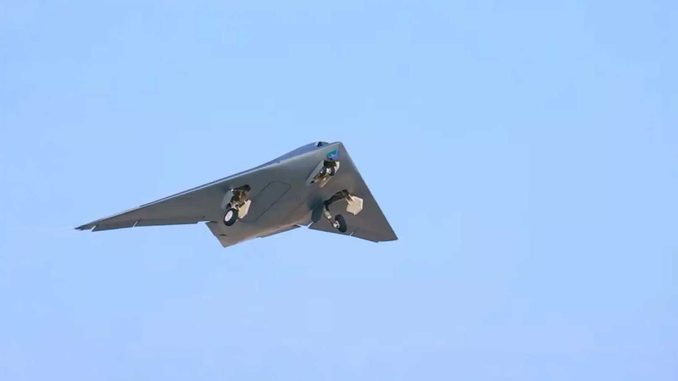
China reveals the weapon bays and sensors of the GJ-11 and announces a first successful live fire. The footage sheds light on its stealth features and its role alongside fighter jets.
Summary
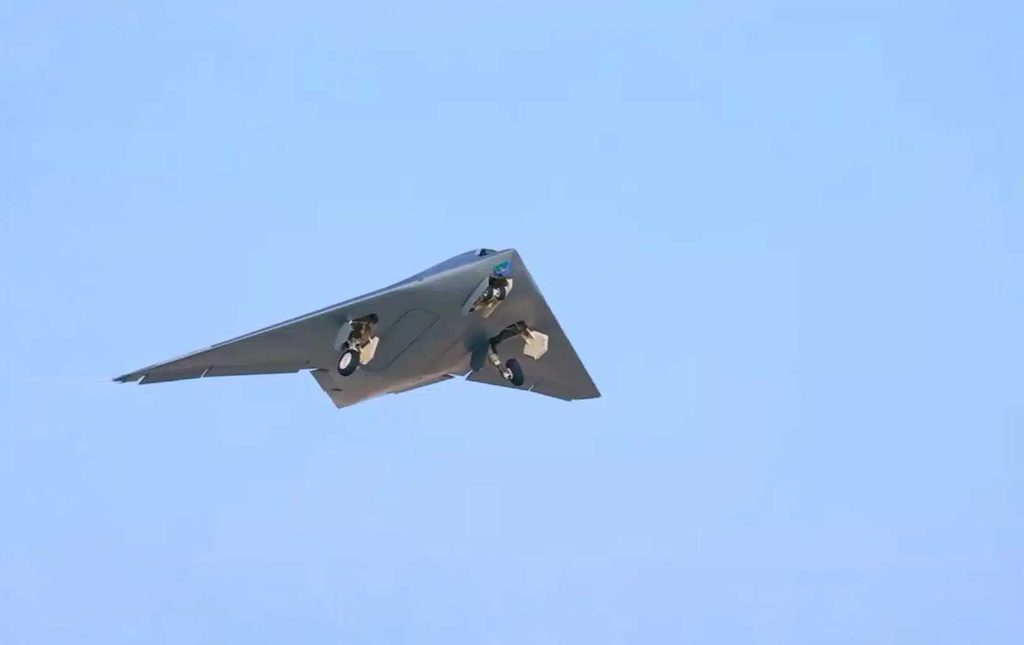
On November 9, 2026, two days before the 77th anniversary of the People’s Liberation Army Air Force (PLAAF), CCTV broadcast the most detailed footage to date of the GJ-11 Xuanlong, also known as Sharp Sword. The Chinese stealth combat drone is seen taking off, retracting its landing gear, with its two internal weapon bays, dorsal air intake, masked exhaust, and an optical device under the nose. Beijing also claims that two female operators, Shi Xiaoran and Fu Ting, carried out its first successful live fire. The target, initially obscured by clouds, was reportedly reacquired after another pass. This claim remains impossible to verify independently. The stakes go beyond the strike itself: China now presents the GJ-11 as a partner to J-20 and J-16 fighters, capable of reconnoitering enemy defenses and paving the way for an attack. Its reported entry into service in November 2025 and its deployments in Tibet point to an advanced program, without revealing its true scale.
Chinese Television Finally Shows an Operational Aircraft
The footage broadcast on November 9 is not the first appearance of the GJ-11 Xuanlong. Unveiled during the 2019 Beijing military parade and later displayed as an armed mockup at the 2021 Zhuhai Airshow, this aircraft developed by Hongdu had long remained poorly documented. In November 2025, the PLAAF announced its entry into service and showed it flying in formation with a Chengdu J-20 and a Shenyang J-16D.
This time, the cameras get close to the actual airframe. Belly views and takeoff footage allow a closer look at previously hidden features. However, they provide neither certified range figures, nor maximum payload capacity, nor the number of drones in service. The performance figures commonly circulated in unofficial specification sheets do not constitute validated manufacturer data.
The Gongji-11 (GJ-11) belongs to the UCAV category—unmanned aerial vehicles designed for combat missions. Its flying-wing architecture prioritizes the penetration of defended airspace over the speed or maneuverability of a traditional fighter.
Weapon Bays and Sensors Reveal the Stealth Logic
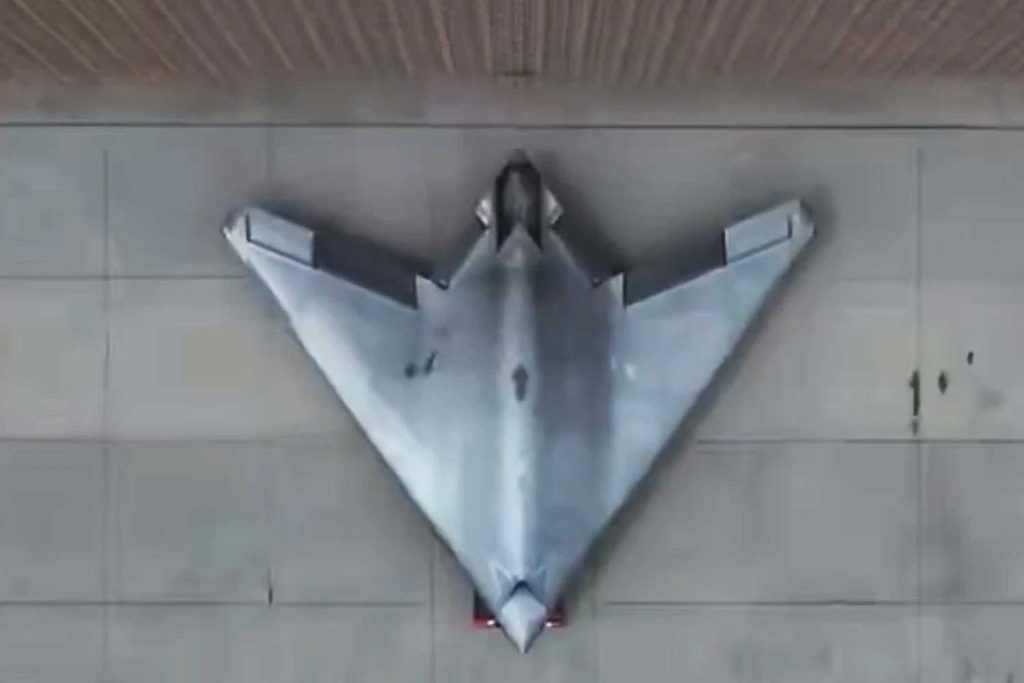
The main takeaway concerns two internal weapon bays, integrated beneath the flying wing between the main landing gear legs. Their doors feature serrated edges designed to scatter radar reflections. Most importantly, internal carriage eliminates external pylons and bombs, which would increase radar cross-section and aerodynamic drag.
A 2021 mockup had already shown several guided bombs inside these compartments. The 2026 video confirms their presence on a real aircraft, though without identifying certified munitions. The War Zone estimates that each bay could accommodate munitions weighing 450 to 900 kg (1,000 to 2,000 lb), a hypothesis that remains to be confirmed.
The top-mounted air intake limits the direct exposure of certain engine components to radar looking up from below. At the rear, the flattened, masked exhaust is designed to reduce—though not eliminate—radar and infrared signatures.
Beneath the nose, a faceted window suggests an electro-optical and infrared (EO/IR) sensor used to observe and designate targets without emitting signals like a radar. Its exact performance remains unknown. The landing gear, shown retracting, rounds out this technical showcase.
The absence of a vertical tail also eliminates surfaces likely to reflect radar waves. However, it requires demanding aerodynamic control, managed by flight control computers and the wing’s movable control surfaces.
Announced First Live Fire Confirms Ambition, Not Full Autonomy
According to CCTV, Shi Xiaoran and Fu Ting, two servicewomen from the first female class trained by the PLAAF on this system, took part in a live-fire mission. Their conversion training reportedly lasted five months. Shi Xiaoran explained that clouds initially obscured the target. After flying another circuit, she reportedly reacquired it and hit it on the first drop.
The episode illustrates a mission-management chain capable of reassessing a situation, but it does not demonstrate automatic target recognition. The footage shows the drone being controlled from a mobile shelter, where training sessions regularly exceed six hours.
Beijing released neither the date and location of the strike, nor the type of munition used, nor an independent assessment of the outcome. Referring to the “first live fire” must therefore remain an official claim, especially since the aircraft has been undergoing flight tests for years.
Manned Fighters Could Delegate the Riskiest Missions
Collaborative aerial combat, or manned-unmanned teaming, is CCTV’s other key message. The GJ-11 could fly ahead of a J-20 to observe, relay target coordinates, or strike a radar site while limiting the pilot’s exposure to danger.
The Shenyang J-16 can provide payload capacity and complex mission coordination; its Shenyang J-16D variant specializes in jamming and electronic warfare.
Suppression of Enemy Air Defenses, known as SEAD, involves more than simply destroying a surface-to-air missile system. It also means detecting it, disrupting its emissions, or forcing it to shut down surveillance.
A stealth drone can provoke an enemy reaction, gather intelligence, and transmit target designation data. It could also fire on its own if authorized to do so.
However, a filmed formation flight proves neither a jam-resistant data link, nor cockpit control of the drone, nor autonomous firing decisions. Those capabilities remain to be documented.
Tibet and the Navy Show Ambition Beyond Demonstrations
The observed activity predates the CCTV broadcast. Commercial satellite imagery identified three GJ-11s at Shigatse, in Tibet, between August 6 and September 5, 2025.
Located at an altitude of roughly 3,780 meters (12,400 feet), this airbase imposes specific constraints on engine thrust, takeoff performance, and technical support. This deployment of GJ-11 stealth drones in Tibet suggests advanced operational evaluations, without proving permanent front-line unit readiness.
The naval GJ-21 variant further expands the program. On October 30, 2026, state media announced its first takeoff and landing aboard the Sichuan, a Type 076 amphibious assault ship displacing more than 40,000 tons and equipped with electromagnetic catapult and arresting gear technologies.
Janes noted, however, that no verifiable video of these maneuvers had been published: the visuals released were apparently computer-generated.
The Real Edge Will Be Measured in Networked Combat Capability
Beijing now has tangible evidence of a family of stealth UCAVs intended for reconnaissance and strike missions. The presence of aircraft at multiple bases and visual confirmation of the weapon bays mark concrete progress.
On the other hand, autonomy, communications reliability, and production scale remain opaque. It is on these factors—far more than on footage released for a military anniversary—that China’s advantage over Western collaborative combat aircraft programs will be decided.