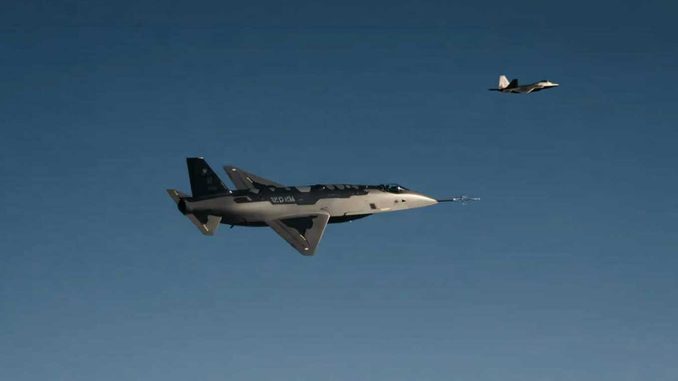
Two FQ-44A Fury drones conducted a coordinated aerial combat exercise powered by Hivemind AI—a step forward for future U.S. autonomous squadrons.
Summary
On November 9, 2026, Shield AI announced a new milestone in the U.S. Air Force’s Collaborative Combat Aircraft (CCA) program. On October 26, two Anduril FQ-44A Fury drones flew in formation and executed coordinated beyond-visual-range aerial combat maneuvers using the Hivemind autonomy software. Conducted in Nevada, the exercise pitted the aircraft against a virtual threat under the supervision of a ground operator. It builds on an October 8 test in which an F-22 Raptor pilot transmitted tactical instructions to a Fury in flight. These demonstrations progressively validate cooperation between autonomous aircraft, though not yet their readiness for real combat. Washington now plans to field at least 500 CCAs by 2032, out of a target fleet of roughly 1,000 aircraft. China, Australia, and Turkey are also developing comparable capabilities, opening up a major technological and industrial race.
The Two Furys Conduct Their First Coordinated Aerial Combat
On October 26, 2026, two FQ-44A Furys took off for an experimental mission at the Nevada Test and Training Range. Their objective was to execute coordinated maneuvers against a virtual aerial threat in a long-range combat scenario.
According to Todd Wesley, head of Hivemind engineering at Shield AI, the two aircraft carried out a complete air-to-air tactical engagement. A ground operator issued high-level directives, and the onboard software then determined the required actions.
The breakthrough does not lie in simple formation flying; several drones are already capable of maintaining relative position. The real progress lies in autonomous tactical coordination: the aircraft must adapt their flight paths and behaviors to a shared mission.
The Fury is a jet-powered drone developed by Anduril Industries. Its experimental variant carries the designation YFQ-44A, while FQ-44A designates the production model. Alongside General Atomics’ FQ-42A Vengeance, it forms the first generation of unmanned fighters selected by the U.S. Air Force.
BVR Tactics Rely on Coordinating Trajectories and Threats
Beyond Visual Range (BVR) combat refers to an aerial engagement conducted beyond direct line of sight. It relies on radars, passive sensors, data links, and guided missiles.
In this environment, two autonomous drones can exploit different positions to complicate an adversary’s defense.
Role Allocation Changes Interception Tactics
A classic tactic involves splitting two aircraft to approach a threat from multiple angles. This maneuver, known as a bracket, forces the adversary to monitor several directions simultaneously.
One drone can maintain a trajectory that preserves target tracking while a second seeks a more advantageous firing position. The two aircraft must then coordinate their speed, altitude, and engagement zones.
Cooperation can also enable the distribution of multiple targets, prevent redundant missile launches, or preserve the formation’s defensive capabilities.
These examples illustrate the potential applications of collaborative BVR tactics. However, Shield AI did not disclose the exact maneuvers executed on October 26, nor the engagement distances or the nature of the data exchanged.
No missiles were fired during the exercise. It was a simulated interception involving two live aircraft operating against a virtual threat.
Hivemind Software Translates Human Orders into Tactical Decisions
Developed by Shield AI, Hivemind is a mission-autonomy system designed to pilot and coordinate unmanned military platforms.
Its operation relies on multiple layers. The system receives a mission and processes available environmental information. It then selects behaviors compatible with mission objectives and safety constraints before sending the necessary commands to the flight control systems.
In a multi-drone formation, each aircraft runs its own autonomy software. Coordination requires maintaining a sufficiently shared understanding of the tactical picture.
The goal is to reduce the number of human inputs. An operator should be able to assign a mission without individually commanding every course change.
Shield AI also develops machine-learning and simulation tools to train its autonomous agents. Hivemind is designed to operate in environments where communications or GPS are degraded.
This advertised capability does not mean the October tests validated cooperation without a data link.
The U.S. Autonomy Government Reference Architecture (A-GRA) also facilitates separating mission software from aircraft-specific flight functions. This allows the U.S. Air Force to evaluate multiple autonomy providers without relying exclusively on a single manufacturer.
Shield AI states that it has integrated the Hivemind software core into more than 40 unmanned systems across multiple operational domains.
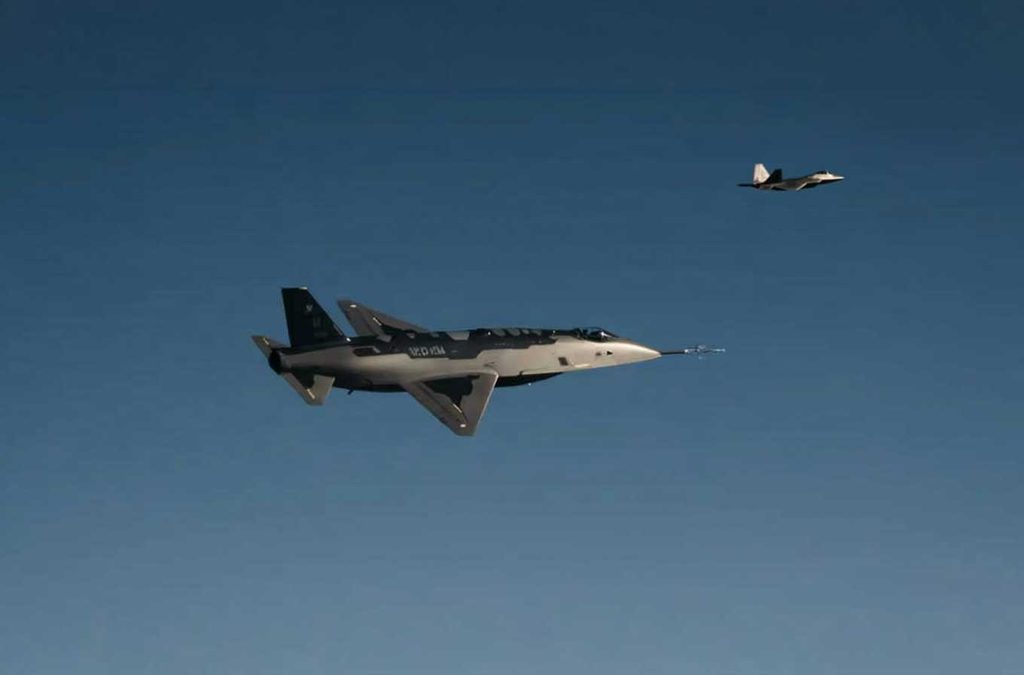
The F-22 Raptor Becomes the Quarterback of Autonomous Drones
The October 26 test follows a demonstration conducted on October 8 at Edwards Air Force Base in California.
During that trial, a Lockheed Martin F-22 Raptor pilot transmitted high-level directives to an FQ-44A Fury. Hivemind interpreted and executed them in real time, enabling the drone to perform simulated combat maneuvers and tasks.
This experiment introduces the concept of an airborne quarterback.
The pilot defines tactical intent, while the drone organizes its execution.
This division of labor is critical. A fighter pilot cannot individually manage flight commands for multiple aircraft while simultaneously monitoring threats, sensors, and weapons.
The U.S. Air Force has discussed formations of two to five drones per fighter—and up to eight in certain scenarios. These ratios remain experimental targets rather than proven operational capabilities.
The United States Prepares a Fleet of One Thousand Autonomous Fighters
On September 14, 2026, Secretary of the Air Force Troy Meink announced a goal of at least 500 CCAs in service by 2032.
The broader ambition calls for approximately 1,000 CCAs, though without a uniform deadline for the entire fleet. It is paired with a separate program targeting 500 Massed Modular Aircraft—less complex drones intended primarily for reconnaissance and strike missions.
The first production contracts for the FQ-42A and FQ-44A were awarded in June 2026, with an initial target of more than 150 aircraft before the end of the decade.
The stakes are economic as well as military. Early U.S. estimates put the cost of a CCA airframe at roughly $20 million, excluding certain mission systems.
In the Collaborative Combat Aircraft concept, mass production is meant to multiply sensing and firing platforms without proportionally increasing pilot numbers.
A CCA could thus carry additional missiles, cover a distant sector, or expose itself to threats that commanders would avoid imposing on a manned fighter.
China, Turkey, and Australia Are Already Challenging the U.S. Lead
The United States does not hold a monopoly on autonomous air combat.
China is developing the GJ-11 Xuanlong, a stealth flying-wing drone showcased operating alongside J-20 and J-16 fighters. Footage released on November 9, 2026, highlighted its internal weapon bays and sensors, though its true level of collaborative autonomy remains poorly documented.
Australia reached a different milestone in December 2025. Its MQ-28A Ghost Bat destroyed an aerial target using an AIM-120 missile in cooperation with an E-7A Wedgetail and an F/A-18F Super Hornet.
Turkey has also posted notable results. The Bayraktar KIZILELMA completed a successful BVR live fire against an aerial target in November 2025, followed by two prototypes flying in autonomous formation on December 27.
In Europe, France plans to field a collaborative demonstrator in 2028 ahead of the Rafale F5 standard expected in 2033. The United Kingdom already operates StormShroud, primarily dedicated to electronic warfare.
The October 26 U.S. milestone therefore applies specifically to the U.S. Air Force’s CCA program, rather than representing a world first in autonomous formation flight.
Future Superiority Will Depend on Autonomy in Contested Environments
The U.S. tests demonstrate rapid progress. Within three weeks, the U.S. Air Force moved from controlling a single drone from an F-22 to coordinating two autonomous aircraft against a simulated threat.
Yet the decisive challenges still lie ahead: jammed communications, reliable target identification, coordination of larger formations, and live-fire integration.
Shield AI plans specifically to increase the complexity of engagements and the number of participating aircraft.
The real advantage will not necessarily go to the country fielding the highest-performing individual drone. It will belong to the nation capable of operating hundreds of autonomous aircraft as a cohesive force, with limited human intervention, controlled costs, and proven effectiveness against modern air defenses.