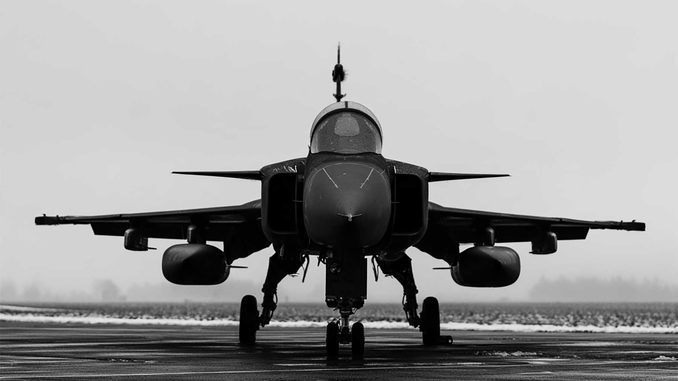
Saab launches its AI Fighter Pilot Academy to train artificial pilots on the Gripen E and prepare for tomorrow’s autonomous air combat.
Summary
On November 3, 2026, at the International Fighter Conference in Munich, Saab unveiled its AI Fighter Pilot Academy, a program designed to develop, train, and qualify artificial intelligence agents capable of participating directly in air combat missions.
The Swedish manufacturer claims to have already flown its own algorithms on the Gripen E, particularly in beyond-visual-range combat scenarios. These tests build upon trials conducted in 2025 with Centaur, an artificial intelligence system developed by the German defense firm Helsing.
The Academy relies on massive simulations, machine learning, and real-world flight trials. Saab aims to convert this research into a scalable industrial capability, applicable to both crewed aircraft and future combat drones.
The goal extends beyond pilot assistance. Saab is laying the groundwork for a military aviation era where manned and autonomous aircraft coordinate tactical decisions within a single unified force.
Saab Unveils a New Generation of Artificial Pilots
In Munich in early November 2026, Saab presented a major new milestone in its work on military artificial intelligence. The Swedish defense manufacturer is no longer merely integrating experimental algorithms into its aircraft; it is now developing its own AI agents alongside the industrial infrastructure required to train them.
Peter Nilsson, Head of Advanced Programs at Saab Aeronautics, explained that development teams have been working on these agents for about two years. Several have already flown aboard the Gripen E, executing autonomous maneuvers during Beyond Visual Range (BVR) air combat scenarios.
Unlike standard decision-support software, an AI agent can analyze a tactical situation, select an action, and control specific aircraft functions within a defined parameters framework.
Saab considers this technology essential for future air combat systems that will pair manned fighters with autonomous platforms.
The AI Fighter Pilot Academy Forms a True Industrial Training Pipeline
While the name evokes a military flight school, the AI Fighter Pilot Academy (AIFPA) hosts no human students.
It is an infrastructure dedicated to the development, learning, and validation of autonomous software. Saab aims to apply a methodology to artificial agents comparable to military pilot training: skill acquisition, progressive training, exposure to complex tactical scenarios, and evaluation prior to operational certification.
The program follows four main phases:
The first phase consists of mission definition. Military specialists identify expected tactical decisions: detecting a threat, selecting an interception vector, maintaining a favorable tactical position, or avoiding an disadvantageous engagement.
The second phase relies on digital training. Agents operate in combat simulations that replicate the physical characteristics of aircraft, sensors, and weapons.
The third phase tests algorithms under degraded conditions: electronic jamming, loss of data links, contradictory information, or unexpected adversary behavior.
The final phase involves verification of results and real-world flight trials.
The industrial stake is significant. Saab wants to train multiple agents simultaneously, then reuse validation tools across different missions and platform types.
Reinforcement Learning Enables Simulation of Millions of Combat Hours
The primary technology leveraged is Reinforcement Learning.
An agent receives an objective and attempts various actions within a simulated environment. Its decisions are evaluated against criteria set by engineers: favorable behavior is reinforced, while tactical mistakes are penalized.
In a BVR air combat scenario, the algorithm must factor in enemy position, speed, altitude, missile performance, and detection ranges.
A missile like the Meteor does not have a fixed effective range: its lethality depends on available energy, launch conditions, and the target’s evasive maneuvers.
The agent must therefore learn to seek a favorable firing solution while preserving its own survivability.
Through millions of simulated flight hours, it can explore scenario variables that are physically impossible to replicate at scale in real life.
However, this digital experience carries a limitation: an agent that performs well in simulation may fail when confronted with real-world behavior improperly represented in its training environment.
The Sferical AI Supercomputer Aims to Dramatically Accelerate Training
Saab relies on Sferical AI, a sovereign Swedish computing infrastructure developed with industry partners including Ericsson and AstraZeneca.
Inaugurated in October 2026 in Linköping, the supercomputer is based on a NVIDIA DGX SuperPOD architecture equipped with 1,152 NVIDIA GB300 GPUs.
According to Peter Nilsson, previous infrastructure allowed roughly 1,200 iterations of a one-hour simulation. The new processing power could theoretically reach up to one billion simulated hours for an equivalent scenario.
This industrial estimate does not imply that an agent automatically acquires a billion hours of relevant experience. Scenario diversity, realism, and evaluation quality remain the deciding factors.
For Saab, this raw compute power is primarily meant to compress the timeframe between identifying a new threat and deploying software capable of countering it.
2025 Trials with Helsing Demonstrated the Feasibility of Autonomous Combat
This new initiative builds on Project Beyond, conducted alongside the German firm Helsing under a contract with the Swedish Defence Materiel Administration (FMV).
On May 28 and June 3, 2025, three test flights were conducted using Centaur, the air combat agent developed by Helsing.
During the trials, a Saab Gripen E delegated certain controls to Centaur. The AI executed autonomous tactical maneuvers, evaluated firing opportunities, and engaged in dogfights against a human-piloted Gripen D.
The safety pilot inside the Gripen E retained the ability to override controls at any time. No live missile firings were conducted.
System integration had taken less than six months.
In November 2026, Saab took another step forward by announcing flights conducted with its own internal agents. However, the manufacturer has not released the exact number of sorties, flight dates, or comparative performance metrics.
Gripen E Architecture Facilitates AI Integration
Modern fighter jets like the Gripen E feature computing architectures tailored specifically for continuous software evolution.
Its mission avionics are strictly separated from flight-critical safety functions. This structural separation allows engineers to integrate new tactical software without modifying primary flight controls.
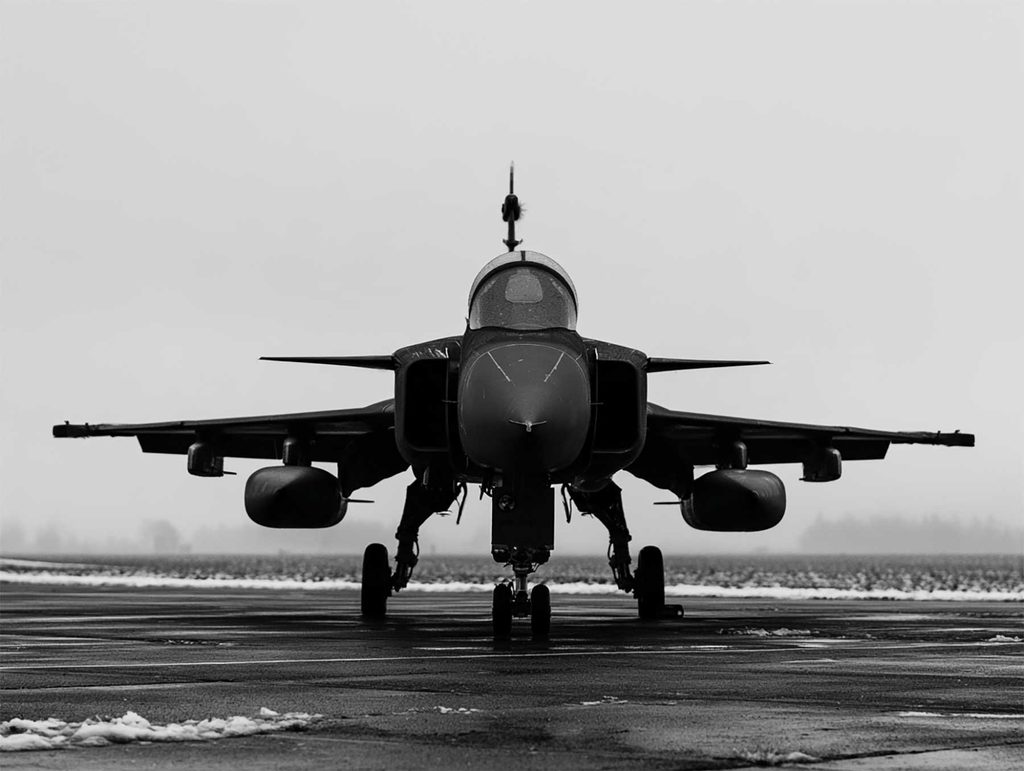
The Gripen E measures 15.2 meters in length, has a maximum takeoff weight of 16,500 kg, and is powered by a General Electric F414G turbofan generating approximately 98 kN of maximum thrust.
It carries a Raven ES-05 AESA radar, an IRST infrared search and track sensor, electronic warfare suites, and tactical data links.
These systems supply the data stream necessary for the AI agent to build a clear representation of the air situational picture.
The architecture also enables software testing directly on an operational combat aircraft, avoiding the need to develop dedicated experimental testbeds.
Future Agents Will Cooperate with Pilots and Drones
Saab’s vision extends well beyond individual dogfighting.
Future agents will need to share tactical data and coordinate actions across multiple platforms. A Gripen E could potentially command crewless aircraft assigned to reconnaissance, electronic warfare, or suppression of enemy air defenses (SEAD).
This evolution requires an AI capable of understanding a collective mission rather than optimizing maneuvers for a single airframe.
Saab is also studying the integration of reinforcement learning with large language models and world models capable of representing complex tactical situations and predicting their evolution.
The company is evaluating operational applications for its GlobalEye airborne early warning aircraft and future uncrewed systems.
These prospects mirror French initiatives focused on collaborative combat capabilities between military aviation assets, even if the underlying architectures and target levels of autonomy differ.
The Swedish Program Prepares 2030s Air Combat Systems
On September 9, 2026, Saab secured a contract from FMV worth approximately 2.9 billion Swedish kronor (around €270 million) to continue research and technology demonstrators for future air combat systems between 2026 and 2028.
This funding covers the broader future combat system program rather than exclusively funding the AI Fighter Pilot Academy.
Saab also unveiled its A3-001 combat drone concept in August 2026, designed for high-risk missions alongside manned fighters.
The manufacturer plans to fly autonomous technology demonstrators before 2030. The A3 concept could eventually yield an operational platform in the mid-2030s, subject to approval from the Swedish government.
Peter Nilsson estimates that initial AI agents could join an operational test unit within a timeframe ranging from a few months to a few years.
This timeline remains contingent on validation and formal adoption by armed forces.
The real challenge is no longer demonstrating that artificial intelligence can fly a fighter jet. Saab must now prove it can do so reliably, safely, and repeatedly within an unpredictable combat environment.
The AI Fighter Pilot Academy represents a structured attempt to solve that challenge. The success of the program could fundamentally reshape the training, organization, and operational deployment of air forces over the coming decade.