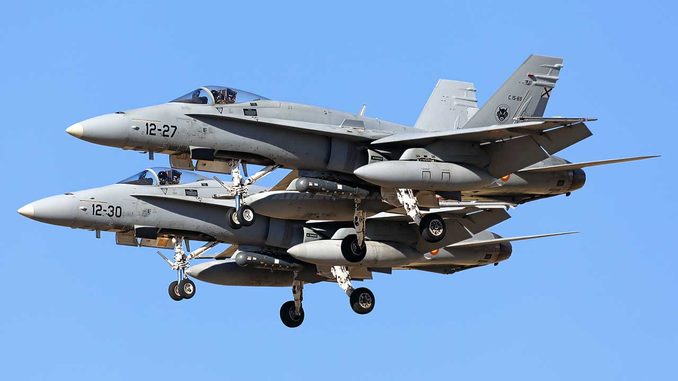
Spain is preparing its F/A-18s to fly until 2040 following the failure of the FCAS project. Missions, modernization, costs, and strategy to replace its fighter fleet.
Summary
Spain is preparing to extend the service life of its McDonnell Douglas F/A-18 Hornet fighters until the 2035–2040 horizon. Initially targeted around 2030, their retirement had already been pushed back to 2035. This new timeline responds to a strategic difficulty: Madrid still lacks a clearly identified successor for its entire fleet.
The cancellation, in June 2026, of the joint combat aircraft project under the FCAS program—developed alongside France and Germany—has deepened this uncertainty. Additional Eurofighters ordered under the Halcón program will replace part of the fleet, but will not provide a sixth-generation capability.
Spain is therefore investing in the maintenance of its Hornets while continuing research into future air combat technologies. The country must now balance three imperatives: preserving its operational capabilities, limiting aging costs, and selecting a new industrial partner.
The Spanish Ministry Prepares Its F/A-18s to Fly Until 2040
The Spanish Ministry of Defence plans to keep its F/A-18 Hornet fighters in service until 2035–2040, nearly ten years beyond the original retirement schedule.
This direction was confirmed in a parliamentary response on February 23, 2026. The government acknowledged that the extension requires adapting maintenance assets, test equipment, and the supply chain.
The decision does not mean all aircraft will fly until 2040. Retirement will depend on structural health, availability, and the actual delivery of replacement assets.
The timeline rests on an industrial constraint. Following the abandonment of the shared FCAS fighter in June 2026, Madrid can no longer rely on the Franco-German-Spanish program to renew its fleet within the timeframe originally planned. Spain has also not ordered the Lockheed Martin F-35.
F/A-18s Remain Essential to Spanish Combat Aviation
Spain has operated the McDonnell Douglas F/A-18 Hornet since 1986. Madrid ordered 72 aircraft in 1983, including 60 single-seat F/A-18As and 12 two-seat F/A-18Bs under the FACA program.
These fighters gradually replaced the McDonnell Douglas F-4 Phantom II. A second fleet, consisting of second-hand American aircraft, was subsequently assigned to air defense in the Canary Islands.
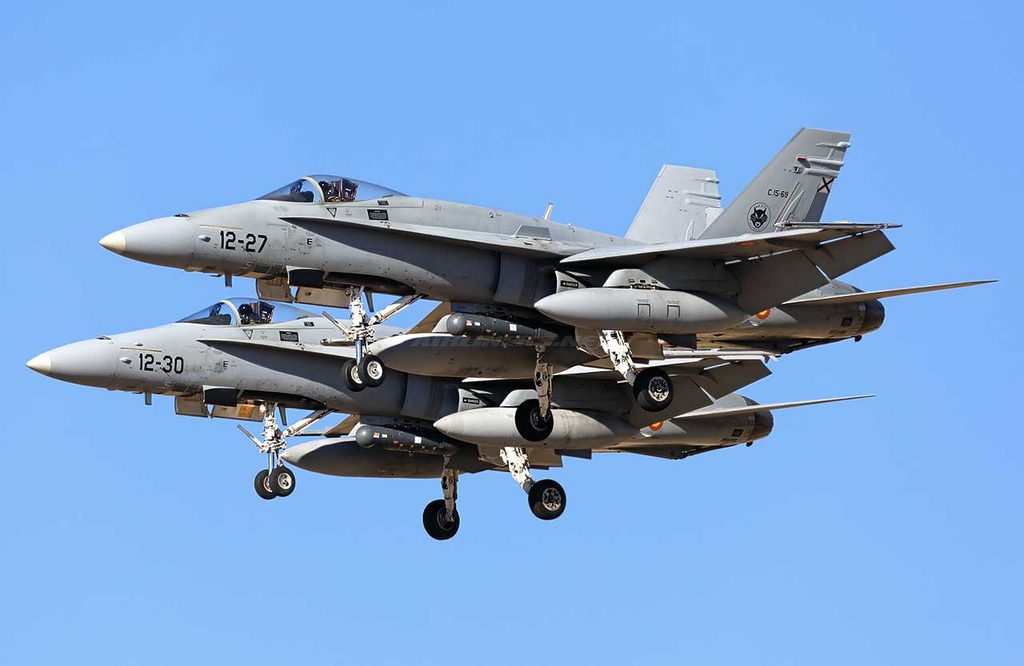
The modernized Hornets, designated EF-18M or C.15M, are today concentrated in two main units:
- Ala 12, stationed at Torrejón de Ardoz near Madrid.
- Ala 15, based at Zaragoza in northeastern Spain.
These units carry out air defense, interception, combat training, and ground-attack missions. They also participate in NATO operations.
Their operational value remains tangible. On August 16, 2026, two EF-18Ms from Ala 12 deployed to Romania under the Alliance’s air policing mission intercepted a combat drone that had entered Romanian airspace. One of the fighter jets shot it down with air-to-air weaponry.
Retirement of Canary Islands Hornets Already Complete
An important distinction involves Ala 46, stationed at Gando on Gran Canaria.
Its older F/A-18s were replaced by Eurofighters in 2026. The first eight Eurofighters arrived in June. The final F/A-18 assigned to this unit departed Gando on October 7, 2026.
The extension to 2035–2040 therefore primarily concerns the EF-18Ms at Torrejón and Zaragoza, rather than the former Canary Islands air defense aircraft.
Modernization Keeps Hornets Mission-Effective
The F/A-18 Hornet remains a versatile multirole combat aircraft. Powered by twin General Electric F404 turbofans, it reaches speeds of Mach 1.8. The aircraft measures 17.07 meters in length, has a wingspan of 11.43 meters, and can reach altitudes of 15,240 meters.
Its maximum takeoff weight is 25,400 kg. Spanish military documentation notes a maximum payload capacity of 7,700 kg, depending on configuration.
Spain’s Mid-Life Upgrade (MLU) program significantly enhanced its operational capabilities, updating the AN/APG-65 radar, mission computers, avionics, and communication suites.
Modernized aircraft feature the Link 16 tactical data link, facilitating real-time data sharing with other platforms and command centers. They can employ AIM-120 AMRAAM and IRIS-T missiles, guided bombs, and the Taurus KEPD 350 cruise missile.
The Taurus represents a major asset. With a range exceeding 500 km, it enables strikes against heavily defended land targets without entering hostile airspace. The Hornet currently remains Spain’s sole qualified launch platform for this weapon.
However, this modernization does not make the F/A-18 a stealth fighter. Its mechanically scanned radar and radar cross-section limit its effectiveness against modern air defense systems.
Aging Aircraft Demand Growing Investment
Maintaining an aircraft designed in the 1970s through 2040 presents major mechanical and logistical hurdles.
Airframes accumulate flight hours and structural fatigue. Inspections must target critical high-stress structural points, particularly wing attachment fittings and components subjected to repeated high-g maneuvers.
Avionics obsolescence is another growing issue. In July 2026, Spain awarded Indra a €30 million contract for four new automated avionics test benches.
This equipment will diagnose and repair components whose original test infrastructure has become unserviceable.
Dependence on the United States remains total. In December 2025, Washington approved a potential $200 million Foreign Military Sale for F404 engine components and related support equipment, including 250 fan modules (rather than full engines).
While approval does not constitute a finalized contract, it highlights the extensive logistical footprint required to sustain Hornet operations.
The Halcón Program Prepares the Gradual Replacement of the F/A-18
Concurrently, Spain is relying on the Eurofighter Typhoon to renew its fleet.
The Halcón initiative encompasses 45 new Eurofighters: 20 ordered in 2022 and 25 added in December 2024. Together, these acquisitions will expand the Spanish fleet to 115 Eurofighters.
These newly built fighters will feature upgraded avionics, enhanced strike capabilities, and eventually the ECRS Mk1 AESA radar.
Unlike mechanically scanned systems, active electronically scanned arrays use stationary modules to steer radar beams electronically, enabling far more flexible search and tracking routines.
However, industrial schedules have encountered delays. Reports published on November 5, 2026, indicate that initial deliveries under Halcón I have slipped from 2026 to 2027. Deliveries for Halcón II are slated to begin in 2030.
Spain is also evaluating a potential Halcón III phase, whose final configuration remains undetermined.
While Eurofighters will gradually replace the Hornet, Madrid intends to maintain a mixed fleet to avoid operational reliance on a single platform.
Abandonment of Joint FCAS Fighter Upends Spanish Strategy
FCAS (Future Combat Air System) was designed to pair a sixth-generation New Generation Fighter with remote carrier drones and a battle-cloud network.
France, Germany, and Spain had targeted an entry-into-service date around 2040. However, persistent disputes between Dassault Aviation and Airbus regarding industrial leadership, workshare, and intellectual property stalled development.
In June 2026, Paris and Berlin formally abandoned the joint fighter concept. This rupture does not mean the end of all FCAS-derived technologies.
Research into uncrewed systems, advanced sensors, and the Combat Cloud retains high operational value. This connected architecture allows multiple platforms to share target data and coordinate strikes without each aircraft exposing itself by emitting on radar.
Spain is actively seeking to preserve these technical competencies.
Spain Pursues FCAS Technologies While Hunting for Alternatives
Madrid already oversees two national defense technology initiatives grouped under the SIAGEN framework, representing €700 million in allocated funding.
The first, led by Indra with €540 million, targets core New Generation Weapon System technologies. The second, valued at €160 million, pairs Indra and Airbus to study a potential national future combat air capability.
Research spans advanced sensors, digital architectures, collaborative drones, low observability, and legacy platform integration.
The Astra concept serves as the foundational baseline for this planned transformation of the Spanish Air and Space Force.
On the industrial front, Airbus, Indra, GMV, Grupo Oesía, ITP Aero, and Sener have voiced interest in pursuing a new European defense solution. A re-alignment with Germany remains possible, while the tri-national GCAP program (UK, Italy, Japan) offers another potential path for international cooperation.
None of these options, however, guarantees Madrid an operational fighter by 2040.
Extending the F/A-18 meets an immediate operational necessity, but leaves the long-term succession question unresolved. Spain will ultimately have to decide between deeper reliance on the Eurofighter, procuring a foreign platform, or joining a new international military aviation program.
The ultimate challenge is time. Developing, testing, and fielding a sixth-generation combat aircraft requires decades. The longer Madrid delays a final decision, the harder it will be to avoid flying half-century-old Hornets well past their intended limits.