Airbus is dropping its Wingman drone to develop the U760 Ravenstorm, expected in 2032. Performance, technologies, and stakes for European defense.
Summary
Airbus Defence and Space is dropping the Wingman combat drone concept, presented in 2024, to accelerate the development of two collaborative aircraft: the U740 Valkyrie, expected in 2029, and the U760 Ravenstorm, now scheduled for 2032. Announced on November 3, 2026, this shift responds to the timeline requirements of German defense. The Ravenstorm builds on the experience of the Barracuda demonstrator to reduce industrial risks and development costs. This jet-powered drone, with an announced maximum weight of six tonnes, could carry 500 kilograms of weaponry in an internal bay and fulfill strike, air defense, and electronic warfare missions. Its MARS mission system will allow it to operate alongside manned aircraft, notably the Eurofighter Typhoon. For Airbus, the stake goes beyond replacing the Wingman: it is about offering a European collaborative air combat capability before the arrival of future sixth-generation fighters.
The Wingman dropped to meet new German requirements
Airbus Defence and Space is changing its strategy in the development of collaborative combat drones. The European manufacturer is abandoning the Wingman, a stealth aircraft concept unveiled at the ILA Berlin air show in June 2024, to focus its resources on the U760 Ravenstorm, presented two years later.
This decision was confirmed on November 3, 2026, by Laurent Le Quément, head of marketing for future air combat systems and drones at Airbus, during the International Fighter Conference in Munich.
The reason is primarily chronological. The Wingman was initially scheduled to reach operational maturity around 2040. However, European air forces, and particularly the Luftwaffe, wish to have collaborative combat drones available by the end of the decade.
Airbus has therefore chosen to favor proven technologies rather than an entirely new architecture.
Notably, the Wingman was supposed to receive a specific powerplant developed with Rolls-Royce Deutschland and ITP Aero. Instead, the Ravenstorm will use a turbofan derived from business aviation, the model of which has not yet been specified.
This approach should reduce costs, development risks, and military certification delays. It also reflects a market evolution: militaries now want rapidly available assets rather than particularly ambitious demonstrators.
The U760 Ravenstorm builds on twenty years of technological experience
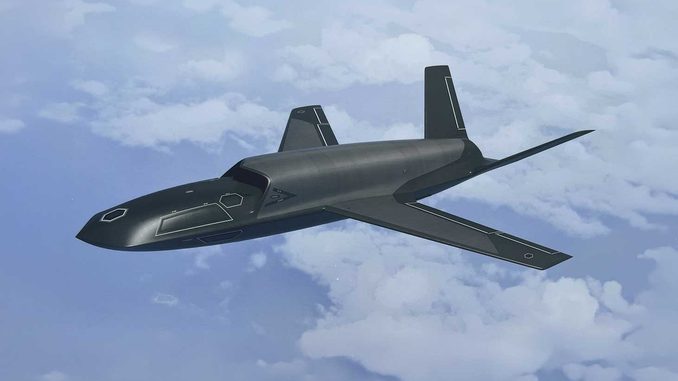
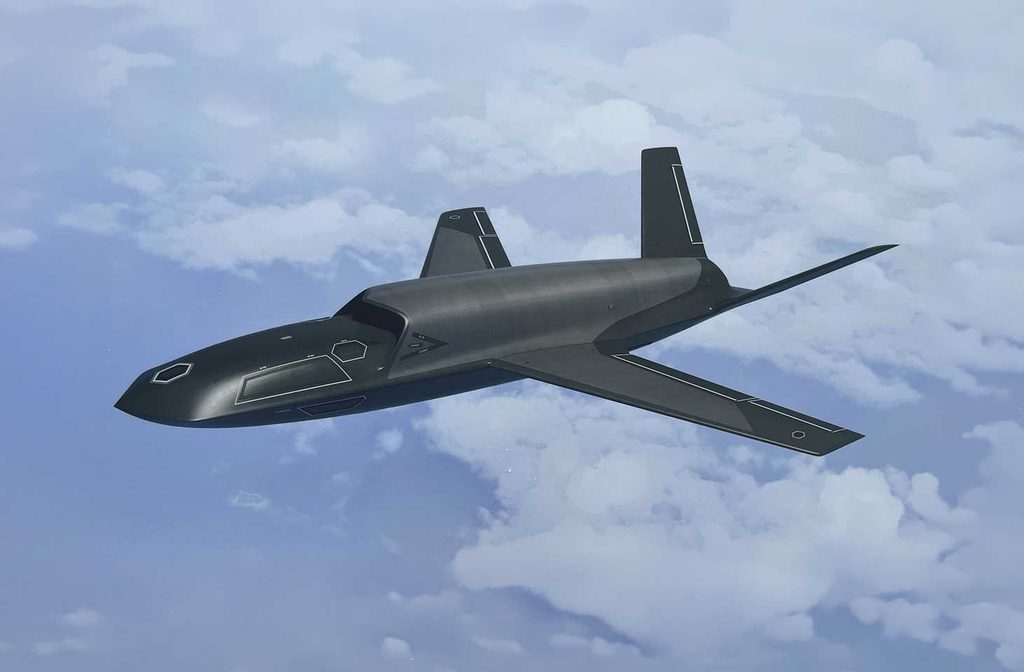
Presented at ILA Berlin in June 2026 as a full-scale mockup, the Ravenstorm belongs to the category of Collaborative Combat Aircraft (CCA), drones designed to fight alongside manned aircraft.
Its design derives from the Barracuda, a jet drone demonstrator developed by Airbus starting in 2003. This aircraft completed six flight test campaigns, acquiring experience in autonomous flight, digital flight controls, and discrete aerodynamic configurations.
The Ravenstorm takes this technological baseline and adapts it to contemporary operational needs.
Announced dimensions and performance
According to Airbus, the U760 Ravenstorm measures 13 meters in length and has a 10-meter wingspan. Its maximum takeoff weight reaches approximately six tonnes, according to the specifications presented at the ILA air show.
The aircraft is designed to fly at a high subsonic cruising speed. However, Airbus has not released a quantified maximum speed, action radius, or endurance.
The main published characteristic concerns its 500-kilogram internal bay, designed to house guided weapons without multiplying external payloads.
This architecture is intended to preserve a reduced radar signature, although no public measurement yet allows for the quantification of the Ravenstorm’s stealth.
Unlike a supersonic fighter, this drone will likely prioritize range, equipment payload, and operating cost over pure speed.
Its unit price has not been disclosed. Nevertheless, Airbus emphasizes that highly specialized equipment, particularly AESA radars and custom-developed engines, can make a drone almost as costly as a manned combat aircraft.
The MARS system turns the Ravenstorm into an autonomous wingman
The technological core of the Ravenstorm will be its MARS (Multiplatform Autonomous Reconfigurable and Secure) mission system, developed by Airbus.
It relies on an open and modular software architecture, allowing the integration of various sensors, electronic equipment, and weapons without entirely redeveloping onboard systems.
The principle of collaborative combat consists of assigning the drone an objective rather than a succession of piloting orders.
From an Eurofighter Typhoon, a pilot can ask it to monitor an area, identify radar emissions, or reach a tactical waypoint. The MARS system will then calculate a trajectory, manage sensors, and transmit useful information.
Its autonomy software must also allow it to pursue certain missions when satellite navigation signals are jammed.
Airbus provides for human control over critical decisions, in compliance with applicable rules of engagement.
Strike and electronic warfare missions
The Ravenstorm is intended for three categories of missions.
The first concerns precision air-to-ground strikes, particularly against defensive positions located in heavily monitored zones.
The second is air defense, with the anticipated carriage of medium- and long-range air-to-air missiles.
The third falls under offensive electronic warfare, with jamming capabilities intended to disrupt adversary radars and communications.
A group of drones could thus accompany a formation of fighter jets, some carrying weapons while others provide reconnaissance or electronic protection.
The objective is to increase available combat power without systematically exposing pilots.
However, these capabilities remain to be demonstrated on the Ravenstorm, for which no flight tests have yet been publicly announced.
The U740 Valkyrie prepares the arrival of the Ravenstorm by 2029
Airbus is adopting a progressive strategy with two complementary platforms.
The U740 Valkyrie, developed with the American company Kratos Defense & Security Solutions on the basis of the XQ-58A, constitutes the first step.
Measuring 9.1 meters long with an 8.2-meter wingspan and a maximum weight of about three tonnes, it boasts a range capability exceeding 5,000 kilometers, according to Airbus. This figure does not necessarily correspond to its combat mission action radius.
On October 12, 2026, Airbus announced its first European flight. Carried out from a test facility in Northern Europe, it verified a rocket-assisted takeoff, various maneuvers, and speeds reaching Mach 0.8.
A cooperation demonstration with a Eurofighter is planned for 2027.
The U740 must allow for the validation of MARS software and collaboration procedures prior to the arrival of the Ravenstorm, scheduled for 2032.
Airbus is also studying a third model, more specialized in air-to-air combat or electronic warfare, but potentially more costly.
European defense seeks to master its own combat drones
Airbus’s strategic shift comes within an increasingly competitive European market.
In Germany, Helsing is developing the CA-1 Europa, while Boeing is offering the MQ-28 Ghost Bat with German industrial partners. In October 2026, Berlin renounced a direct acquisition of the MQ-28, leaving the competition open.
In France, Dassault Aviation is preparing a stealth combat drone intended to accompany the Rafale F5 standard, whose arrival is scheduled starting in 2033.
These programs respond to a common necessity: strengthening European air forces before next-generation fighters become available.
For Airbus, European technological sovereignty relies notably on control of the MARS mission system. While the U740 uses an American airframe, Airbus intends to retain mastery over software, data, and military applications. This does not eliminate industrial dependencies tied to the platform.
The Ravenstorm could offer greater industrial autonomy thanks to its European design.
An essential difficulty remains: developing an economic, truly autonomous drone capable of surviving in a contested airspace. A 500-kilogram cargo bay and advanced software architecture are not enough to guarantee its effectiveness against modern defenses.
By abandoning the Wingman, Airbus accepts scaling back its initial ambitions to shorten timelines. The success of this strategy will now depend on its capacity to transform the Ravenstorm into an operational asset by 2032 while keeping costs low enough to enable volume acquisitions.