In 2014, a hijacked Boeing 767 landed in Geneva without Swiss interception. A look back at the global ridicule and the establishment of a 24/7 air defense capability.
Summary
On February 17, 2014, Ethiopian Airlines Flight ET702, operated by a Boeing 767-300, was hijacked to Geneva by its own co-pilot. As the aircraft approached Switzerland, the Italian and French air forces scrambled their fighters to escort it. The Swiss Air Force did not scramble. The reason sparked an international scandal: its combat aircraft were only operational during office hours.
The affair triggered a wave of sarcasm in the media and online. Above all, it exposed a critical vulnerability in the air defense of a country equipped with F/A-18 Hornet fighters.
Twelve years later, the situation has changed radically. Since December 31, 2020, Switzerland has maintained two armed fighters ready to scramble in fifteen minutes, day and night. The setup required nearly 100 additional positions and an annual investment of 30 million Swiss francs.
The Co-pilot Hijacks a Boeing 767 to Geneva
On February 17, 2014, Ethiopian Airlines Flight ET702 was en route from Addis Ababa to Rome, then Milan. On board the Boeing 767-300—and not a Boeing 737 as some accounts of the event erroneously state—were 202 people, including 193 passengers.
While the plane was flying over Sudan, the co-pilot took advantage of the captain using the lavatory to lock the cockpit door. He set the transponder code to 7500, the international emergency signal for a hijacking. He requested political asylum in Switzerland, claiming he feared for his safety in Ethiopia.
He circled over Geneva to negotiate while fuel ran low. The aircraft finally landed at 6:02 a.m. with no injuries reported. The co-pilot descended from a cockpit window using a rope and surrendered to the police. In 2016, Swiss courts ordered him placed in supervised psychiatric care after ruling he was not criminally responsible for his actions at the time of the event.
Italian and French Fighters Take Over
Italian air defense reacted as soon as the aircraft entered its area of responsibility. Two Eurofighter Typhoon aircraft, designated F-2000 by the Aeronautica Militare, scrambled from Gioia del Colle in southern Italy. Belonging to the 36th Wing (36° Stormo), they intercepted the Boeing off the coast of Sicily.
This Quick Reaction Alert (QRA) setup keeps armed aircraft and crews ready to launch within fifteen minutes. The fighters identified the plane, monitored its trajectory, and stood ready to transmit instructions.
As the plane approached France, French Mirage 2000 jets took over. Two aircraft were deployed successively to escort the flight toward Geneva. Their missions fell under air policing rather than an offensive tactical intervention against a civilian airliner. Cross-border cooperation agreements did not transfer the authority to fire weapons over Swiss airspace to neighboring countries.
The Swiss Air Force Was Unavailable Before 8 A.M.
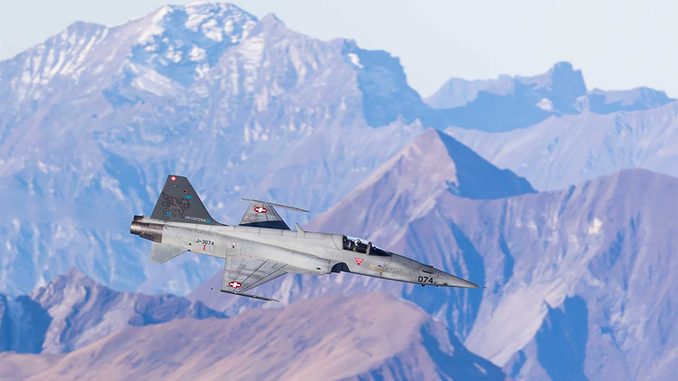
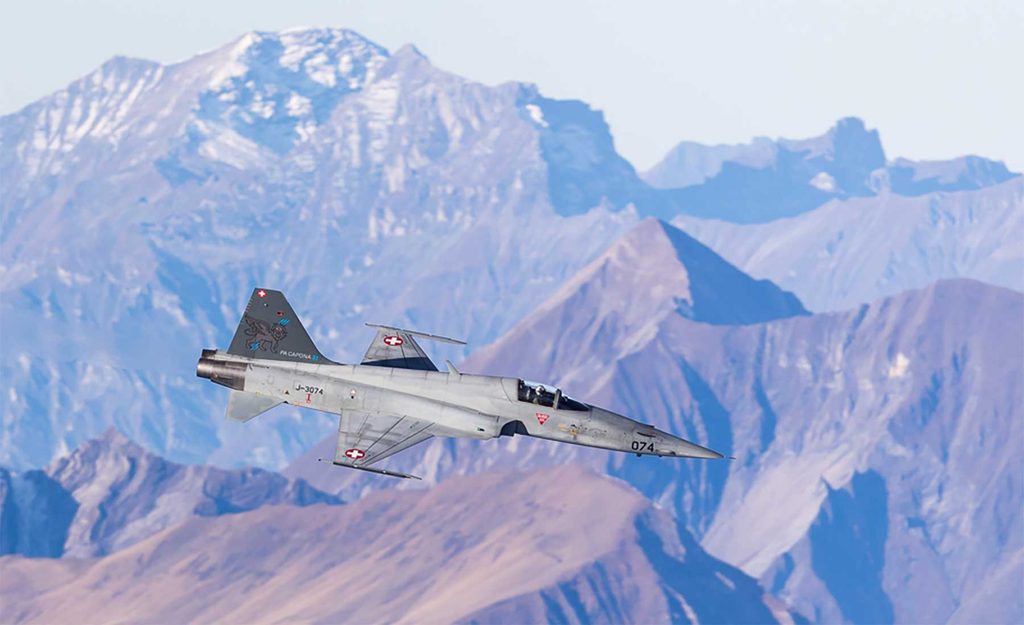
In 2014, Switzerland possessed F/A-18 Hornets and F-5 Tigers, but did not maintain a continuous fighter alert patrol. Standard flight operations were only conducted Monday through Friday, from 8:00 a.m. to 12:00 p.m., and from 1:30 p.m. to 5:00 p.m.
Airspace surveillance, however, was continuous. The FLORAKO radar system had operated 24/7 since 2005, and air traffic control was similarly maintained around the clock. What was missing were pilots, technicians, and ready-to-scramble fighters.
Officials cited costs, staffing levels, and noise restriction constraints. Defense Minister Ueli Maurer also argued that the short distance between the French border and Geneva would have limited the usefulness of a Swiss scramble in this specific case. Yet aerial threats do not keep a schedule.
Global Ridicule Follows
The phrase “office-hours air force” quickly became an international talking point. The Guardian mocked the fighter jet force as “armed and dangerous,” but only during office hours. Bloomberg sarcastically suggested in a headline that an adversary should launch an attack before 8 a.m. or after 5 p.m.
Headlines and jokes spread across British, American, French, Italian, and Chinese media outlets. The lunch break and the absence of weekend duty generated particular satire. A wealthy nation committed to armed neutrality was relying on its neighbors to escort a hijacked airliner at dawn.
While satire oversimplified the issue—the radars were active, but no Swiss interceptor could respond immediately—it highlighted severe operational gaps.
Air Policing Reforms Were Already Underway
The incident accelerated political pressure, though it did not spark the reform from scratch. As early as 2009, Parliamentarian Hans Hess had requested fighter availability outside standard operating hours. The “Air Police 24” (PA24) program was subsequently rolled out in phases.
By 2016, two aircraft were standing by Monday through Friday from 8 a.m. to 6 p.m. In 2017, coverage extended to every day of the year. In early 2019, operational hours expanded from 6 a.m. to 10 p.m. Finally, on December 31, 2020, Switzerland achieved continuous, 24/7, 365-day alert readiness.
The transformation required nearly 100 additional personnel. Its operational cost is estimated at an additional 30 million Swiss francs annually, requiring round-the-clock availability for technical crews and air traffic control.
F/A-18s Now Maintain Constant Alert Status
Today, two armed F/A-18C/D Hornets are ready to scramble within fifteen minutes from Payerne Air Base, with fallback capabilities at Emmen or Meiringen. This window guarantees takeoff time, rather than a guaranteed interception within fifteen minutes.
“Hot Missions” respond to real-world incidents, such as loss of radio contact, airspace violations, or potential threats. “Live Missions” primarily involve verifying foreign state aircraft and their diplomatic clearances. According to authorities, Switzerland executes an average of roughly ten “Hot Missions” and nearly two hundred “Live Missions” per year.
In May 2025, the military tested an enhanced capability over a two-week period: deploying two pairs (four ready-to-scramble F/A-18s) instead of two aircraft. The exercise aimed to evaluate the resource requirements for such a surge capacity.
Replacing the Hornet Presents a New Challenge
Switzerland must now sustain this constant readiness with an aging fleet. In June 2026, armasuisse announced the completion of a structural overhaul across all 30 F/A-18C/D aircraft. The 450-million-franc program extends airframe life to 6,000 flight hours per jet, aiming to keep them operational into the early 2030s.
The designated successor is Lockheed Martin’s F-35A. However, rising costs led the Federal Council in March 2026 to scale back its initial target of 36 aircraft to approximately 30 units within the available budget envelope.
While the 2014 episode is now history regarding quick-reaction alert readiness, it serves as a lasting reminder that effective military aviation defense depends as much on personnel, infrastructure, and budgeting as it does on aircraft performance.