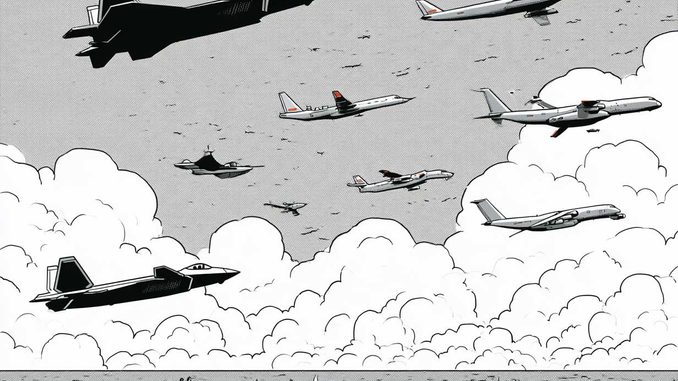
In western China, nearly 300 aircraft have been spotted across 11 bases. Here is what Red Sword reveals about Chinese air power and tensions with Taiwan.
In Brief
China is massing an unusual air force in the west of the country. According to an analysis of satellite imagery released in November 2026, around 279 aircraft are visible across 11 bases, compared to 80 to 100 under normal circumstances. The total could exceed 300 when accounting for aircraft housed in shelters. Analysts likely recognize this as the “Red Sword” exercise, though there has been no official confirmation.
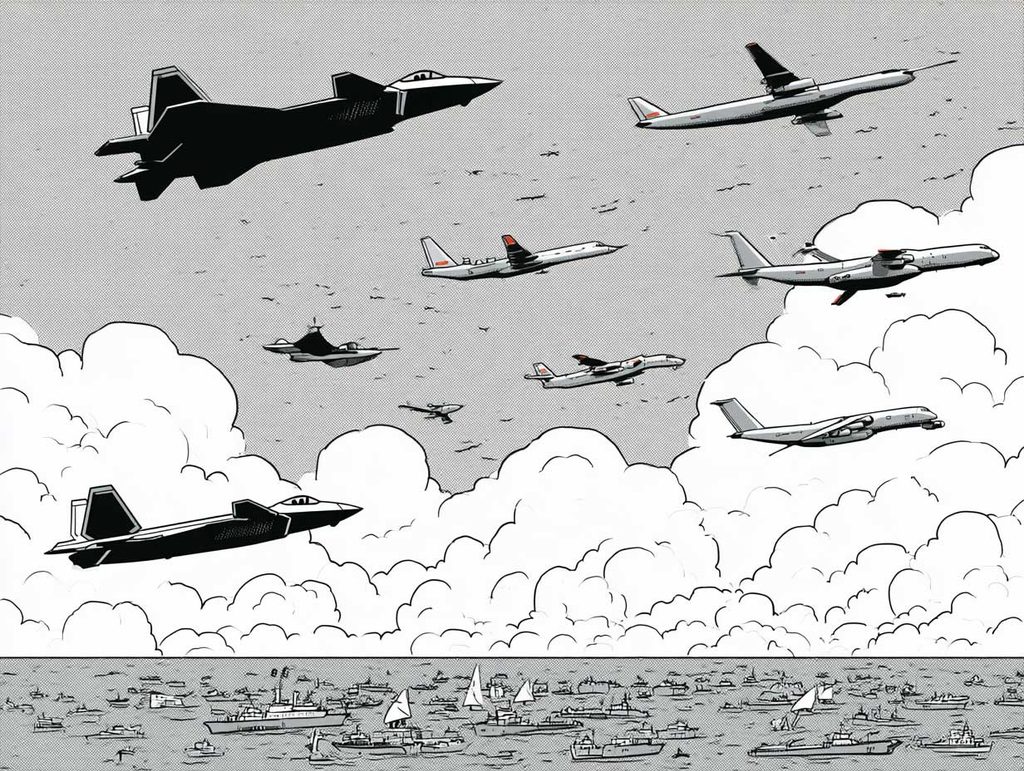
J-20 stealth fighters, J-16 fighters, H-6 bombers, KJ-500 airborne early warning and control aircraft, and Y-20 tankers form a composite force designed to train force coordination and endurance.
The real stake goes beyond the sheer number of aircraft: it concerns their ability to operate together, across multiple sites, over several weeks.
At the same time, Beijing is ramping up air and naval activities around Taiwan. There is no proof that these operations are directly linked. Nevertheless, they increase strategic pressure on Taipei and force the United States to reconsider the resilience of its bases and logistics networks.
Air Concentration Reveals an Operation of Unusual Scale
Since mid-October 2026, commercial satellite imagery has revealed an exceptional gathering of military aircraft at 11 bases in western China. The Mitchell Institute for Aerospace Studies, through analyses by J. Michael Dahm, sees this as likely being the 2026 edition of “Red Sword,” the People’s Liberation Army Air Force’s (PLAAF) premier large-scale air combat exercise.
The tally published on November 13 accounts for roughly 279 visible aircraft, compared to the 80 to 100 typically parked outdoors at these facilities. Including aircraft under shelter, the total could surpass 300. Beijing has confirmed neither the exercise nor its troop and equipment numbers.
In 2025, analysts counted 194 aircraft across eight bases during an exercise that likely lasted five weeks. The current deployment covers more airfields. This geographic expansion matters more than the headline figure.
J-20s, H-6s, and Support Aircraft Form a Composite Force
The observed composition explains the significance of Red Sword. Estimates count 43 Chengdu J-20 stealth fighters, 43 J-10s, 93 J-11s and J-16s combined, 20 Xi’an H-6 bombers, and 12 JH-7 fighter-bombers. Added to these are roughly 16 KJ-500 radar aircraft, 27 Y-20 transport or tanker aircraft, and 25 specialized Y-8 or Y-9 variants.
The Chengdu J-20, designed to reduce its radar detectability, can help detect and engage adversaries at long range. The twin-engine multirole J-16s provide heavy payload capacity for air-to-air and air-to-ground missions. The H-6 serves as a standoff missile launch platform. Any munitions carried on board remain unknown.
KJ-500s handle radar surveillance and formation coordination—functions that the future KJ-3000 is intended to bolster. Depending on their variants, Y-8s and Y-9s can perform intelligence and electronic warfare missions. This networked air combat relies as much on information sharing as on fighter performance.
Training Scenarios Target Complex Air Combat
Red Sword is often compared to the U.S. Red Flag exercise. In this type of maneuver, units face a simulated opposing force comprising fighters, radars, and surface-to-air defenses. They learn to operate jointly, particularly when communications are disrupted.
Three mission categories are plausible: achieving air superiority, escorting bombers, and penetrating an integrated air defense system; coordinating strikes with reconnaissance and jamming; and sustaining rotations across multiple bases.
Fighters from different generations can also face off in training. Satellite imagery does not prove that these missions were executed, nor whether they succeeded.
Selecting desert airfields provides vast training airspace. However, they do not replicate the specific challenges of maritime surveillance, anti-ship missiles, or coordination at sea.
Logistics Constitute the True Operational Test
Y-20s and their tanker variants appeared as early as October 17 and 18, ahead of a portion of the fighter force. This early arrival points to logistical preparation.
Getting 300 aircraft airborne once does not demonstrate the capacity to fly them daily. It requires fuel, spare parts, ordnance specialists, maintenance crews, and robust data links.
Dispersal across 11 bases complicates these tasks while reducing the vulnerability of a single concentration.
For the United States, the issue is tangible: a Chinese air force capable of sustaining distributed operations could multiply threat axes and put allied bases under pressure, particularly in Japan and the Western Pacific.
Pressure Around Taiwan Follows a Separate Dynamic
Red Sword is taking place far from the Taiwan Strait. No public evidence directly links its aircraft to the deployments observed around the island.
Taiwan’s Ministry of National Defense detected 30 Chinese air sorties on November 13, 23 of which crossed the median line of the strait; on November 14, it reported ten sorties, including four crossings. These aircraft entered various parts of Taiwan’s Air Defense Identification Zone, though this does not necessarily constitute a violation of its territorial airspace.
On November 4, Taipei also identified fighters, KJ-500s, Y-20U tankers, and drones during a coordinated patrol.
According to Taiwanese officials cited by Reuters, more than 100 Chinese naval and coast guard vessels were mobilized at the height of unannounced maneuvers in early November in the Western Pacific. Beijing has announced no connection to Red Sword. These activities could notably serve to test area denial and the conditions for a blockade.
Another factor: in 2026, the Mitchell Institute identified at least 200 retired J-6s converted into attack drones, deployed at six bases near the strait. They could contribute to an aerial saturation strategy aimed at exhausting Taiwanese defenses.
China Can Intimidate Taiwan, but Cannot Force Capitulation
The accumulation of exercises can wear down Taiwanese crews, weigh on trade, and complicate U.S. intervention calculations.
A prolonged blockade would be more coercive than an aerial show of force, yet far riskier as well: it would disrupt international trade and could trigger a military confrontation.
Pressure guarantees no political concessions. In a poll published on October 22, 2026, by the Mainland Affairs Council, 92% of respondents stated that Taiwan’s future should be decided by its residents.
This survey does not predict how they would react in wartime. It does, however, undercut the notion of an easy political capitulation.
Above all, Red Sword highlights a transformation: China is seeking to transition from a large fleet to an air force capable of fighting over extended periods, from multiple airfields, and with complementary capabilities.
The truly decisive threshold remains invisible from space: the ability to sustain these operations against an adversary that jams communications, strikes infrastructure, and fights back.