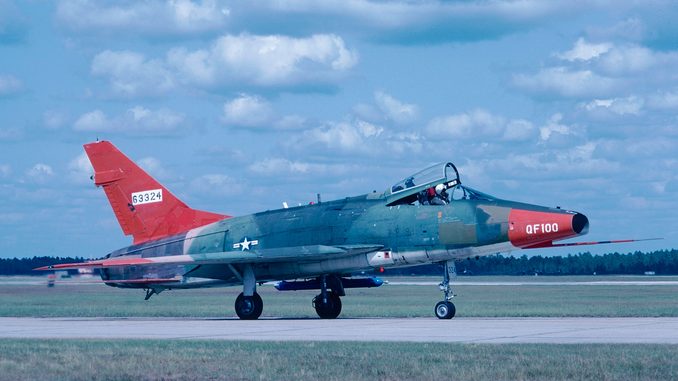
The F-100 Super Sabre suffered from two deadly flaws: inertia coupling and the “Sabre Dance.” Discover the physics behind these accidents.
Summary
The first production fighter aircraft capable of exceeding Mach 1 in level flight, the North American F-100 Super Sabre revealed the little-known dangers of supersonic flight in the 1950s. Its elongated fuselage, concentrating most of its mass, and its short, thin wings favored a phenomenon called inertia coupling. During certain maneuvers, the aircraft could become uncontrollable across all three axes of rotation and suffer loads capable of causing midair breakup. On October 12, 1954, chief test pilot George Welch fell victim to it. At low speed, another flaw threatened pilots: wingtip stall caused a sudden pitch-up, accompanied by uncontrolled lateral motions. This phenomenon was nicknamed the “Sabre Dance.” North American Aviation had to enlarge the vertical fin, modify the wing, and improve stability systems. These accidents deeply influenced the design of subsequent generations of combat aircraft.
The race for supersonic flight at the root of the problem
On May 25, 1953, George Welch conducted the first flight of the YF-100A prototype at Edwards Air Force Base, California. The aircraft broke the sound barrier on that very flight. North American Aviation had just achieved a major breakthrough in the history of fighter aircraft.
Successor to the F-86 Sabre, the F-100 Super Sabre was meant to give the U.S. Air Force technological superiority against Soviet fighters. Its design prioritized speed, with a 45-degree swept wing, a slender fuselage, and a Pratt & Whitney J57 turbojet fitted with an afterburner.
The F-100A features a fuselage length of 13.91 meters (45.64 feet), an initial wingspan of 11.15 meters (36.58 feet), and a basic weight of roughly 8,918 kg (19,662 pounds), excluding fuel, fluids, and pilot.
Reducing wing thickness helps limit wave drag, generated by air compression effects at transonic and supersonic speeds.
However, this architecture profoundly alters mass distribution and the dynamic behavior of the aircraft. Engineers discovered that design choices made to increase speed could also compromise the fighter’s stability.
Inertia coupling, a phenomenon capable of breaking up an aircraft
Mass distribution at the heart of instability
An aircraft moves around three axes: roll, pitch, and yaw. Roll corresponds to tilting the wings, pitch to the vertical movement of the nose, and yaw to its side-to-side movement.
On conventional aircraft, these motions can generally be controlled without excessive interaction. On the F-100, the situation was different.
The engine, fuel, cockpit, and a large share of equipment were concentrated in the fuselage. The wings, relatively short and light, contributed less to lateral mass distribution.
This layout created a major disparity among the moments of inertia across the three axes. Moment of inertia measures an object’s resistance to a change in rotational motion.
The F-100 could therefore roll rapidly around its longitudinal axis, while its mass opposed far greater resistance to pitch and yaw motions.
During a rapid roll, interactions between aerodynamic forces and inertial effects could trigger uncommanded rotations around the other axes. These motions risked amplifying when rotation rates approached certain natural oscillation frequencies of the airframe.
This is inertia coupling, or inertial roll coupling.
The resulting loads could exceed the corrective authority of the control surfaces and the structural limits of the airframe. The aircraft risked breaking apart, even when its speed remained below its theoretical maximum.
The death of test pilot George Welch
On October 12, 1954, George Welch flew the ninth production F-100A, serial number 52-5764. He was conducting tests aimed at checking the fighter’s structural strength limits.
During a pull-out maneuver from a dive at Mach 1.55, the aircraft became uncontrollable and broke up in flight. George Welch managed to eject, but died of his injuries.
The crash occurred just fifteen days after the F-100A officially entered service with the U.S. Air Force.
Other crashes followed. On November 10, 1954, the U.S. military grounded its entire fleet of F-100A aircraft, which then numbered around 70 jets.
The phenomenon had nonetheless been identified theoretically as early as 1948 by William Hewitt Phillips, an engineer at the National Advisory Committee for Aeronautics (NACA), predecessor to NASA. The crashes of the Super Sabre brutally demonstrated the relevance of his work.
The Sabre Dance, the aerodynamic trap at low speeds
Wingtip stall
The F-100 Super Sabre also suffered from a second flaw, independent of inertia coupling, yet just as dangerous.
On a swept wing, airflow has a component directed toward the wingtips. At high angle of attack, this feature can promote premature airflow separation at the wingtips.
Angle of attack corresponds to the angle formed between the wing chord and the relative wind.
When the wingtips stall, they lose part of their lift. Yet on a swept wing, those tips sit well behind the center of gravity.
The resultant lift force therefore shifts forward. This shift generates a pitching-up moment that raises the nose of the aircraft, further increasing its angle of attack and worsening the stall.
This self-amplifying mechanism is called pitch-up, or aerodynamic pitch-up.
If one wing stalls more than the other, the aircraft banks abruptly. Roll and yaw motions then combine with the pitch-up. Pilots nicknamed this behavior the Sabre Dance.
The Super Sabre’s limits on landing
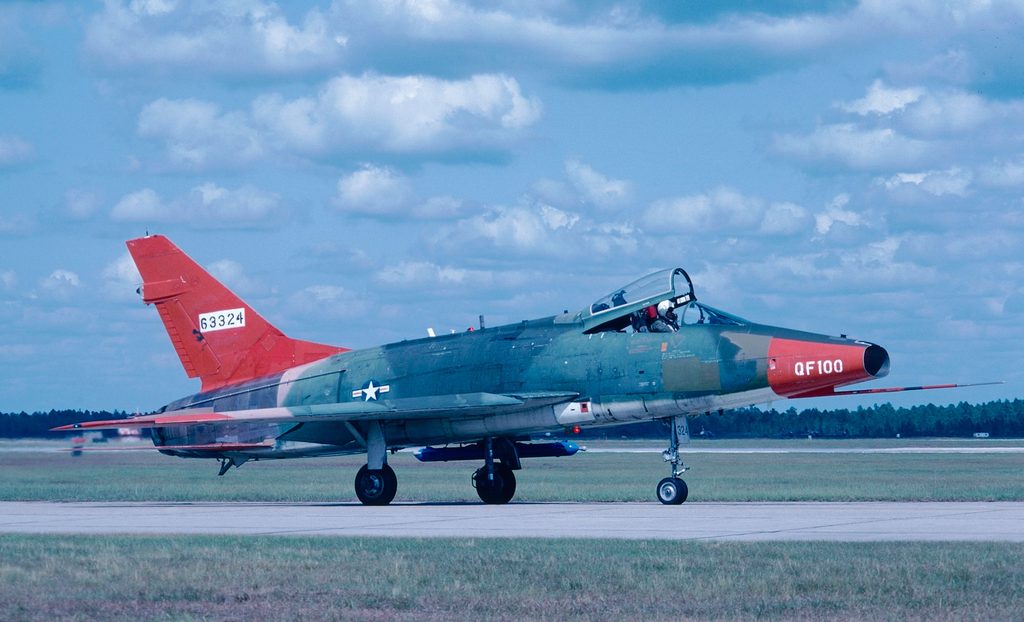
Early F-100A and F-100C versions lacked conventional landing flaps. Despite their automatic leading-edge slats, they exhibited particularly demanding low-speed handling characteristics.
On January 10, 1956, Lieutenant Barty R. Brooks lost control of his F-100C during an emergency landing at Edwards Air Force Base. The fatal crash was filmed by cameras originally set up for other tests.
That footage became one of the best-known illustrations of the Sabre Dance.
Just a few meters above the ground, the altitude available to regain normal airflow was insufficient. Engine thrust could not instantly offset the loss of lift.
Technical modifications that saved the F-100
Enlarging the vertical fin and wing
NACA engineers studied the F-100’s behavior alongside several American experimental aircraft, notably the Douglas X-3 Stiletto.
In December 1954, they tested a vertical fin whose area was increased by 10%. North American Aviation then adopted a configuration featuring a 27% increase in vertical tail area.
This modification strengthened directional stability and reduced the risk of dynamic instability.
Wingspan was also increased by 61 centimeters (24 inches), reaching roughly 11.76 meters (38.58 feet) on the aircraft studied by NACA.
Yaw and pitch dampers progressively rounded out these improvements. They detected unwanted motions and commanded corrections meant to limit their amplification.
Stall-control devices
Evolution of the Super Sabre also included aerodynamic wing fences, meant to limit spanwise airflow.
Leading-edge slats helped delay airflow separation. The F-100D also introduced landing flaps and a redesigned wing.
These changes improved the aircraft’s handling, without completely eliminating the risks tied to high angles of attack.
The F-100’s technical legacy in modern military aviation
Despite its troubled beginnings, 2,294 Super Sabres were built. It holds an important place in the history of Cold War fighter jets and took part heavily in U.S. operations in Vietnam.
Its failures contributed to the development of flight-dynamics simulations, automatic stabilization systems, and flight-envelope validation methods.
Subsequent generations, notably the General Dynamics F-16 Fighting Falcon, would benefit from computers and fly-by-wire flight controls capable of coordinating control surfaces and limiting dangerous excursions.
The F-100 Super Sabre demonstrated that mastering supersonic flight does not depend solely on engine power or material strength. It also rests on understanding interactions among mass distribution, aerodynamic forces, and rotational motions. It was a fundamental lesson that 1950s engineers learned at the cost of several lives.