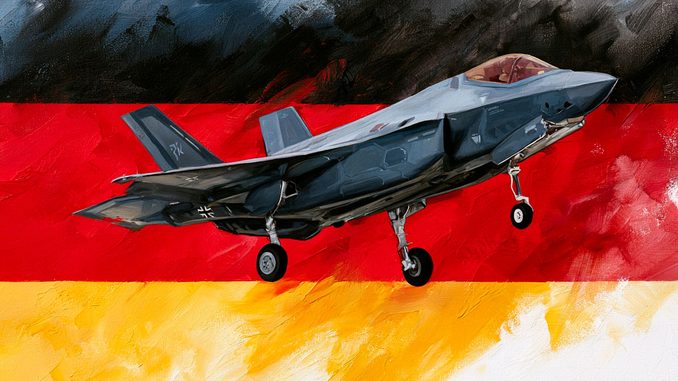
In Manching, Airbus’s works council is demanding a German-led fighter jet. Berlin’s choice will weigh heavily on the F-35’s foothold in Europe.
Summary
On November 23, 2026, in Manching, the works council of Airbus Defence and Space urged the Chancellery to launch the development of a fighter under German leadership. Employee representatives are calling for a maiden flight in 2032. They consider joining GCAP—the British, Italian, and Japanese program—”doomed to fail.” Airbus management, however, is keeping that door open. German Defense Minister Boris Pistorius wants a decision in principle by the end of March 2027. Meanwhile, six F-35As in Luftwaffe livery have already flown in the United States. For Berlin, the immediate priority is preserving the capability to design the aircraft that will succeed the Eurofighter. For its neighbors, Germany’s decision will have tangible consequences. Depending on which program receives its orders and research funding, Germany could either make a European offering more credible or further bolster the appeal of buying American.
Manching’s Timeline Puts the Chancellery Under Pressure
In Manching, Bavaria, employee representatives framed the debate in terms of schedules. If the Bundeswehr wants to field a new fighter before 2040, they argue, the prototype must fly as early as 2032. During the November 23 assembly, works council chairman Thomas Pretzl warned that additional F-35 purchases would “spell the end of German military aviation.” The phrasing reflects the fear of losing a highly specific trade in Germany: that of combat aircraft designer.
The timeline championed by employees is tighter than the Airbus option currently under review in Berlin, which targets an operational aircraft in the early 2040s. The gap matters. A prototype can fly several years before a front-line unit has serial production aircraft, certified software, spare parts, and trained crews. As for the end-of-March 2027 deadline set by Boris Pistorius, it strictly concerns choosing an industrial path. Development funding and aircraft orders remain to be negotiated.
The FCAS Breakup Leaves Industrial Control Up in the Air
The Future Combat Air System, or FCAS, brought together France, Germany, and Spain. It was intended to link a manned fighter, unmanned aircraft, and a data-sharing network. It was the development of the joint fighter that collapsed in the summer of 2026. Dassault Aviation and Airbus failed to overcome their disagreement over project leadership and design authority.
Prime contractorship confers very concrete power. When a radar gains weight or demands more electrical power, someone must arbitrate between sensor performance, aircraft limits, and modification costs. The manufacturer entrusted with that decision must understand the entire aircraft. That is the expertise Manching wants to preserve. Moreover, a German-led fighter could still welcome foreign partners. Airbus is working with Berlin and Madrid on the future of their combat aviation.
GCAP Has Already Divided Up Responsibilities
The Global Combat Air Programme aims for service entry in 2035. Its three founding manufacturers—BAE Systems, Leonardo, and Japan Aircraft Industrial Enhancement Co.—each hold a one-third stake in Edgewing, the joint venture responsible for design. In 2026, the three nations awarded it a £4.6 billion contract for the next phase of development.
Berlin would therefore be arriving after the team has been formed and a major contract signed. Its financial contribution and future orders would give it leverage. Securing a share of design authority, however, would force the founders to reopen compromises already settled. This is where positions diverge within Airbus. The works council rejects joining the program, whereas group CEO Guillaume Faury still cited it in late October as one of the possible solutions.
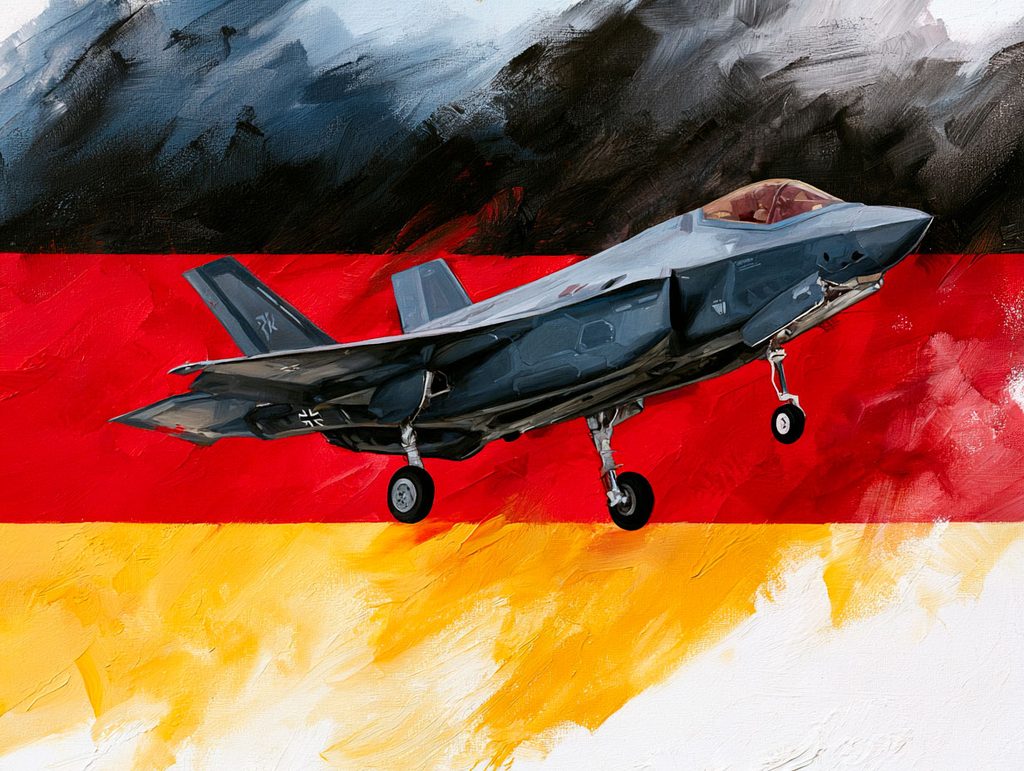
Germany’s F-35 Has Already Taken Flight in the United States
The F-35A Lightning II meets a much nearer deadline. In 2022, Berlin ordered 35 units to replace the Panavia Tornado, particularly in NATO’s nuclear-sharing mission. Germany must continue providing aircraft and crews certified for this mission while renewing its fleet.
As of November 24, the German aviation magazine Flug Revue counted six F-35As that have flown in German markings. The first, tail number 35+01, was officially handed over to the Luftwaffe on September 18 before heading to Ebbing Air National Guard Base in Arkansas for training. Several others were still conducting factory flights in Texas. The first arrivals in Büchel, Germany, are scheduled for the third quarter of 2027. At the same time, Berlin is preparing the future of its European fleet: in October 2025, it ordered 20 additional Eurofighter Typhoons.
Berlin’s Clout Is Measured in Its Neighbors’ Orders
Germany exerts its influence in both directions. By joining the European F-35 fleet, it increases the aircraft’s practical appeal for its allies. Crews trained on the same type of jet can prepare joint exercises using familiar procedures. For a nation renewing its fleet, knowing that several neighbors will operate the same hardware for decades weighs heavily in the calculation. However, Berlin is reinforcing an already established trend: Finland selected 64 F-35As in December 2021, a year before the German order.
The Spanish Precedent Shows the Weight of an Alternative Procurement Policy
In December 2024, Madrid ordered 25 Eurofighters under the Halcón II program to replace part of its F-18 fleet. The Spanish and German orders keep a shared industrial assembly line alive. They also extend the timeframe during which both countries can split upgrade costs. For a future European fighter, a German launch order would have a comparable effect: it would spread development costs over a longer production run and give potential partners an anchor customer to negotiate with.
This is the arena where Berlin will carry the most weight. Any capital looking to retire its aircraft within ten years will scrutinize approved budgets, delivery schedules, and the workshare offered to its domestic industry. If Germany funds the initial stages and agrees to share certain decisions, it will give its neighbors a reason to invest alongside it. If it delays, each nation will have to set its own timeline. The risk for Manching is that prospective customers for a European fighter will have already signed elsewhere by the day Berlin is ready to launch it.