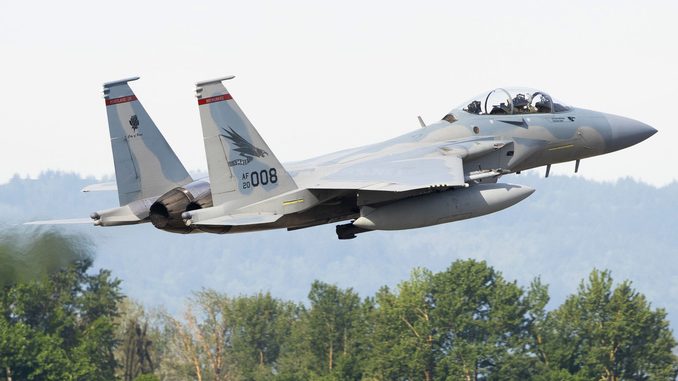
The first F-15EX Eagle IIs arrive in Okinawa. Their deployment strengthens Japan’s defense and alters the military balance facing China.
In Brief
On November 15, 2026, two US Air Force Boeing F-15EX Eagle II fighters landed at Kadena Air Base in Okinawa, Japan. This event marks the first permanent stationing of this new American combat aircraft outside the United States.
The aircraft, assigned to the 67th Fighter Squadron, initiate the replacement of the aging F-15C/Ds that have been progressively retired since 2022. Ultimately, 36 F-15EXs are set to be stationed at Kadena.
Equipped with a modern radar, advanced electronic warfare systems, and an exceptional payload capacity, the F-15EX is designed to bolster American air superiority in the Western Pacific.
Its arrival also carries geopolitical weight. Located approximately 720 kilometers from Taiwan, Kadena occupies a strategic position facing China. The deployment confirms the American commitment to maintaining permanent air power in the region while strengthening military cooperation with Japan.
The First Permanent Deployment of the F-15EX Outside the United States
On November 15, 2026, two Boeing F-15EX Eagle IIs arrived at Kadena Air Base on the Japanese island of Okinawa. Belonging to the 18th Wing’s 67th Fighter Squadron, they are the first examples of this fighter to be permanently stationed abroad.
This is not the F-15EX’s first appearance in Japan. Test aircraft had already participated in training missions in July 2025 and June 2026. This time, however, the jets are integrated into a permanent combat unit.
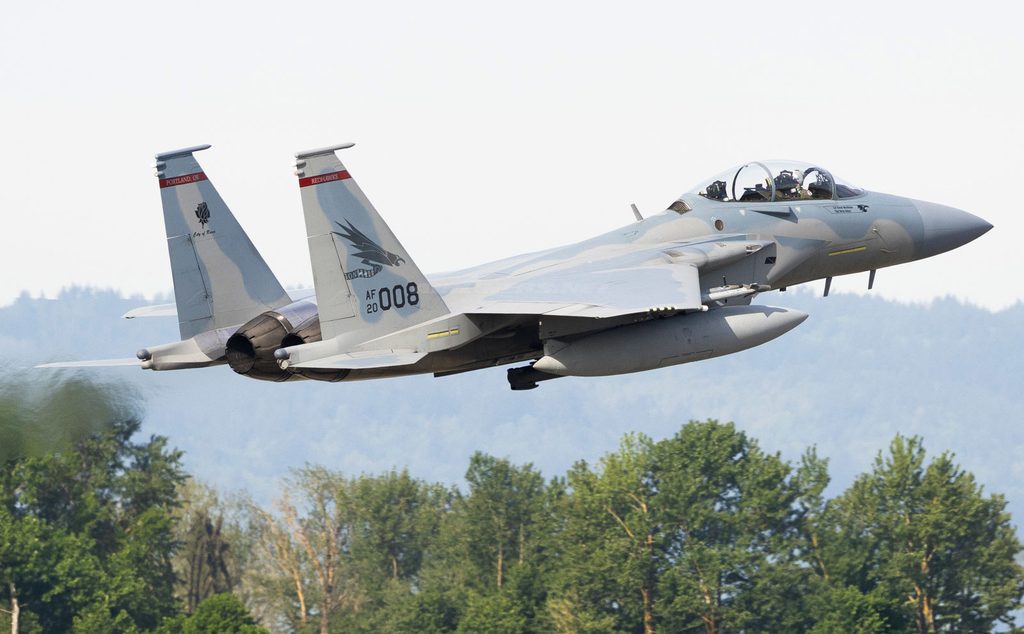
Kadena thus becomes the second operational home for the F-15EX, following Portland Air National Guard Base in Oregon, where the 142nd Wing has operated the aircraft since 2024.
This arrival comes four years after the start of the withdrawal of the 48 aging F-15C/D Eagle jets based in Okinawa. Since the 1970s, these fighters had ensured American air defense in this part of the Pacific.
The replacement plan calls for 36 F-15EXs, divided between the 44th and 67th Fighter Squadrons. During this transition, the US Air Force is maintaining rotational deployments of F-22s, F-35s, F-16s, and F-15Es to preserve its operational capabilities.
The F-15EX Brings Superior Firepower Over Older Eagles
The Boeing F-15EX Eagle II retains the general airframe of the F-15, but its design incorporates digital avionics and deeply modernized combat systems.
The aircraft keeps its twin engines, a reported top speed of Mach 2.5, and a service ceiling of 15,240 meters (50,000 feet).
Its primary difference lies in its weaponry. Boeing reports a payload capacity of 13.4 metric tons (29,500 pounds). Notably, the F-15EX can carry up to 12 AIM-120 AMRAAM air-to-air missiles, depending on its configuration.
This capacity allows it to multiply potential engagements during a single mission, provided it has the necessary targeting data.
AESA Radar and Electronic Warfare Suite
The F-15EX uses an AN/APG-82(V)1 active electronically scanned array (AESA) radar. Unlike older mechanical radars, its beam is steered electronically, accelerating the search and simultaneous tracking of multiple targets.
The EPAWSS system, developed by BAE Systems, handles the detection, identification, and geolocation of hostile radar emissions. It also integrates jamming and electronic protection capabilities.
The aircraft features fly-by-wire flight controls, a digital cockpit, and an open mission systems architecture that facilitates the integration of future equipment.
Nevertheless, it remains a non-stealth fighter. Its electronic warfare capabilities enhance its survivability, but they do not allow it to replace an F-35 or an F-22 across all missions.
Complementarity With Stealth Fighters Strengthens Air Defense
The F-15EX addresses a major operational challenge: US forces must be able to engage numerous aircraft, missiles, and other aerial threats in an environment characterized by vast distances.
Stealth fighters like the F-35 Lightning II can gather tactical intelligence and penetrate heavily defended airspace.
The F-15EX provides superior payload capacity. Through tactical data links and information supplied by other sensors, it can engage targets without relying exclusively on its own radar.
This complementarity makes it possible to envision formations in which stealth aircraft help detect threats while F-15EXs deliver heavy firepower.
However, this concept has a limitation. Against modern air defenses, an F-15EX remains vulnerable. Its effectiveness therefore depends on the range of its missiles, the reliability of communications, and the protection provided by other military assets.
Kadena’s Position Places Taiwan at the Center of Military Calculations
Kadena is located roughly 720 kilometers (450 miles) from Taiwan. This proximity gives the United States a forward operating base to monitor and defend the airspace of the Western Pacific.
Okinawa belongs to the first island chain, which stretches from Japan toward Taiwan and the Philippines. This geographic configuration occupies a central place in both American and Chinese military strategies.
For Washington, the F-15EX deployment helps maintain a permanent rapid-response capability near the East China Sea and the Senkaku Islands, which are administered by Japan but claimed by China and Taiwan.
For Beijing, it complicates the planning of potential air operations in the region. A fleet of F-15EXs can assist in protecting aerial refueling tankers, intercepting adversary fighters, and providing air cover for US forces.
Yet this presence does not mean the United States would automatically intervene in a conflict over Taiwan. The US-Japan Security Treaty specifically covers the defense of territories administered by Japan, rather than serving as an automatic military guarantee for Taiwan.
Strengthening Military Cooperation With Japan
The permanent stationing of the F-15EXs also bolsters the assets available for joint operations with the Japan Air Self-Defense Force.
Japanese forces operate F-15Js out of Naha Air Base, also located on Okinawa. The two nations regularly hold exercises aimed at improving intercepts, aerial coordination, and intelligence sharing.
The arrival of the new American fighter facilitates the continuity of this training. It also supports the modernization of bilateral command structures initiated in 2024.
The objective is to shorten decision-making timelines and better coordinate air and missile defense operations.
This interoperability does not depend solely on aircraft performance. It requires compatible communications, shared procedures, and a common tactical picture.
Operational Limitations of a Permanent Presence in Okinawa
The deployment comes with several challenges.
Only two F-15EXs arrived at Kadena on November 15. Transitioning to a 36-aircraft fleet will require further deliveries, aircrew training, and the ramping up of maintenance teams.
According to Boeing, 25 F-15EXs had been delivered to the US Air Force as of November 16, 2026. The manufacturer held contracts for 120 aircraft at that time, following an additional order for 22 jets worth $2.38 billion announced in September.
Kadena’s forward position also constitutes a vulnerability. In a major conflict, its runways, logistics facilities, and fuel depots could be targeted by missiles.
Infrastructure hardening, aircraft dispersal, and tanker availability will therefore be just as critical as the performance of the F-15EX itself.
Furthermore, this military concentration fuels local tensions in Okinawa, which hosts a disproportionate share of the US military installations in Japan.
American Deterrence Will Depend on the Actual Readiness of the F-15EXs
The arrival of the first Eagle IIs at Kadena represents a significant shift in the US military posture in the Indo-Pacific. It gradually restores a permanent fighter fleet with capabilities superior to those of the legacy F-15C/Ds.
However, two aircraft alone do not alter the strategic balance with China.
The true impact of this deployment will be measured by the delivery pace of the remaining 34 jets, their operational readiness, and their ability to fight within an integrated US-Japanese framework.
In the Pacific, air power no longer depends solely on the number of aircraft or missiles. It also relies on the ability to protect bases, sustain units, and continue operations despite adversary attacks.
It is on this proving ground that the F-15EX will now have to demonstrate its worth.