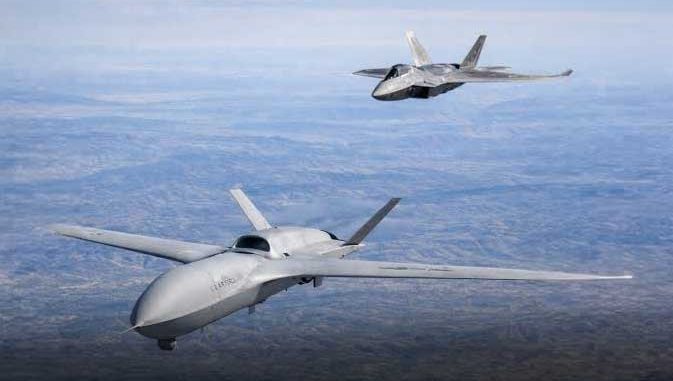
An F-22 pilot directed an autonomous YFQ-44A Fury drone in flight, marking a decisive milestone in human-machine collaborative combat for the US Air Force.
In Summary
On October 16, 2026, the US Air Force announced a major breakthrough in its Collaborative Combat Aircraft (CCA) program. During a flight test conducted in early October at Edwards Air Force Base, California, an F-22 Raptor pilot transmitted tactical instructions to an Anduril YFQ-44A Fury combat drone. The autonomous platform interpreted these commands, executing dynamic flight maneuvers and simulated combat missions.
This demonstration brings the airborne quarterback concept to life: the pilot retains command of the overall mission while the drone determines the execution details. Unlike traditional remote piloting, the pilot does not need to directly control flight surfaces or propulsion systems.
While this flight marks a first for the F-22/Fury tandem, the United States had previously tested a similar control architecture using an MQ-20 Avenger drone. The next engineering challenge will focus on controlling multiple drones simultaneously in contested combat environments subject to heavy electronic jamming.
F-22 Transmits First In-Flight Tactical Orders to Fury
The flight test took place during the week of October 5, 2026, at Edwards Air Force Base, the primary US military flight test center.
A Lockheed Martin F-22 Raptor and an Anduril YFQ-44A Fury took off separately before joining formation in flight. The stealth fighter pilot then transmitted an updated mission plan to the drone via a secure tactical data link.
The Fury received the instructions, interpreted the mission parameters, and adjusted its flight profile accordingly. According to the US Air Force, the aircraft executed dynamic maneuvers and simulated combat missions.
The flight operation lasted several hours, according to Anduril, involving key organizations including the 412th Test Wing, the 422nd Test and Evaluation Squadron, the 309th Software Engineering Group, and the dedicated CCA experimental unit.
While significant, the test scope remains specific: only a single drone was controlled, no live weapons were released, and exact data link throughput metrics were not disclosed.
Airborne Quarterback Role Redefines the Fighter Pilot
The primary innovation centers on redistributing operational responsibilities between human pilots and machine intelligence.
With conventional remotely piloted aircraft, an operator directly inputs trajectory commands. The CCA concept operates differently: the pilot communicates a high-level tactical intent—such as moving to a new area or adjusting formation position.
Onboard mission software then autonomously calculates the required maneuvers while remaining strictly within the aircraft’s flight envelope.
Mission Autonomy Software Replaces Manual Piloting
Anduril designed the Fury around its Lattice software architecture and mission autonomy systems.
These technologies process incoming commands, plan optimized flight paths, and adapt vehicle behavior without requiring continuous human intervention.
The operational architecture relies on three distinct functions: order transmission, software interpretation, and flight control execution.
The October test validated this complete control chain on a pre-production aircraft.
However, the US Air Force did not disclose the specific communication protocol used, the physical separation distance between the two platforms, or performance metrics in a jammed environment.
This distinction is crucial: a reliable data link in controlled test airspace does not yet guarantee survivability against intensive electronic warfare.
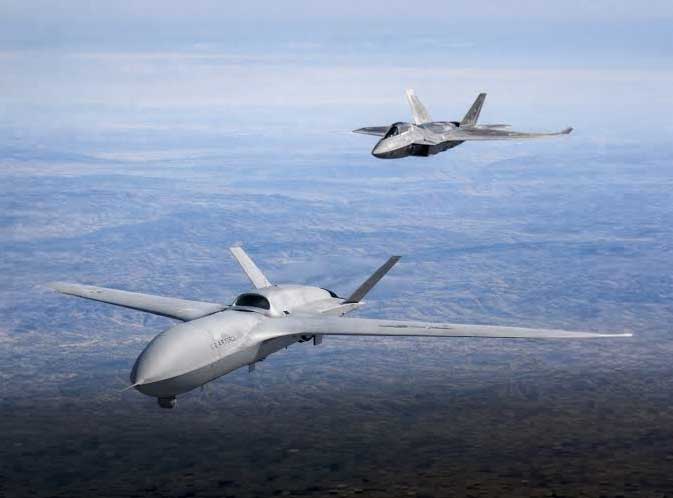
Fury Built as a True Combat Drone Rather Than a Simple Auxiliary Platform
The YFQ-44A Fury is being developed by Anduril Industries to provide an autonomous platform significantly less expensive than a crewed fighter.
The manufacturer lists a top speed of Mach 0.95, approaching the speed of sound. The drone features a modular architecture designed to integrate diverse sensor payloads and mission hardware, including radiofrequency and infrared systems.
Anduril emphasizes commercially available industrial components—particularly for propulsion—to reduce overall manufacturing and sustainment costs.
The Fury made its maiden flight on October 31, 2025. In July 2026, it reached another milestone by firing an AIM-120 AMRAAM missile at a digital target under human authorization.
Its formal integration into the American CCA combat drone program brings a new designation: FQ-44A Fury for the operational production variant, with YFQ-44A designating test platforms.
F-22 Expands Combat Power Without Putting More Pilots at Risk
The tactical advantage of this capability is substantial.
An F-22 is optimized to penetrate contested airspace, detect threats, and engage enemy aircraft. However, its missile payload, fuel capacity, and sensor reach are inherently limited by the single platform.
Escort drones could carry supplemental air-to-air missiles, act as forward sensor nodes, or operate in high-risk zones without exposing an additional human pilot to danger.
The fighter jet effectively evolves into a tactical decision center, capable of distributing tasking across multiple uncrewed assets.
This architecture also allows forces to attack from multiple vectors, complicating enemy threat assessment and defensive response.
However, it introduces a new challenge: pilot cognitive workload. Managing air-to-air combat while supervising several autonomous drones demands highly intuitive cockpit interfaces. Mission autonomy systems must minimize required human inputs to avoid task saturation.
Consequently, integration of artificial intelligence into future air combat platforms becomes an operational necessity rather than a purely technical exercise.
CCA Program Lays Groundwork for a Fleet of Hundreds of Drones
The Fury is not the only aircraft in development. General Atomics is concurrently building the FQ-42A Vengeance, another platform selected for the initial increment of the CCA program.
The US Air Force aims to field at least 500 CCAs by 2032, with long-term projections exceeding 1,000 aircraft.
The target unit cost for a first-generation drone is approximately $20 million, excluding sensors, weapons payloads, and specialized mission kits.
The strategic financial objective is to build sufficient combat mass without relying solely on far more expensive crewed fighters.
The F-22/Fury flight test serves as preparation for Exercise Emerald Flag, scheduled for December 2026, where the drones will operate within a larger composite air package under realistic operational procedures.
Crewed-Uncrewed Teaming Enters a Critical Phase
The Edwards flight test proves that an F-22 pilot can transmit tactical commands directly to a Fury and achieve autonomous execution in flight.
It does not yet demonstrate the ability to lead multiple drones simultaneously in a heavily contested environment. Key areas requiring further validation include data link resilience, contingency management, software security, and rules of engagement.
The next major transition will be human-centric. Pilots must learn to trust autonomous behaviors, anticipate machine actions, and seamlessly reclaim manual command whenever operational conditions demand.
Ultimately, the program’s success depends on more than airframe performance alone. It rests on building reliable collaboration between human intelligence and onboard autonomy.
When a single fighter pilot can routinely command multiple armed drones in complex air combat, the fundamental balance between force numbers, firepower, and aircrew risk will be permanently transformed.