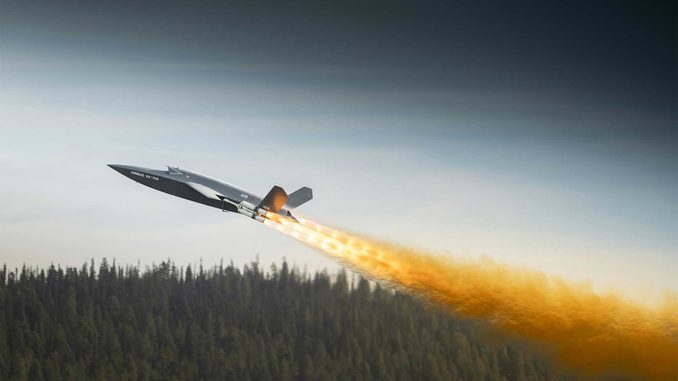
Airbus and Kratos flew the U740 Valkyrie in Europe. Performance, runway-independent launch, MARS autonomy, and operational target for 2029.
In Summary
Airbus Defence and Space and US-based Kratos Defense & Security Solutions announced, on October 12, 2026, the first European flight of the U740 Valkyrie combat drone. Conducted on September 29 at an undisclosed site in Northern Europe, the test combined rocket-assisted runway-independent launch, maneuvers at various altitudes, and accelerations up to Mach 0.8. The aircraft also accepted in-flight mission modifications.
Measuring 9.1 meters long, the Valkyrie is derived from the American XQ-58A. Airbus plans to integrate a European mission system, MARS, to transform it into a collaborative combat aircraft capable of escorting the Eurofighter Typhoon. The industrial goal is an operational capability by 2029, particularly for the German Luftwaffe.
A key distinction is essential: the first flight test validated flight performance and launch systems. It has not yet demonstrated autonomous teamwork with a fighter aircraft or the employment of weapons under operational conditions.
The First European Flight Validates Runway-Independent Launch
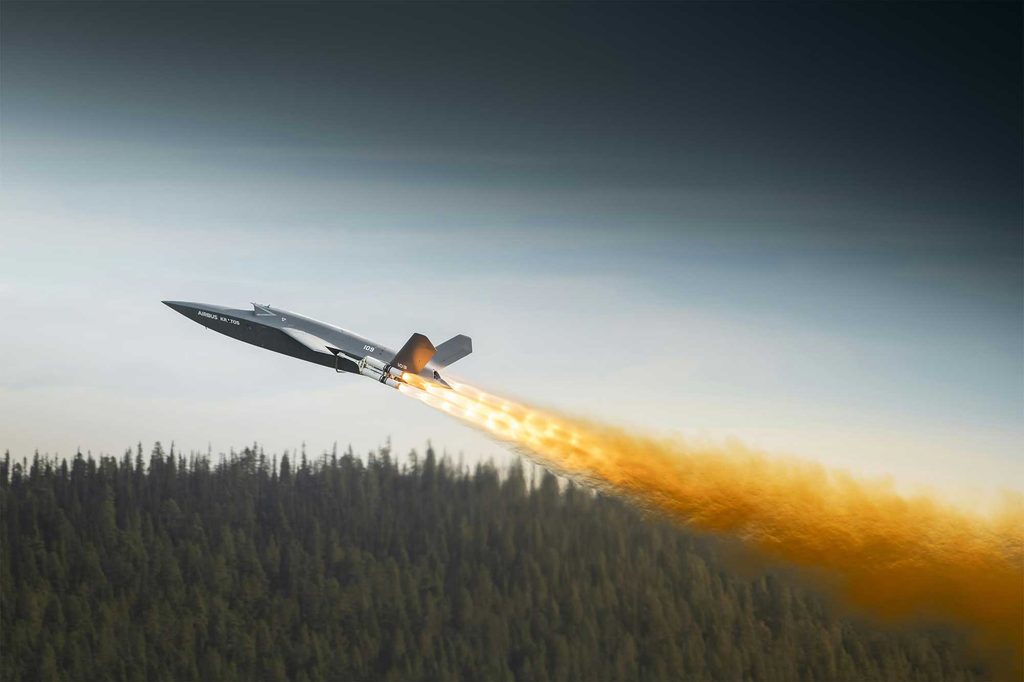
Announced on October 12, the test took place on September 29, 2026, according to Aviation International News, at a facility in Northern Europe whose exact location was not disclosed. The unmanned aircraft departed a rail launcher using rocket assistance. It then executed maneuvers at various altitudes, reached Mach 0.8, and received mid-flight mission updates.
At an altitude of 11,000 meters (36,000 feet), Mach 0.8 represents approximately 850 km/h (530 mph). This speed conversion depends on ambient air temperature; Airbus did not specify the exact altitude at which the maximum test speed was achieved.
Assisted Takeoff Reduces Dependence on Airbases
The booster rocket accelerates the aircraft off its launch ramp before its jet engine takes over sustained flight. The strategic advantage is tangible: a U740 can be launched without relying on a long runway, an infrastructure element highly vulnerable to enemy missile strikes.
The mobility of a rail launcher enables dispersed tactical deployments. However, it does not by itself solve the challenges of recovery, refueling, and ground maintenance. Airbus is also planning an option for conventional runway takeoff and landing.
The American Airframe Offers a Proven Platform
The U740 is based on the Kratos XQ-58A Valkyrie, whose maiden flight took place in March 2019 in the United States. Airbus is therefore not starting from scratch.
The drone measures 9.1 m (29.9 feet) in length with an 8.2 m (26.9 feet) wingspan. Its maximum takeoff weight is approximately 3,000 kg (6,614 lbs). Airbus claims a range exceeding 5,000 km (2,700 nautical miles) and a service ceiling of 13,716 m (45,000 feet).
It features an internal weapons bay as well as underwing hardpoints. The internal bay allows payload carriage without adding drag or increasing the aircraft’s radar cross-section as much as external stores.
The stated range should not be confused with combat radius. The latter depends on weapons payload, flight profile, fuel reserves, and recovery location. Qualified payloads for the European variant have not yet been detailed.
The MARS System Aims to Turn the Drone into an Autonomous Wingman
The European contribution is less visible than the airframe itself. The Multiplatform Autonomous Reconfigurable and Secure (MARS) system combines mission software, processing hardware, and autonomous software functions. Its MindShare module is designed to enable multiple aircraft to distribute tasks without continuous remote piloting.
A pilot could assign the drone a reconnaissance, electronic jamming, or strike mission. Algorithms would establish a flight path, adapt the mission based on incoming intelligence, and transmit actionable data back to the fighter jet.
Airbus emphasizes that critical decisions will remain strictly overseen by a human chain of command. However, this level of autonomy has yet to prove itself against dense jamming, signal loss, and rapid tactical shifts.
Crucially, the MARS system was not installed during this initial European flight. A follow-up test is scheduled for early 2027 to demonstrate what the aircraft can truly accomplish with its European mission architecture.
The Eurofighter Tandem Must Be Demonstrated in 2027
The Luftwaffe wants an Eurofighter Typhoon to be able to command a collaborative mission without turning its pilot into a dedicated drone operator. The concept relies on transmitting objectives and receiving data and alerts, rather than commanding individual flight movements.
Airbus and Rafael are notably working on an evolution of the Litening 5 targeting pod to provide the necessary connectivity with minimal modifications to the Typhoon’s avionics. Joint tests involving the drone and fighter aircraft are planned for 2027.
The operational benefit lies in placing sensors, decoys, or weapons closer to hostile threats while keeping human pilots at a safer distance. Such a setup can also multiply attack vectors and complicate enemy air defense operations.
However, this collaborative combat capability has not yet been demonstrated by the September flight alone.
The 2029 Target Remains an Industrial Objective, Not an Acquired Qualification
Airbus prepared two Valkyrie airframes in Manching, Germany, as part of its partnership with Kratos. Its ambition is to offer a combat-ready system as early as 2029. This timeline still requires full MARS integration, Eurofighter teaming trials, weapons clearance, software certification, and maintenance support structuring.
Reuters reports an estimated unit cost of around 20 million euros per aircraft. This figure is not a fixed procurement price; it will depend heavily on configuration, equipment options, and production volume. The success of this first flight does not equate to an operational fleet order.
The promised industrial sovereignty must also be clearly defined. Airbus will control the mission software and its European evolutions. However, the airframe originates from an American manufacturer. Reliance on foreign components, export authorizations, and production lines will not automatically disappear.
In parallel, Airbus is developing the larger U760 Ravenstorm—13 m long with a 10 m wingspan—targeted for the early 2030s. The U740 therefore represents an initial stepping stone rather than the final destination of European uncrewed air strategy.
The true shift will become measurable when multiple Valkyries can successfully execute complex missions alongside a Typhoon under degraded communications, return, and quickly turn around for another sortie. It is this repeatable operational capability, far more than a Mach 0.8 flight, that will determine the program’s ultimate military value.