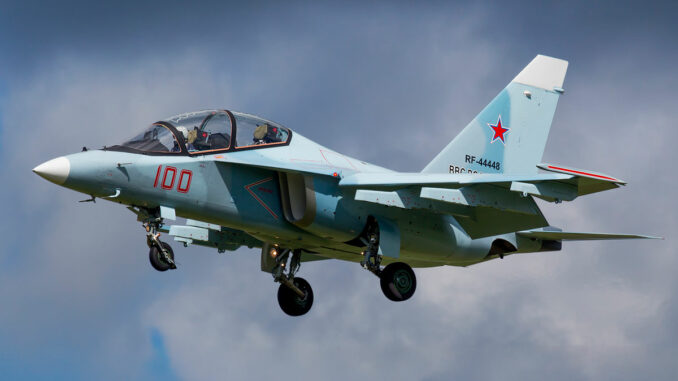
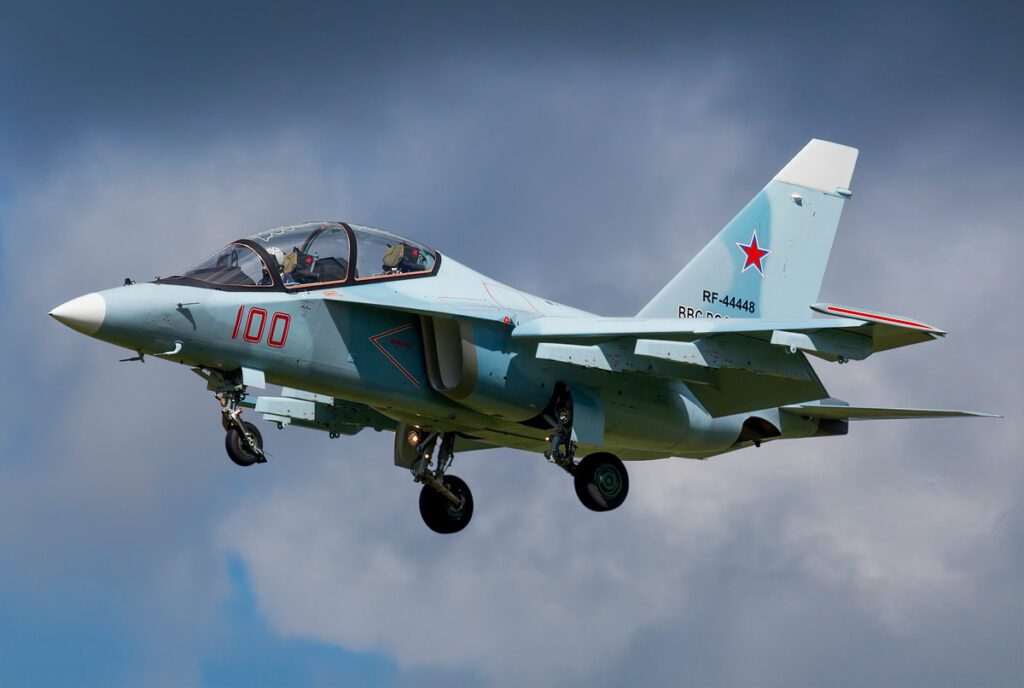
The Yak-130M is becoming a light anti-drone fighter. Moscow is looking to protect its territory without committing its valuable Su-57s and Su-35s.
In Summary
Russia aims to convert the Yak-130M—a derivative of an advanced trainer aircraft—into a light fighter capable of intercepting heavy long-range drones and striking naval drones. The aircraft made its maiden flight on June 25, 2026. Three prototypes are now participating in a test flight program scheduled to run through December 2028. The Yak-130M is being fitted with a radar, an electro-optical system, a self-protection suite, and guided weapons. Its value stems less from its raw performance than from its operating economics: a slow drone does not always justify scrambling a stealth Su-57 or an air-superiority Su-35. Moscow is thus attempting to distribute missions according to their difficulty. The Yak-130M could protect infrastructure and coastal areas, while heavy fighters remain available for contested airspace. This strategy remains experimental, however. The aircraft is subsonic, its radar remains modest, and no specialized weaponry targeting naval drones has yet been officially unveiled.
Russia Assigns a New Mission to the Yak-130M
Framing the Yak-130M as a drone hunter is no longer mere industrial speculation. During a visit to the Irkutsk Aviation Plant on July 24, 2026, Vladimir Putin explicitly cited the destruction of large drones and uncrewed surface vessels (USVs) among the aircraft’s new missions.
Documents presented during the visit describe an aircraft capable of performing fighter, attack, and strike roles. They also indicate that more than 50% of its onboard equipment has been replaced or upgraded compared to the original Yak-130.
Nevertheless, the program remains far from full operational capability. The first prototype completed its maiden flight on June 25, 2026. Lasting approximately 50 minutes, the sortie saw the aircraft climb to 2,000 m and reach speeds of 600 km/h. This was not a combat demonstration, but a initial checkout of the airframe and systems.
Three prototypes have been built. Testing is scheduled to continue through December 2028, with initial deliveries envisioned for the end of that same year.
The distinction is important: Russia is not yet deploying a fleet of anti-drone Yak-130Ms. It is developing a platform that could fulfill this function starting in 2028, provided its sensors, weapons, and communications suites meet advertised performance standards.
The term “conversion” must also be used with precision. The Yak-130M is not simply a standard Yak-130 with a few missiles slapped on. It represents a deep modernization of the existing airframe. The primary modification involves the mission system, which was previously constrained by the absence of a true combat radar.
The Yak-130M Becomes a Light Fighter Rather Than a Simple Trainer
The Yak-130 was originally designed to train pilots destined for modern fighters. Its digital cockpit and programmable flight control system allow it to replicate aspects of different combat aircraft handling characteristics.
The airframe is compact, featuring twin engines, tandem seating, and a wing optimized for low- to medium-speed maneuvering. While the original model could carry unguided bombs, rockets, and certain missiles, it remained a trainer with a secondary light-attack capability.
The Yak-130M progressively flips this hierarchy. Training remains a core mission, but the aircraft is now receiving the systems required to search for, identify, and engage targets autonomously.
Its maximum takeoff weight reaches approximately 10,290 kg, with a payload capacity of up to 2,500 kg distributed across nine hardpoints. Its stated top speed is 960 km/h, with a service ceiling near 12,500 m.
Its range is listed at 1,610 km, extending up to 2,265 km with two 450-liter drop tanks. These figures represent maximum ferry distances rather than a combat radius. The actual operational radius will be smaller, as the aircraft must retain fuel to search for a target, execute an interception, and return to base.
The Yak-130M remains a subsonic aircraft. It cannot catch every threat or reach a distant sector as quickly as a Su-35. Conversely, its speed is well-suited for intercepting propeller-driven drones flying between 150 and 300 km/h.
This speed differential gives the pilot time to maneuver into position, identify the target, and select an attack angle. Yet it can also pose a challenge: a fast jet must throttle back to trail a slow drone without overshooting it. Here, the Yak-130M holds an inherent advantage over heavy fighters engineered for supersonic combat.
New Radar Gives the Yak-130M Genuine Intercept Capability
The primary addition to the airframe is the BRLS-130R radar, which utilizes an active electronically scanned array (AESA). This technology relies on numerous solid-state transmit/receive modules capable of operating independently.
An AESA radar can steer its beam rapidly without mechanical movement. It can track multiple targets simultaneously, alternate between modes, and offer superior resistance to electronic jamming compared to conventional mechanical radars.
According to Yakovlev, the BRLS-130R can detect a low-flying drone at a maximum range of approximately 27 km. This figure should be treated as a manufacturer claim, as it has not been verified by independent testing.
A 27 km detection range remains modest for a combat aircraft. The Su-35’s Irbis-E radar can theoretically detect certain large targets at several hundred kilometers under favorable conditions. However, this raw comparison is misleading.
Long-range drones often feature small radar cross-sections, fly at low altitudes, and can easily blend into ground clutter. Earth curvature and terrain features also reduce detection distances. Even a powerful radar struggles when a small target is operating just tens of meters above the ground.
Consequently, the Yak-130M will not be expected to hunt down a drone over a vast area unassisted. It will rely on initial vectoring from ground-based radars, passive detection systems, or command nodes.
The aircraft will then fly to the probable area, where its radar will refine the target’s coordinates. Finally, the SOLT-130K electro-optical system will enable visual or infrared identification.
This sensor fusion is critical: a radar can detect an object without necessarily identifying it. A thermal camera can discern engine heat signatures and confirm whether a target is a hostile drone rather than a civilian aircraft.
The two-seat cockpit layout streamlines this process. The front crew member handles piloting and spatial awareness, while the rear officer manages the radar, optical sensors, communications, and weapons employment. This division of labor is especially valuable during nighttime interceptions or operations near civilian airspace.
Hunting Heavy Drones Responds to an Industrialized Threat
Ukrainian strikes are no longer limited to border regions. Long-range drones have targeted refineries, fuel depots, manufacturing plants, air bases, and logistics hubs deep inside Russia.
The sheer size of Russian territory complicates its defense. Spanning over 17 million square kilometers, protecting every single critical site with heavy surface-to-air missile (SAM) systems is an impossible task.
Available SAM batteries must also cover the Ukrainian front, major metropolitan areas, strategic bomber bases, and nuclear infrastructure. Redeploying a battery to protect an oil refinery can leave another sector exposed.
The volume of attacks exacerbates this pressure. For example, the Russian Ministry of Defense claimed to have intercepted 328 Ukrainian drones between the evening of July 24 and the morning of July 25, 2026. While this claim comes from a belligerent and cannot be independently verified, it illustrates the claimed scale of engagements.
A fighter aircraft provides mobility that ground batteries lack. It can scramble to temporarily reinforce a threatened sector, cover multiple infrastructure sites during a single sortie, and pursue a drone that alters its course.
However, this air mobility carries costs. Every flight hour consumes fuel, requires maintenance crew hours, and degrades engine and airframe lifespans. Committing sophisticated jets against slow targets may be militarily effective, but it is economically inefficient.
The Yak-130M is designed specifically to fill this gap between ground air defenses and front-line air-superiority fighters.
Preserving Su-57s and Su-35s for High-End Missions
The Su-57 and Su-35 perform fundamentally different roles than the Yak-130M.
The Su-57 is Russia’s fifth-generation stealth fighter. It combines a reduced radar cross-section, distributed sensors, sensor fusion, and internal weapons bays. Its utility is maximized in high-threat environments against modern fighters, powerful radars, and advanced SAM networks.
The Su-35S is a heavy air-superiority fighter featuring long range, a high-power radar, Mach 2+ speed, and a heavy ordnance payload. It is built to patrol vast distances and engage fast or distant airborne threats.
Scrambling these high-end assets to chase a slow-moving drone over interior regions consumes only a fraction of their technical capability. It amounts to expending a rare, complex instrument on a task that can be delegated to a lower-tier platform.
Russia’s logic is force preservation. The Yak-130M would handle local air defense, anti-drone patrols, and coastal surveillance duties. The Su-35 fleet would remain available for front-line operations, escort duties, and air superiority. Su-57s could focus on deep penetration, long-range strikes, and highly contested environments.
While this framework is conceptually sound, it does not yet represent an officially codified doctrine. Moscow has confirmed the Yak-130M’s anti-drone mission, but it has not formally announced that the platform will replace the Su-57s or Su-35s currently tasked with homeland intercepts.
Nor should one assume that Russia’s modern fighter fleet is on the verge of exhaustion. A Royal United Services Institute study published in January 2026 estimated that combined Su-35S and Su-30SM fleets had suffered roughly twenty write-offs or severe damage cases since February 2022. The study noted that domestic production has allowed Russia’s primary modern fighter fleets to expand slightly despite combat attrition.
Russia’s primary issue is therefore less a total numerical collapse than a misallocation of high-end assets. High-value aircraft are being taxed by a prolonged war, daily operational sorties, and the defense of an immense territory. Preserving airframe hours remains a rational goal, even if total inventory numbers are holding steady.
The Cost-per-Intercept Equation Remains the Core Challenge
While a light jet is cheaper to operate than a heavy fighter, it does not single-handedly solve the economic asymmetry of drone warfare.
Expending a sophisticated air-to-air missile against a low-cost drone remains a net negative exchange. Exact production costs for Russian air-launched munitions are undisclosed, but a modern guided missile can cost significantly more than the drone it destroys.
Munition selection will therefore be decisive. Against a heavy, fast, or high-value target, a missile intercept is justified. Against a slow, positively identified drone, an internal gun or a cheaper short-range munition would be preferable.
Gun engagements, however, carry operational risks. The pilot must close distance with a target that may be packed with high explosives. Detonation debris can damage the interceptor. An off-target burst or premature detonation could also direct the falling drone into populated areas or the very infrastructure it was targeting.
Russia will need to establish precise rules of engagement. These must define minimum engagement distances, safety corridors, coordination protocols with ground air defenses, and procedures for interceptions over populated areas.
Deconfliction will be paramount. A Yak-130M operating amidst active SAM batteries, electronic warfare jammers, and other interceptors risks becoming a friendly-fire target if Identification Friend or Foe (IFF) systems and communications links fail.
The Prezident-S130 self-protection suite is intended to warn the crew of incoming threats, while the KSS-130 communications system is designed to integrate the jet into the broader command network. How effectively these systems function in a saturated, electronically hostile environment remains to be proven.
Targeting Naval Drones Poses a Steeper Challenge
Destruction of uncrewed surface vessels (USVs) is the other mission explicitly assigned to the Yak-130M. It addresses a threat that has dramatically reshaped the naval balance in the Black Sea.
Ukrainian naval drones have struck warships, port facilities, and coastal infrastructure around Crimea. Their presence alone forced the Russian Black Sea Fleet to bolster defenses and withdraw a significant portion of its surface combatants from Sevastopol.
A light aircraft can quickly search expansive maritime sectors and vector onto contacts picked up by coastal radars or naval vessels. From altitude, an aircrew enjoys a far wider visual and radar horizon than a surface patrol boat.
Yet destroying a naval drone from the air remains technically demanding. These small vessels present a low profile above the waterline, resulting in a minimal radar cross-section. Sea clutter, waves, rain, spray, and darkness significantly degrade optical and infrared sensor performance.
The SOLT-130K optical suite could theoretically use its thermal channel to detect engine heat or paint the target with a laser designator. However, sensor acquisition is only half the battle: the aircraft requires a munition capable of tracking and hitting a small, fast-moving, maneuverable watercraft.
Rostec claims the Yak-130M will carry satellite- or laser-guided air-to-ground weapons. However, no specialized anti-USV munition has yet been officially unveiled for the platform.
Satellite-guided weapons are primarily suited for static targets or those moving along predictable paths. Intercepting a high-speed naval drone requires real-time guidance updates or a terminal seeker capable of tracking an evasive target.
The Yak-130M will likely have to operate as a node within a networked system combining coastal radars, warships, reconnaissance drones, and command posts. The jet would serve as the terminal shooter rather than a standalone sensor platform.
A Light Fighter Cannot Replace Air-Superiority Aircraft
While the Yak-130M offers tangible benefits for low-intensity missions, its structural limitations are equally clear.
It is not stealthy, it is subsonic, its radar is far less powerful than those on heavy fighters, and its payload and range are limited. It lacks the speed required to quickly intercept supersonic targets or distant cruise missiles.
In a heavily defended, high-threat environment, it would be highly vulnerable to enemy fighters, SAM systems, and electronic warfare. Consequently, it cannot replace the Su-57 or Su-35 along the Ukrainian front line.
Its natural role lies in defending less contested interior sectors. It could be assigned to point defense around Moscow, industrial hubs, air bases, or Black Sea coastal zones, or temporarily forward-deployed when an attack is deemed imminent.
The Yak-130M’s low speed helps it track slow drones, but limits its coverage footprint over vast distances. Establishing a persistent air defense umbrella would require multiple detachments deployed across numerous bases.
Personnel constraints also present a hurdle. Utilizing the Yak-130M as an operational combat aircraft risks diverting airframes and flight instructors away from their primary mission: training new pilots.
This bottleneck could be mitigated by producing additional airframes, but that depends on formal procurement orders from the Russian Ministry of Defense—orders that have not yet been publicly detailed.
Russia Is Building a Layered Air Defense Network
The Yak-130M program reflects a broader evolution in Russian defense strategy. Rather than seeking a single silver-bullet solution to drone warfare, Moscow is multiplying its defense layers.
Long-range SAM systems protect strategic assets and counter high-end threats. Short-range systems guard local installations. Electronic warfare jammers disrupt guidance and control links. Helicopters and fixed-wing aircraft hunt targets that slip through these forward screens, while specialized interceptor drones are under development to lower per-kill costs.
The Yak-130M would occupy an intermediate layer: more mobile than static ground defenses, yet less costly to operate than a heavy fighter. It can carry multiple weapon types and loiter over a designated sector for extended periods.
This approach reflects the realities of a war of attrition. Victory depends not merely on fielding the most advanced aircraft, but on maintaining a sufficient inventory of platforms, pilots, spare parts, and munitions to sustain thousands of alerts over time.
The program also carries a commercial dimension. Yakovlev seeks to export the Yak-130M to foreign air forces desiring pilot training and light combat capabilities without the expense of purchasing heavy fighter fleets. Anti-drone and maritime surveillance capabilities expand the export sales pitch.
The war in Ukraine serves as a live-fire marketing showcase. Air forces worldwide are recognizing the need to intercept low-speed drones, guard borders, and patrol coastlines—tasks many cannot afford to assign to costly stealth or air-superiority platforms.
The Yak-130M Must Still Prove It Can Close the Kill Chain
The underlying concept is logical: a light, two-seat, radar-equipped jet can handle routine interception tasks that require neither stealth nor supersonic speed, preserving airframe life on Su-35s and freeing Su-57s for high-end operations.
However, the airframe is only the visible component of an integrated system. Success hinges on the platform’s ability to detect small targets, transmit target data, achieve positive identification, select the appropriate weapon, and execute the engagement before the target reaches its objective.
This sequence constitutes the sensor-to-shooter kill chain. It must function flawlessly within minutes, at night, in adverse weather, and under heavy electronic jamming.
The Yak-130M has yet to demonstrate this complete operational capability. Its radar remains in testing, its full weapons suite has not been finalized, its anti-USV munitions remain unproven, and serial production is not scheduled to begin before late 2028.
For now, Russia does not possess an operational, low-cost anti-drone fighter; it is building the doctrinal prototype. The gap between concept and reality will determine whether the Yak-130M becomes a genuinely useful asset or merely a trainer overburdened by overly ambitious combat roles.