France reduces its Eurodrone purchases while Dassault contests its exclusion. Budgets, technologies, and the risks of a new European setback.
Executive Summary
Following the cancellation of the FCAS aerial core, a new dispute pits Dassault Aviation against Airbus over Eurodrone. This European Medium-Altitude Long-Endurance (MALE) drone is developed by Germany, France, Italy, and Spain. The contract signed in 2022 covers 20 systems—representing 60 aircraft and 40 ground stations—for approximately €7.1 billion. However, France has removed purchase allocations up to 2035 from its military programming. Airbus subsequently reduced Dassault’s industrial workshare before seeking to end its participation altogether. Dassault is contesting this decision and demanding respect for its contractual rights. The French company cannot single-handedly cause the program to fail; Airbus serves as prime contractor. Yet its departure could trigger a new design and certification phase. The main threat comes less from Dassault than from delays, military divergences, and the cancellation of French orders.
Eurodrone Dispute Extends FCAS Breakdown
European defense cooperation has barely digested the cancellation of its shared fighter jet project before another aerospace program cracks. This time, the disagreement centers on Eurodrone, also known as the European MALE RPAS.
The comparison with FCAS is compelling; however, it must be handled with technical precision.
In June 2026, Paris and Berlin decided to halt the joint development of the Next Generation Fighter (NGF), the future combat aircraft meant to form the central pillar of the Future Combat Air System (FCAS). Dassault Aviation confirmed in its half-year financial report that the FCAS aerial core has been cancelled by mutual agreement between the French and German presidents.
The program had been paralyzed by persistent divergences. Dassault demanded clear authority over aircraft design, while Airbus advocated for a more balanced sharing of work and technology. France sought to preserve capabilities linked to airborne nuclear deterrence and carrier operations; Germany and Spain prioritized other operational requirements.
Attributing this failure solely to one company’s obstruction would be inaccurate. Industrial partners defended their corporate interests, while participating states failed to establish stable governance or a truly unified set of operational requirements.
On Eurodrone, industrial roles differ significantly. Dassault does not lead Eurodrone. Airbus Defence and Space GmbH in Germany acts as the prime contractor. Dassault serves only as a major subcontractor alongside Leonardo and Airbus Defence and Space in Spain.
This distinction is crucial. Dassault possesses neither the contractual authority nor the industrial control to unilaterally stop the program. However, it can severely complicate progress if its work packages must be transferred to another supplier.
Eurodrone Is a Very Large Remotely Piloted Aircraft
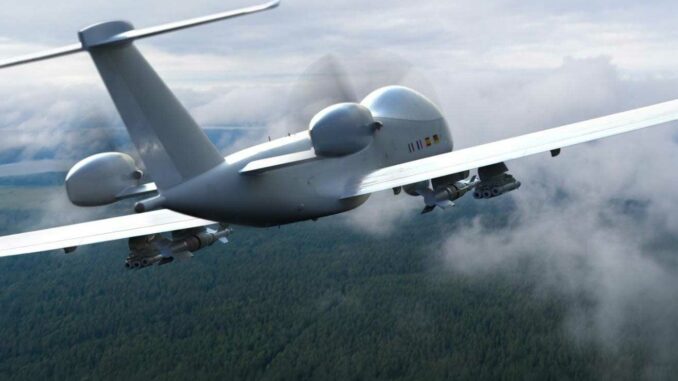
Eurodrone is a remotely piloted aircraft system (RPAS) belonging to the MALE category, an acronym designating platforms capable of flying at medium altitudes for extended durations.
Its primary functions encompass intelligence, surveillance, target acquisition, and reconnaissance (ISTAR). It can monitor vast geographic areas, track ground or naval movements, intercept electronic emissions, and transmit actionable data to command centers.
The platform will also accommodate strike capabilities. Leonardo and MBDA are working on integrating the Brimstone air-to-ground missile. Additional configurations are planned for maritime surveillance, anti-submarine warfare, communications relay, signals intelligence (SIGINT), or airborne early warning.
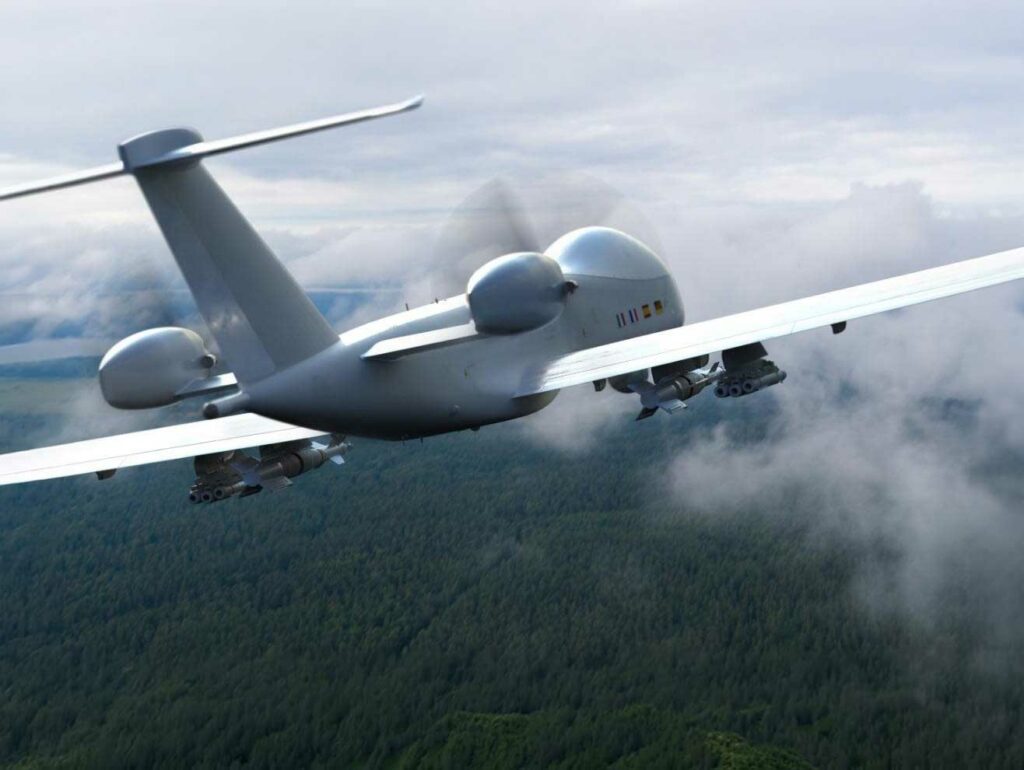
Eurodrone is not a light tactical platform comparable to the Bayraktar TB2. Recent public documentation describes a 12 to 13-metric-ton drone at maximum takeoff weight. Minor discrepancies between figures published by Airbus and OCCAR likely reflect evolving baseline configurations.
The aircraft measures approximately 17 meters in length, with a 30-meter wingspan and a height of nearly 6 meters. Its wingspan approaches that of a regional airliner. Operational ceilings are targeted at 12,200 meters (40,000 feet), with maximum speeds approaching 500 km/h (270 knots).
Airbus highlights an endurance of up to 40 hours and a 2.3-metric-ton mission payload, excluding fuel. This capacity allows the simultaneous integration of multiple heavy sensors: radar, electro-optical/infrared pods, SIGINT suites, communications equipment, and precision munitions.
The platform relies on a twin-engine configuration powered by two Catalyst turboprops from Avio Aero, a European subsidiary of GE Aerospace. Designed and manufactured in Europe, this propulsion choice aims to limit U.S. export restrictions and support the goal of an ITAR-free system.
Twin-Engine Design Fulfills Safety and Certification Demands
The twin-engine layout remains one of Eurodrone’s most debated features. It increases overall weight, fuel consumption, acquisition costs, and maintenance demands.
In return, it provides critical system redundancy. In the event of an engine failure, the aircraft can theoretically maintain flight and transit to a safe recovery area. This safety margin is particularly relevant over maritime zones, densely populated land areas, and shared civil air routes.
Eurodrone was designed from inception to operate within unsegregated airspace, requiring it to co-exist with commercial traffic without necessitating permanent airspace corridors.
This objective drives much of its design complexity. The aircraft must meet certification standards close to those imposed on civil aviation, incorporating redundant flight controls, high-reliability command links, collision avoidance systems, and fail-safe architectures designed to prevent catastrophic losses.
The program applies NATO STANAG 4671 standards alongside civil aviation airworthiness requirements. This dual approach distinguishes Eurodrone from tactical military drones designed primarily to operate within restricted airspace or active combat zones.
High Takeoff Mass Limits Utility in Contested Airspace
Civil airworthiness compliance and redundant systems carry a military trade-off. Eurodrone is large, slow, and lacks low-observable stealth features. Against modern integrated air defense systems (IADS), it remains relatively easy to detect and engage.
Its operational utility lies primarily in permissive or moderately contested airspace, monitoring borders, maritime sea lines of communication, supply routes, or rear areas of a theater. It can also operate standoff, leveraging long-range sensors outside enemy engagement zones.
It will not replace stealthy uncrewed combat aerial vehicles (UCAVs) designed to penetrate anti-access/area-denial (A2/AD) bubbles, nor can it survive unescorted against adversaries equipped with advanced fighters, long-range surface-to-air missiles, and electronic warfare capabilities.
These operational constraints underpin French skepticism. Lessons from the war in Ukraine have heightened interest in lower-cost, high-attrition, uncrewed platforms. Investing tens of millions of euros per system, alongside extensive ground support infrastructure, can appear mismatched with high-intensity attrition warfare.
However, this assessment warrants context. Eurodrone was never designed to be expendable. Its mission is to deliver persistent airborne surveillance, carry high-end sensors, and replace legacy platforms or manned platforms like the U.S.-sourced MQ-9 Reaper.
Budget Covers Entire Operational System, Not Just Airframes
The core contract was signed on February 24, 2022, by OCCAR, the joint armament procurement agency overseeing major European defense projects.
The procurement framework covers 20 operational systems. Each system includes three airframes and two ground control stations (GCS), translating to a total baseline order of 60 drones and 40 ground stations.
The original distribution allocated:
- 7 systems to Germany (21 airframes);
- 5 systems to Italy (15 airframes);
- 4 systems to France (12 airframes);
- 4 systems to Spain (12 airframes).
The total contract value stands at approximately €7.1 billion. This figure includes research and development, prototype construction, production of the 60 series airframes, ground control stations, support equipment, training systems, and initial in-service support.
A simplified division yields €355 million per system or roughly €118 million per airframe. These figures do not represent the unit flyaway cost of an individual aircraft; they encompass billions of euros in upfront R&D, flight testing, airworthiness certification, infrastructure setup, and long-term logistics.
The European Union also allocated nearly €100 million to the program through the European Defence Industrial Development Programme (EDIDP). While modest relative to the total contract value, this funding holds political significance: Brussels views Eurodrone as a cornerstone of European strategic autonomy.
National budget comparisons remain complex, as line items vary across member states. Germany budgeted nearly €3 billion for its seven systems. Spain approved approximately €1.7 billion for four systems, alongside additional allocations for national integration and support.
Initial French defense planning targeted approximately €2 billion to acquire up to six systems by 2035—exceeding the four systems included in the 2022 procurement contract. Those long-term procurement goals have since been called into question.
Industrial Workshare Balances Corporate and National Interests
Eurodrone operates under a strict industrial return structure among participating nations. Each government expects its procurement funding to generate matching high-tech employment for domestic aerospace firms.
This mechanism, known as juste retour (geographical return), addresses a core political reality: governments rarely commit billions of euros to joint projects if key engineering jobs and critical technology transfers shift to foreign partners.
However, geographical return can introduce industrial inefficiencies. Work packages are not always allocated based on technical efficiency or cost competitiveness; they must maintain a delicate balance between Germany, France, Italy, and Spain.
If a nation reduces its procurement footprint, its industrial workshare faces proportional reduction. This dynamic lies at the heart of the current dispute between Airbus and Dassault Aviation.
German Airbus Stakes Prime Contractor Credibility
Airbus Defence and Space GmbH leads the program from Germany. The division manages general system architecture, airframe integration, subsystem selection, certification, and final production.
The stakes extend beyond delivering 60 drones: Airbus must demonstrate its capability to manage a major European military aerospace program independently. This credibility became even more vital following the collapse of the joint FCAS fighter effort.
Another high-profile failure would reinforce perceptions that Europe cannot develop complex air systems without incurring delays, cost overruns, and industrial infighting. It would also handicap Airbus in a global MALE market dominated by the United States, Israel, Turkey, and China.
Eurodrone is also designed to serve as a sovereign, exportable baseline platform. Airbus is exploring international partnerships, including a joint study with Kawasaki Heavy Industries on a potential anti-submarine warfare derivative for Japan.
Japan and India have secured observer status within the program. Neither country has placed firm orders, yet international interest offers Airbus a long-term mechanism to offset reduced French orders.
French Dassault Defends Critical Flight Control Technologies
Dassault Aviation holds responsibility for flight control systems and a portion of mission communications architecture, in partnership with Thales. The company is also slated to participate in flight testing.
These work packages are technically critical. Flight control systems translate pilot inputs and automated navigation logic into control surface movements, directly impacting aircraft stability, safety, and flight performance.
Mission communication architectures handle data links between the platform, ground stations, satellites, networked aircraft, and operational command centers. These systems must remain resilient against electronic jamming, cyber threats, and signal loss.
Dassault CEO Éric Trappier estimated the company’s contractual share at approximately €1.2 billion across the life of the program—representing nearly 17% of the €7.1 billion baseline contract.
For Dassault, the dispute involves key technological competencies alongside financial returns. The firm seeks to preserve its proprietary expertise in digital flight controls, autonomous systems, and secure combat cloud communications—skills essential for future uncrewed combat aircraft and collaborative adjuncts paired with the Rafale F5.
Airbus argues that France’s reduced procurement volume changes the industrial return model that justified Dassault’s workshare. The German prime contractor moved to reduce this allocation and subsequently sought to terminate Dassault’s contract participation.
Dassault disputes this move. In its July 2026 financial report, the manufacturer asserted its intention to defend its contractual rights, with Trappier accusing Airbus of attempting to remove the company from the program.
Italian Leonardo Controls Core Mission Systems Architecture
Leonardo occupies a strong position within the program structure. The Italian defense group is responsible for the airborne mission system, which ingests, processes, and displays data from on-board sensors.
Leonardo supplies the Gabbiano surveillance radar, mission computers, environmental and electrical management systems, and weapons integration architectures. The firm also manufactures the complete wing structure.
This allocation gives Italy influence extending well beyond basic structural assembly. Leonardo controls key operational systems on Eurodrone, leveraging these capabilities across other maritime surveillance, electronic warfare, and collaborative combat efforts.
The firm is also collaborating with MBDA on Brimstone missile integration. For Rome, Eurodrone supports multiple domestic industrial sectors, including aerostructures, radar, sensors, avionics, and precision weapons.
Leonardo estimates that Eurodrone supports approximately 7,000 high-skilled aerospace jobs across Europe—a figure representing total supply chain employment rather than newly created positions.
Spanish Airbus Secures Strategic Aerospace Workshare
Airbus Defence and Space in Spain represents another major subcontractor. Madrid aims to consolidate its national capabilities in advanced aerostructures, system integration, and uncrewed platforms.
Spain negotiated a substantial industrial return in exchange for its funding. Spanish authorities cited a target return rate of approximately 19%, with higher domestic participation in specific program phases.
For Madrid, Eurodrone complements capabilities built on the Eurofighter Typhoon and Airbus military transport platforms, while reducing operational reliance on imported U.S. or Israeli uncrewed systems.
A French withdrawal could result in additional workshare for Spanish facilities, though it could also raise unit costs if overall development overhead is distributed across a smaller fleet.
French Budget Shift Disrupts Contract Balance
France has not formally withdrawn from Eurodrone. However, Paris removed procurement funding to purchase production aircraft prior to 2035 from its updated military planning.
This nuance is significant. According to Dassault’s financial report, France continues to fund research and development, but has paused funding for operational fleet procurement on the original timeline.
Paris considers that lower-cost, rapidly deployable platforms may better serve near-term high-intensity conflict needs. The French armed forces have shown growing interest in lighter tactical MALE platforms, including the Aarok system developed by Turgis & Gaillard.
France currently operates the U.S.-built MQ-9 Reaper. The Reaper features a maximum takeoff weight of approximately 4.76 metric tons, a payload capacity of 1.75 tons, and endurance exceeding 27 hours depending on configuration.
Eurodrone is more than twice as heavy, carries larger payloads, provides multi-engine redundancy, and offers longer endurance. Crucially, it promises European airworthiness certification, open system architecture, and operational sovereignty over software, sensors, and hardware upgrades.
The choice is not simply a comparison of sticker prices; it reflects two competing procurement models.
The first prioritizes rapid off-the-shelf procurement of proven systems, accepting operational dependencies on foreign suppliers. The second funds a more ambitious, sovereign European capability—accepting higher costs and longer development timelines to retain industrial control over multi-decade lifecycles.
Military needs are evolving faster than program timelines. Eurodrone was originally targeted for entry into service in the mid-2020s. However, the Critical Design Review (CDR) was completed only in October 2025, and Airbus currently targets a first flight in 2029.
This operational delay pushes initial operational capability (IOC) for customer nations into the early 2030s.
Removing Dassault Presents Technical and Schedule Challenges
Dassault cannot legally cancel the Eurodrone contract. The primary agreement links OCCAR, Airbus, and the participating states. Airbus can theoretically reassign French work packages internally or transfer them to another supplier.
Executing such a transition would be technically complex.
Flight control systems are tied to core airworthiness, interface dynamics, aerodynamics, flight computers, actuators, electrical power distribution, and failure mode management. Modifying these architectures post-Critical Design Review goes beyond swapping out modular components.
Reassigning these systems would require rewriting software, re-engineering system interfaces, and repeating safety demonstrations. The new supplier’s architecture would require re-qualification for functions already validated on paper.
Similar hurdles apply to mission communication suites. Replacing a primary vendor requires re-validating data protocols, encryption systems, cybersecurity architectures, satellite communications links, and ground station interoperability.
Airbus can proceed without Dassault, but doing so would likely introduce added costs and schedule risks.
Dassault also has incentives to avoid a total rupture. Its workshare remains substantial, and Eurodrone provides a footprint in large-scale European uncrewed systems. Exiting would mean forfeiting industrial returns linked to prior French development investments.
The dispute reflects less a deliberate attempt to derail Eurodrone than a struggle over work packages, contractual rights, and financial compensation.
FCAS Parallels Have Structural Limitations
FCAS and Eurodrone face a shared structural tension: European states seek an integrated defense industrial base while protecting domestic prime contractors.
However, program governance structures differ significantly.
On the Next Generation Fighter (NGF) project within FCAS, Dassault insisted on unambiguous technical leadership based on its combat aircraft heritage. Airbus resisted being reduced to a secondary partner representing German and Spanish interests. The dispute centered directly on system design authority.
On Eurodrone, prime contractor authority rests clearly with Airbus—a hierarchy Dassault accepted at the outset. Current friction centers on preserving agreed workshare volumes and contesting Airbus’s authority to terminate a subcontractor’s involvement.
Framing Dassault as attempting to repeat the FCAS outcome overlooks these contractual differences. The company is seeking to defend an existing contract and an allocated industrial workshare.
Still, the context cannot be ignored. The broader relationship between Dassault and Airbus remains strained. Following the breakdown of the joint fighter program, technical disagreements are easily viewed through the lens of corporate sovereignty, eroding the trust required for industrial compromises.
Export Sales Offer Volume Potential but Cannot Fix Delays
Eurodrone can proceed without immediate French production orders. Germany, Italy, and Spain maintain their baseline requirements, and demand persists for maritime surveillance, signals intelligence, and broad-area domain awareness.
Japan’s interest in an anti-submarine warfare variant represents a potential export path. A long-endurance platform operating over water for dozens of hours can perform maritime domain awareness, deploy acoustic sensors, or relay data to maritime patrol aircraft and surface vessels.
India represents another potential market as it seeks to expand maritime surveillance and diversify defense procurement. However, observer status does not equal a firm contract or financial commitment.
The program must demonstrate progress to secure export sales: proving the 2029 first-flight target, keeping production costs controlled, validating mission sensors, and confirming ITAR-free exportability.
Designing an ITAR-free platform provides a key marketing advantage, but it must be verified across every component, software module, and weapon integration. Incorporating a European-developed engine does not automatically guarantee an export-unrestricted platform.
Eurodrone’s Future Rests on Government Procurement Commitments
Dassault Aviation is unlikely to derail Eurodrone single-handedly, as it holds neither overall program management nor budget authority. Airbus can reallocate subsystem work packages and proceed alongside Germany, Italy, and Spain.
However, replacing key subcontractors would be neither rapid nor cost-free. It risks introducing cost increases and adding potential delays to a program targeting a 2029 maiden flight.
The central question is not whether Dassault seeks retribution for FCAS, but whether European states remain committed to jointly funding a long-endurance, sovereign, civil-certified RPAS as national defense priorities diverge.
France is prioritizing lighter, lower-cost tactical systems. Germany remains focused on civil airspace certification and safety redundancy. Italy protects its mission system integration, while Spain defends its domestic industrial return. Airbus is working to preserve a program for which it carries prime responsibility, and Dassault is fighting to retain a contract valued at over €1 billion.
The principal risk rests with participating governments. Joint defense programs face headwind when a core customer defers procurement, first-flight schedules slip by multiple years, and industrial workshares must be renegotiated after detailed design completion.
Eurodrone can still mature into a key asset for European strategic autonomy. Alternatively, it risks becoming another example of joint defense programs that generate industrial compromises more efficiently than operational military capabilities. The outcome will depend less on corporate statements than on the procurement funding committed by Berlin, Rome, Madrid, and prospective international clients.