
In the United States, the L-39 Albatros has transformed the military jet into a private asset. Costs, regulations, piloting, maintenance, and limitations of this phenomenon.
In Summary
Designed in Czechoslovakia to train Warsaw Pact pilots, the Aero L-39 Albatros embarked on an unlikely second career in the United States following the Cold War. Hundreds of surplus military aircraft flooded the civil market. In the 1990s and 2000s, some could be purchased for $200,000 to $300,000—the price of a high-end sports car. The market has since appreciated significantly: as of August 2026, publicly listed L-39Cs in the United States range between $475,000 and $975,000. Legally, owning the aircraft remains fairly straightforward. Piloting it is much less so: specific training, FAA authorization, demanding insurance requirements, and specialized maintenance are essential. With speeds up to 750 km/h, the L-39 can indeed serve as personal transportation for its owner. However, it is not a cheap business jet. Its limited range, high fuel consumption, and regulatory restrictions make it first and foremost an extraordinary passion aircraft.
The L-39 Has Become America’s Iconic Private Military Jet
Few objects illustrate the unexpected consequences of the end of the Cold War quite as well.
For two decades, the Aero L-39 Albatros was one of the iconic machines of the Soviet military system, training future pilots before their transition to MiGs and Sukhois.
Then the Soviet Union vanished.
Oversized air forces found themselves with hundreds of obsolete aircraft. Governments needed liquidity, and military inventories were liquidated. At the same time, the United States possessed an extremely active community of warbird collectors.
The convergence of these two worlds produced a market that would have been almost unimaginable a decade earlier.
L-39s crossed the Atlantic. Demilitarized and registered as experimental civil aircraft, they were acquired by entrepreneurs, collectors, former military pilots, and wealthy aviation enthusiasts.
The phenomenon took on exceptional proportions.
Aero reports having produced nearly 2,900 L-39s, operated by more than 30 air forces. The Soviet Union was by far its primary operator.
In the United States, the civil fleet reached approximately 250 aircraft. As early as 2012, American registries listed more than 250 L-39s. Today, US specialists on the model estimate that number remains close to 250 units.
The L-39 has thus become one of the most widespread private military jets in the world.
The Price of a Ferrari Can Truly Buy a Military Aircraft
The viral appeal of the L-39 relies primarily on its price point.
While fundamentally true, that story requires an update.
In the years following the collapse of the Soviet bloc, supply was abundant. L-39s often arrived with low flight hours, and their residual military value was negligible. American buyers could acquire airframes for around $200,000 to $300,000.
For a military jet aircraft capable of exceeding 700 km/h, the price was striking.
However, the 2026 market is no longer that of 2000.
In late August 2026, Controller listed three L-39Cs publicly offered in the United States, with asking prices of $475,000, $565,000, and $975,000.
The $475,000 model was a 1981 airframe with nearly 3,000 total hours. The unit listed at $565,000 featured upgrades aimed at cross-country travel capabilities. The most expensive, priced at $975,000, was retrofitted with a modernized western TFE731 engine.
Thus, the average asking price tells only part of the story.
A collectible L-39 relatively close to its original military configuration, an IFR-equipped aircraft, and a fully modernized airframe with Garmin avionics and a Western engine represent three economically distinct products.
Nevertheless, the comparison with a supercar remains relevant.
For the price of a high-end Ferrari, a well-equipped Lamborghini, or certain pre-owned hypercars, it is indeed possible to legally own a genuine military jet.
Yet, the purchase price is the easy part of the equation.
Purchasing Is Surprisingly Simple in the United States
To understand the phenomenon, one must separate ownership from operation.
US law does not prohibit a private individual from owning a former military aircraft simply because of its origin.
Once demilitarized, the L-39 can become a civil aircraft.
Armaments are naturally removed or disabled. The aircraft in question generally receive a Special Airworthiness Certificate in the Experimental category, operating primarily under the Exhibition purpose.
An eligible buyer under US registration rules can purchase the aircraft much like any other airframe.
The FAA requires proof of ownership—typically a Bill of Sale—and a registration application.
The aircraft is then assigned a US registration number beginning with “N.”
This is where the phrase “buying your own military jet” takes on its full meaning: one does not need to be a former fighter pilot to be an owner.
A corporation can also hold the title. This is common in the United States, where many aircraft are registered under LLCs.
However, owning an L-39 and taking the controls are two radically different matters.
Pilots Must Obtain Specific FAA Authorization
The L-39 is a high-performance single-engine jet.
Consequently, it falls under the US framework applicable to experimental turbine aircraft where a specific Pilot-in-Command type rating or authorization may be required.
In 2026, the FAA specifies that pilots must obtain an Experimental Aircraft Authorization endorsed on their pilot certificate.
The procedure resembles a traditional type rating.
Candidates must undergo ground and flight training with an authorized instructor, followed by a practical test administered by an independent Experimental Aircraft Examiner.
The practical test adheres to Airline Transport Pilot (ATP) performance standards regarding aircraft control.
It is by no means a casual checkout.
In practice, the insurance market often imposes criteria even stricter than federal administrative requirements.
AOPA noted in 2024 that insurers typically require around 1,000 hours of total flight time, an instrument rating, approximately 12 hours of dual instruction in the L-39, and at least 25 hours in the specific model before granting standard coverage.
The ease of purchase must therefore be kept in perspective.
A wealthy entrepreneur can sign a check and become an owner, but they cannot step into the cockpit the next day and take off solo at 700 km/h.
The L-39 Remains Relatively Easy to Fly for a Jet
This is one of the secrets of its success.
The L-39 was not designed as a front-line fighter; it was built to teach military jet flight.
This distinction is fundamental.
Its design prioritizes airframe robustness and predictability. The tandem cockpit gives an instructor seated in the rear seat excellent visibility. The flight controls are precise enough to teach aerial combat and aerobatics, yet the airframe remains more forgiving than a pure fighter optimized solely for peak performance.
The L-39C measures 12.13 meters in length with a wingspan of 9.46 meters.
Its empty weight is approximately 3,456 kg, with a maximum ramp weight near 4,700 kg.
Its landing gear is rugged, and its systems were engineered to endure intensive military flight-school operations. The aircraft can take off in roughly 480 meters under optimal conditions, with a landing speed around 165 km/h.
Its maximum level speed reaches approximately 700 km/h at sea level and 750 km/h at 5,000 meters (16,400 feet).
Initial rate of climb can reach 22 meters per second.
These are genuine military jet performance metrics.
However, “trainer aircraft” must not be translated as “easy aircraft.”
Speeds unfold much faster than in a general aviation piston plane. Fuel consumption requires precise planning, emergency procedures are more demanding, and energy accumulated at high speeds drastically reduces the time available to correct an error.
Even taxiing is unconventional: the L-39 utilizes a free-castering nosewheel with a differential braking system controlled via the rudder pedals and a hand-brake lever on the stick.
An experienced pilot can adapt quickly.
An inexperienced pilot can become overwhelmed almost immediately.
Maintenance Is Simple for a Military Jet, But Not for a Private Plane
The second factor driving the L-39’s US success is its engineering.
Designed to operate from austere military bases and log high flight hours, it had to be maintained by military technicians and tolerate student errors.
It is therefore vastly simpler than a true supersonic fighter.
Its original engine is the Ivchenko AI-25TL, producing approximately 16.9 kN (3,792 lbf) of thrust.
The L-39 employs a single engine, carries no complex combat radar, and lacks mission systems typical of modern fighters. Civil versions are stripped of armaments and unnecessary military hardware.
This significantly reduces maintenance complexity.
The FAA even developed an inspection program tailored specifically to the L-39, featuring 50-hour/6-month inspections, 100-hour/12-month inspections, and heavier 400-hour/48-month checks.
Still, robustness should not be confused with low cost.
An L-39 remains a 40-year-old military aircraft.
Parts availability is therefore critical.
Specialized companies like Code 1 Aviation have built a dedicated industry around the L-39 in the United States. Code 1 operates over 40,000 square feet (3,700 m²) devoted in part to warbird parts inventory and support.
This infrastructure makes the L-39 far more practical to operate than many other former military jets.
However, original Soviet-era components are becoming harder to support.
The AI-25TL engine is a prime example: the war in Ukraine has complicated access to historical overhaul facilities. Consequently, some American owners choose a radical solution: replacing the Ukrainian engine with a Western Honeywell Garrett TFE731.
The American Engine Transforms the L-39 into a True Experimental Private Jet
The TFE731 conversion perfectly illustrates the evolution of this market.
This engine standardly powers several business jets.
Code 1 Aviation offers its installation in the L-39 as a replacement for the AI-25TL.
The result goes beyond parts availability.
The original engine requires roughly 9 to 12 seconds to spool up from idle to high power, whereas the TFE731 can respond in approximately four seconds.
It is also lighter and consumes less fuel.
Code 1 cites approximately 145 US gallons per hour for the AI-25TL at a baseline cruise condition (around 549 liters per hour), compared to 124 gallons (around 469 liters per hour) with the TFE731-3.
Maintenance intervals also expand. Depending on history and variant, the AI-25TL features time-between-overhaul (TBO) intervals often ranging between 500 and 1,000 hours, whereas the TFE731 can reach roughly 1,400 hours between major interventions.
The modification is expensive.
AOPA reported a cost of approximately $350,000 for the engine conversion.
In other words, seriously modernizing an L-39 can cost almost as much as purchasing an intact aircraft.
Yet for an owner intending to use the aircraft for cross-country travel, the logic becomes compelling.
Business Owners Can Truly Travel in an L-39
This is perhaps the most fascinating angle of the phenomenon.
A civil L-39 is not confined to low passes at airshows.
Certain US-registered aircraft are outfitted for IFR flight with modern GPS units, Garmin flight displays, modern transponders, autopilots, and extended fuel capacities.
One L-39C currently offered for sale in the United States is explicitly advertised as IFR-equipped, featuring an autopilot and auxiliary fuel to facilitate cross-country flights.
Far more extensive modifications exist.
AOPA highlighted the L-39 belonging to businessman and pilot Jimmy Hayes, completely modernized with four Garmin G3X displays, dual GTN 750s, a traffic advisory system, a TFE731 engine, and fuel capacity expanded to 392 US gallons (approximately 1,484 liters).
This machine can reach approximately 741 km/h (400 KTAS) at 25,000 feet (7,620 meters).
At that speed, a 500-km trip theoretically represents about forty minutes of cruise time.
For an owner with an airfield near their residence and another close to a business destination, the time savings are real.
They bypass major airline terminals, security lines, and commercial flight schedules, climbing directly into their aircraft to reach another region extremely fast.
In this respect, a modernized L-39 can indeed function as an extraordinary personal transportation vehicle.
However, this model faces severe limitations.
The L-39 Loses to Real Business Jets for Serious Travel
A standard L-39C offers a restricted operating radius.
Aero quotes a baseline range of approximately 1,000 km at 5,000 meters.
While that may sound comfortable, for a dedicated cross-country travel aircraft, it is not.
Published range never implies an owner should plan a 1,000-km leg. Fuel reserves mandated by regulations, headwind components, diversions, and weather conditions must all be factored in.
Furthermore, the L-39 is a two-seater.
The owner can carry only one passenger.
Baggage space is minimal.
The cabin obviously offers no lavatory, no ability to stand up, no work table, and no real professional workspace.
Altitude limits must also be considered.
Although the L-39C has a service ceiling published at 11,500 meters, many US-registered units lack RVSM approval. In practice, they often remain below 28,000 feet (8,534 meters) in controlled airspace.
A modern business jet can fly higher, find better winds, and easily cover 2,000 to 3,000 km non-stop.
Finally, the L-39 burns a massive amount of fuel to transport two people.
Even a modernized airframe burns around 470 to 550 liters of Jet A per hour depending on power setting and configuration.
Speed alone does not make a good business aircraft.
Experimental Restrictions Prevent Commercial Taxi Use
There is another constraint often overlooked in videos promoting private military jets.
Most American L-39s operate under an Experimental Exhibition airworthiness certificate.
This means they do not hold the same regulatory status as a Citation or Gulfstream certified in the Normal or Transport category.
Federal regulations impose operating limitations tailored to each individual aircraft.
Crucially, they prohibit using an Experimental aircraft to carry persons or property for compensation or hire in commercial operations.
Passengers must also be advised of the aircraft’s experimental nature.
Operating limitations may also restrict flights over densely populated areas, specific flight corridors, or dictate IFR and night operations depending on the aircraft’s individual FAA issuance.
An owner can fly the L-39 strictly according to their operating limitations and authorizations.
They cannot simply turn a former military jet into a small charter service.
This distinction is fundamental.
The Ultimate Luxury Is Flying It Yourself
Ultimately, this is where the L-39 becomes far more compelling than a simple comparison with a Ferrari.
An owner seeking pure efficiency will generally buy something else.
For several hundred thousand dollars, turboprops or piston aircraft offer lower operating costs, easier insurance terms, more baggage space, and longer range.
With several million dollars, a modern light jet completely outclasses the L-39 for corporate transport.
Yet none provides the same experience.
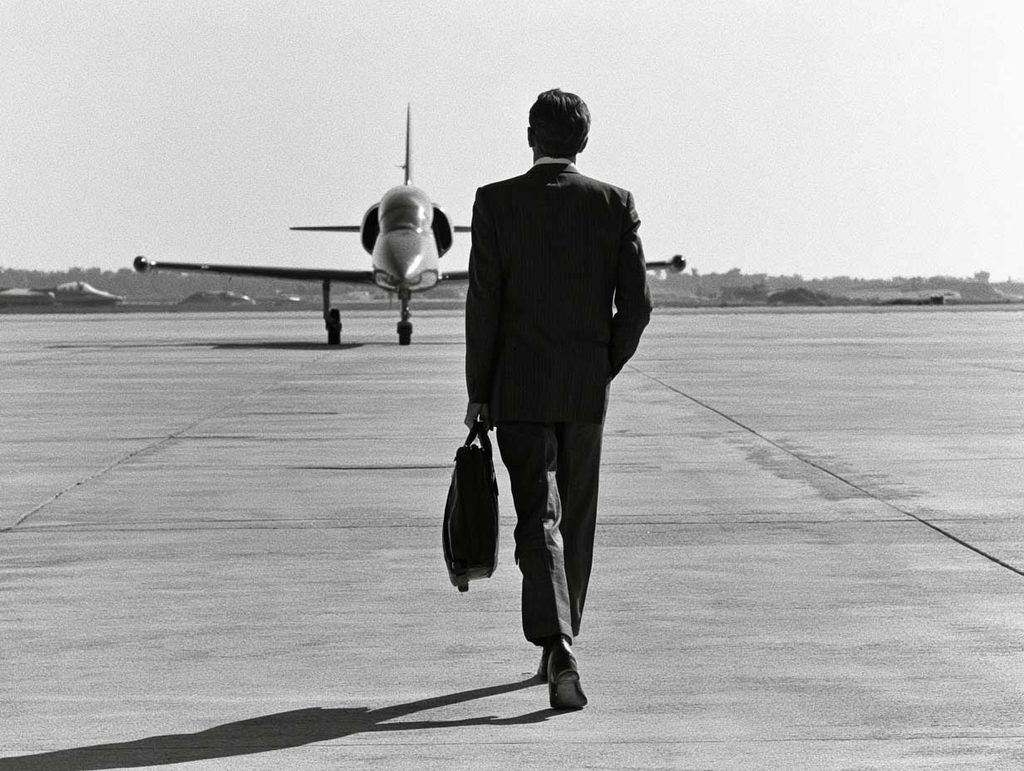
An L-39 owner does not sit behind a desk with a laptop while a flight crew transports them to a destination.
They strap into a military tandem cockpit, close a bubble canopy, and start a turbofan. They taxi in an aircraft that once trained Warsaw Pact fighter pilots. Minutes later, they can exceed 600 or 700 km/h and climb thousands of meters into the sky.
Then they fly the approach and land the aircraft themselves near their destination.
That combination explains the US phenomenon.
The L-39 is not a poor man’s private jet. Rather, it is one of the few former military jets that a wealthy civil pilot can still reasonably expect to own, maintain, and fly.
And that is precisely why its market endures.
The fall of the Soviet Union temporarily turned a military machine produced in nearly 3,000 units into an extraordinarily cheap pre-owned commodity. Thirty-five years later, that historical anomaly is gradually fading. Good airframes cost more, engines age, parts become more precious, and modernized units now approach the million-dollar mark.
Yet the myth remains intact.
One can still visit a US aircraft sales website, find a former Warsaw Pact jet with a listed price, call the seller, and buy it.
A Ferrari gets you to the airport fast.
The L-39 lets you fly away in the jet.