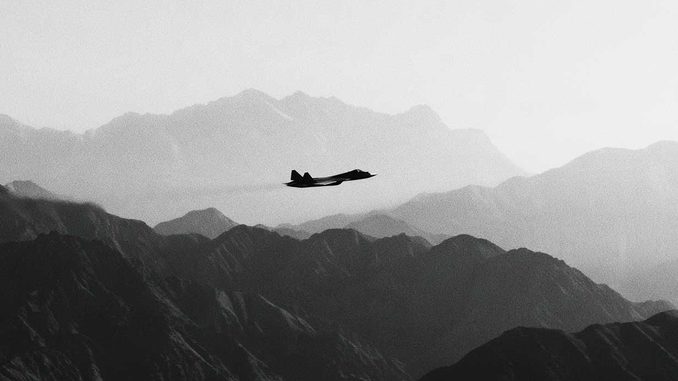
Moscow delivers upgraded Su-57s while the stealth fighter adopts an external configuration designed to intercept drones and cruise missiles.
In Summary
On September 24, 2026, United Aircraft Corporation delivered a new batch of Su-57s to the Russian Aerospace Forces, featured as being in a “new technical configuration.” Moscow has provided no details regarding the modifications to these aircraft, but asserts that they directly reflect operational feedback gathered in Ukraine. Since February, UAC had already mentioned modernized onboard systems and weapons suites. Another evolution is now visible: the Su-57 is being tested or deployed as a long-range drone interceptor, fitted with air-to-air missiles under its wings and an external electro-optical pod. This configuration trades part of its low radar observability for increased weapons payload, optical identification capabilities, and immediate missile readiness. The choice is telling. In the face of deep Ukrainian strikes, Russia is progressively turning its fifth-generation fighter into a multirole air defense platform.
The Su-57’s New Configuration Remains Deliberately Sparse on Details
The press release published on September 24 is clear on one point and remarkably vague on the rest. UAC confirms the delivery of new Su-57 Felon fighters, but gives neither their quantity nor the list of modified equipment.
The manufacturer nevertheless asserts that aircraft currently rolling off the assembly line at Komsomolsk-on-Amur differ significantly from those produced at the start of the war. It points to a “huge evolution” and specifies that the modernization incorporates combat experience.
This phrasing is not entirely new. On February 9, 2026, UAC had already announced the delivery of a batch in a “new technical configuration,” equipped with modernized onboard systems and armament.
Caution is therefore warranted before reaching hasty conclusions. The September batch does not necessarily represent a completely new variant of the Su-57. Rather, it marks another step in an ongoing evolution of the serial production baseline.
The Product 177 engine illustrates this nuance. It completed its first flight on a Su-57 in December 2025 with a claimed maximum thrust of 16,000 kgf (approx. 157 kN). However, there is no official confirmation that the aircraft delivered on September 24 are all equipped with this engine.
Combat Feedback from Ukraine Broadens the Fighter’s Mission Scope
Since 2022, the Su-57 has not primarily seen action over the front lines in Ukraine. Moscow has generally preferred leveraging its sensors and weapons standoff capabilities to minimize exposing this small fleet to ground-based air defenses.
Operational Su-57 operational feedback thus shows an aircraft utilized for standoff strikes, intelligence gathering, and beyond-visual-range air-to-air engagements out of immediate enemy reach.
Concurrently, its arsenal has diversified. Rosoboronexport now offers for the Su-57E export variant the RVV-MD2 short-range, RVV-SDM medium-range, and RVV-BD long-range air-to-air missiles, as well as the Kh-69 cruise missile, Kh-58UShKE anti-radiation missile, Kh-38MLE air-to-ground missile, and Kh-35UE anti-ship missile.
The RVV-SDM is particularly relevant in the current operational environment. Its seeker combines active and passive radar guidance modes, inertial navigation, and mid-course radio link correction. According to the manufacturer, it can engage aircraft, helicopters, cruise missiles, and drones at altitudes ranging from 15 m to 25,000 m.
Consequently, the Su-57 is becoming far less specialized than its original image as a dedicated stealth air-superiority fighter suggested.
The Anti-Drone Configuration Prioritizes External Missiles
The most unusual development surfaced publicly in early summer 2026.
Photographs showed a Su-57 carrying short-range air-to-air missiles under its wings. The visible weapons likely belong to the R-73/R-74 family. Additional equipment was also spotted mounted beneath the left engine nacelle.
This arrangement is uncommon, as the Su-57 is explicitly designed with internal weapons bays to stow its missiles while maintaining a low radar cross-section.
In an anti-drone mission over Russian territory, operational priorities shift.
Stealth becomes secondary. A Su-57 guarding a refinery several thousand kilometers from the front lines typically has no need to penetrate a Ukrainian network of radars and surface-to-air missile batteries. It can therefore accept wing pylons and external missiles.
The operational advantages are practical. Missiles are immediately available for launch. Legacy R-73 missiles can be expended. Furthermore, overall missile payload increases when internal bays and external hardpoints are loaded simultaneously.
This loadout is well suited for repeated interceptions of incoming drones or cruise missiles.
The 101KS-N Pod Provides Visual Sensing Beyond Radar
The second notable element is the pod mounted under the left engine intake.
It resembles the 101KS-N, a component of the 101KS Atoll electro-optical suite. However, precise identification from available photographs remains uncertain. Observers note slight differences compared to previously known iterations of the 101KS-N.
Originally, this pod was designed for navigation, surface observation, and ground targeting. Yet its utility against unmanned aerial vehicles is clear.
A slow, relatively small aerial target may present a low radar cross-section. Nevertheless, it exhibits a distinct optical outline and, depending on its propulsion, a usable thermal signature.
An electro-optical targeting system enables operators to search for and, crucially, passively identify targets without radiating signals as a radar would. This capability proves invaluable when tracking multiple objects in airspace shared with civilian aviation.
The pod complements the Su-57’s existing organic sensor suite. The aircraft features the N036 Byelka AESA radar alongside the integrated 101KS electro-optical complex, which includes an IRST system capable of detecting airborne targets via thermal radiation.
Furthermore, the Su-57’s N036 Byelka radar relies on multiple distributed AESA arrays rather than a single nose-mounted antenna. This architecture is well suited for tracking threats approaching from widely varying azimuths.
Protecting Omsk Demonstrates the Mission Is No Longer Purely Theoretical
On July 6, 2026, a Su-57 was observed operating above Omsk during a Ukrainian strike against the local oil refinery, located approximately 2,500 km from the Ukrainian border.
An A-50U airborne early warning aircraft reportedly participated in the defense response.
This event underscores a critical transition: the anti-drone role has evolved from concept into operational employment. However, it does not prove that the Su-57 is regularly shooting down Ukrainian drones. No verified data exists to establish how many targets have actually been intercepted by the fighter.
In fact, the Omsk refinery sustained damage despite the assets deployed.
Deploying a Su-57 also remains economically questionable. Scrambling a fifth-generation jet and firing a sophisticated air-to-air missile to destroy an inexpensive drone yields an unfavorable cost-per-interception ratio.
However, that calculus shifts entirely when the drone’s intended target is a refinery, defense plant, or airbase valued in the hundreds of millions or billions of dollars.
External Stores Tangibly Degrade Stealth
Hanging missiles and pods beneath the wings comes with clear trade-offs.
Every pylon, missile body, and interface hardware creates additional reflecting surfaces for incoming radar waves. Missile fins, cylindrical bodies, and right-angle junctions with the airframe produce new radar reflections.
As a result, the Su-57 surrenders part of the low-observable advantage provided by its internal weapons bays.
Aerodynamic drag also increases. This leads to higher fuel consumption and can compromise acceleration, operational radius, or top speed depending on the payload.
Yet this configuration underscores an intriguing logic: stealth is treated as a mission variable, rather than an absolute requirement.
To penetrate heavily defended hostile airspace, internal weapons remain essential. To conduct air defense patrols over Russian territory against incoming drones, missile capacity and visual identification capabilities can take precedence.
The Su-57 Becomes Both Drone Hunter and Drone Carrier
This operational shift gained another dimension in September. Rostec unveiled a family of stealth drones designed to be launched directly from the Su-57. The Russian conglomerate describes these as high-speed, long-range, low-observable platforms.
Russia is thus pursuing development on both sides of the same equation.
The Su-57 must be capable of detecting and destroying enemy drones, while simultaneously deploying its own unmanned systems. The two-seat Su-57D prototype, which began flight testing in May 2026, is explicitly presented by UAC as a future command platform for manned-unmanned teaming (MUM-T) operations.
This provides deeper context for the “new technical configuration” announced in September. The Su-57’s evolution is no longer limited to a stronger radar or a new missile type. It reflects how the aircraft is being integrated into an operational environment saturated with sensors, long-range weapons, and autonomous unmanned platforms.
The paradox captures the essence of the war in Ukraine. Russia originally engineered the Su-57 to penetrate modern air defense networks using its stealth characteristics. Today, it finds that one of its most advanced fighters is also being assigned to hunt low-cost drones over home territory with missiles hanging from its wings. Warfare often forces platforms into roles very different from those envisioned by their engineers.