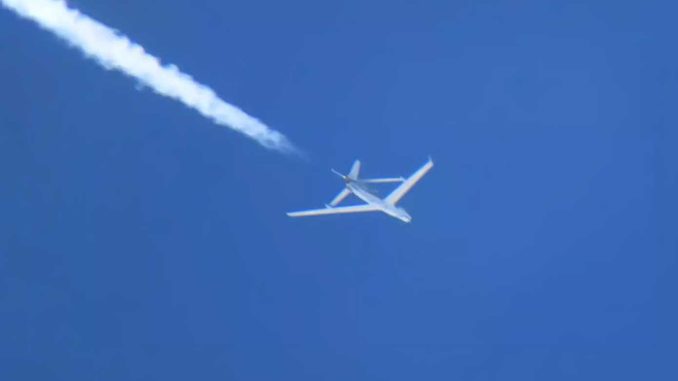
The WZ-7 appears near Scarborough while Beijing multiplies sorties around Taiwan. Analysis of a Chinese surveillance and combat network.
In Summary
The deployment of the WZ-7 near Scarborough Shoal on September 27, 2026, marks a significant evolution in China’s posture in the South China Sea. It is the first publicly documented use of this large HALE drone around this flashpoint between Beijing and Manila. The WZ-7 is designed to remain at high altitude for extended periods and perform intelligence, surveillance, and reconnaissance (ISR) missions. Its data can also feed a targeting chain, track vessels, and serve as a relay between various forces. A few days later, on October 6, Taiwan detected 14 Chinese aerial sorties, nine of which crossed the median line and entered different sections of its ADIZ. These two events fall under the same operational logic: connecting drones, fighters, radar aircraft, electronic warfare, naval vessels, and command centers to achieve a continuous picture of the theater of operations.
The Scarborough Deployment Goes Beyond a Simple Drone Demonstration
On September 27, the People’s Liberation Army Southern Theater Command organized a naval-air exercise around Scarborough Shoal, known as Huangyan Dao to Beijing and Bajo de Masinloc to Manila. The reef is located approximately 222 km (120 nm) from Luzon.
The exercise notably paired a WZ-7 Soaring Dragon with a KJ-500 airborne early warning aircraft, warships, and other aircraft. Type 054A frigates, Type 056A corvettes, and a replenishment vessel were identified in images released by China. A few days later, J-16s and an H-6 bomber were also shown in the sector.
The nuance is important: this was not the first known presence of a WZ-7 in the South China Sea. The drone had already been observed in the region. However, it is the first officially documented deployment near Scarborough Shoal in an operational Chinese exercise.
China is thus progressively turning a maritime dispute into an issue of informational control. Spotting a vessel early makes it possible to identify it, predict its trajectory, and position a frigate or a coast guard cutter before its arrival.
The WZ-7 Is a HALE Drone Built to Look Far and Long
The WZ-7 belongs to the HALE category, for High Altitude Long Endurance. It should not be confused with an armed drone like the Wing Loong. Its primary role is intelligence collection.
The exact specifications of the operational model remain classified. Open-source figures generally associated with the program indicate a length of approximately 14.3 m, a wingspan close to 24.9 m, a service ceiling of around 18,000 m (59,000 ft), and a speed approaching 750 km/h. The endurance of the prototype was estimated at around ten hours. These values should be considered orders of magnitude, as the serial aircraft differs from the initial prototype.
At an altitude of 18 km, the advantage is not just escaping very short-range air defenses. Altitude significantly extends the sensor horizon. An aircraft positioned that high can monitor an extremely wide maritime area, provided its sensors have the necessary range.
This capability directly complements the modernization of the Chinese Air Force, which no longer relies solely on fighter jets, but on an architecture combining sensors, relays, and effectors.
The Joined-Wing Design Gives the WZ-7 Its Distinctive Silhouette
The most easily identifiable feature of the Soaring Dragon is its tandem joined-wing architecture.
A swept-back forewing is connected to a rear wing with a different geometry. The wingtips form a closed structure resembling a diamond shape when viewed from above.
This design aims to provide several advantages. The structure becomes more rigid than an extremely long conventional wing. This is valuable for an aircraft that needs to generate substantial lift while flying for hours at high altitude, where the air is much thinner.
The configuration can also improve the lift-to-drag ratio. This ratio is critical for endurance: the less energy the aircraft expends overcoming drag, the longer it can remain on station.
Operational aircraft feature a turbofan engine mounted at the rear, fed by a dorsal air intake. The production variant also dropped the prototype’s single vertical tail in favor of two canted surfaces.
Sensors Are the Real Military Value of the Soaring Dragon
The full details of the WZ-7’s payload are not public. A distinction must therefore be made between confirmed functions and assumed equipment.
China confirms its use for reconnaissance and intelligence gathering. PLA documents and demonstrations also show that collected data can be transmitted to a command post to support fighters executing penetration or strike missions.
Janes now describes the WZ-7 as capable of carrying out ISR missions, post-strike damage assessment, data relay, and close-up photographic identification of foreign vessels. In 2026, China demonstrated how its drone brigades work alongside intelligence analysts to search for and classify ships at sea.
Open evaluations also attribute radar, electro-optical, and possibly electronic intelligence (ELINT) capabilities to certain configurations.
A Synthetic Aperture Radar (SAR) offers an obvious advantage. The aircraft’s motion allows it to electronically synthesize a much larger antenna and produce detailed radar imaging of ground or sea surfaces. Unlike a standard camera, radar can operate at night and through cloud cover.
Electro-optical sensors then allow for more precise visual identification. ESM systems, if installed, can passively detect radar or communications emissions without revealing the drone’s own location.
The WZ-7 Can Shorten China’s Entire Targeting Chain
The most important military application goes beyond taking photos.
The challenge with a long-range anti-ship missile is not merely reaching a target several hundred or thousand kilometers away. It requires knowing the current position of that target.
An aircraft carrier moving at speed for an hour will no longer be at the coordinates observed hours earlier by a satellite.
The WZ-7 can thus serve as a key link in a sensor-to-shooter chain. A satellite detects an area. The drone searches for or regains contact. It updates the target’s position. The information flows to a command center, which can then transmit a firing solution to an aircraft, a warship, a cruise missile, or potentially a land-based anti-ship missile unit.
Furthermore, the U.S. Army considers that large Chinese drones like the WZ-7 can contribute to targeting and supporting joint force commands.
It is this integration between sensor and weapon that makes the drone far more significant than its aerodynamic performance alone.
The October 6 Sorties Demonstrate This Exact Logic Around Taiwan
On October 6, Taiwan’s Ministry of National Defense detected 14 PLA aircraft sorties. Nine crossed the median line of the strait and entered the northern, central, and southwestern sectors of Taiwan’s monitored ADIZ. Seven PLAN warships and one official government vessel were also present.
Taipei specified that the observed formation included J-11s, JH-7s, Su-30s, a KJ-500, a Y-8 electronic warfare aircraft, and drones. Beijing framed the activity as a “joint combat readiness patrol.”
This operational composition is far more interesting than the raw figure of 14 aircraft.
The J-11, derived from the Su-27 family, can provide air-to-air coverage. The Su-30 is a heavy multirole fighter. The JH-7 is tailored for strike missions. The KJ-500 monitors the airspace with its early warning radar and assists in battle management. The specialized Y-8 adds an electronic warfare component.
This combination reflects the ongoing progression of Chinese electronic warfare and the push toward a force capable of operating as a networked system rather than a mere aggregation of individual aircraft.
Taiwan’s ADIZ Must Not Be Confused with Territorial Airspace
However, the term “incursion” requires precision.
An Air Defense Identification Zone is not sovereign airspace. It is a designated zone in which a state requests the early identification of incoming aircraft for national defense purposes.
Entering an ADIZ is therefore not equivalent to penetrating territorial airspace. Territorial airspace standardly extends up to 22.2 km from the coast (12 nautical miles).
The significance of these Chinese flights stems instead from their frequency, the operational areas covered, and their coordinated nature. They force Taiwan to detect, classify, and track the formations. Simultaneously, they allow Beijing to observe activated radar systems, response times, bases used, and defense procedures.
This pressure has become a permanent element of Chinese patrols around Taiwan.
The WZ-7 Fits into a Much Larger System Than Scarborough Alone
The choice of Scarborough is particularly revealing. Beijing did not send a drone in isolation. It combined high-altitude surveillance, airborne early warning radar, fighters, a bomber, frigates, and coast guard vessels.
The WZ-7 can loiter at high altitude and build a comprehensive operational picture of the area. The KJ-500 primarily monitors air activity and manages the tactical situation. Naval vessels maintain a physical presence. Fighter jets bring speed and firepower. Coast guard units can exert pressure without immediately crossing the threshold into a conventional military clash.
The same principle applies around Taiwan: the network matters more than any single platform.
This is likely the key takeaway from the September deployment. The WZ-7 is not a flashy weapon, nor is it stealthy in the sense of an aircraft like the J-20. A modern adversary can detect it and, in an open war scenario, attempt to destroy it.
Its true value lies prior to the first shot. It gives China time, persistence, and information. Around Scarborough, in the Taiwan Strait, or beyond the first island chain, these three elements can transform a fleet of ships, fighters, and missiles into a far more cohesive combat system.