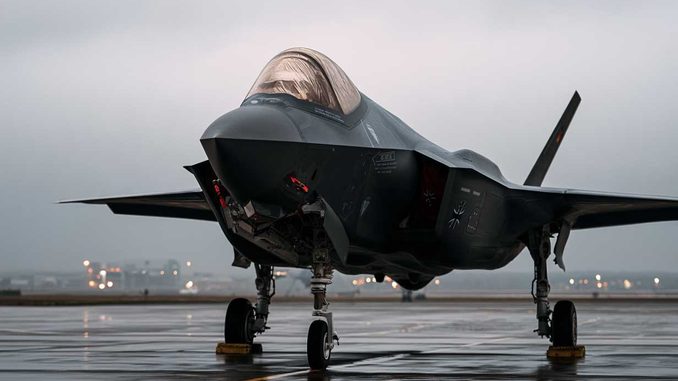
Why European militaries are replacing their fighter jets with American F-35s: budgets, military advantages, technological dependence, and consequences.
In summary
Europe is accelerating the renewal of its combat fleets in favor of the Lockheed Martin F-35 Lightning II. The Czech Republic, Romania, Denmark, and Switzerland have committed to major procurement programs to acquire this American stealth fighter jet. These decisions reflect a profound transformation in air defense strategies, driven by the war in Ukraine and the buildup of Russian military capabilities.
The Czech Republic notably selected 24 F-35As for an acquisition program approaching 150 billion korunas, while Romania is investing approximately $6.5 billion in 32 aircraft. These contracts promise unprecedented capabilities in stealth, intelligence, and NATO interoperability.
However, this modernization comes with significant trade-offs: high operating costs, industrial dependence on the United States, and reduced technological sovereignty. Facing the advancements of Russian Sukhoi and Chinese Chengdu combat aircraft, Europeans must now balance immediate military effectiveness against strategic independence.
The Czech Republic’s choice marks a strategic shift
Prague’s decision illustrates the repositioning of European air forces. In January 2024, the Czech government formalized the acquisition of 24 F-35A Lightning IIs, intended to gradually replace its Saab JAS 39 Gripen C/Ds.
The total program cost approaches 150 billion Czech korunas, or roughly 6 billion euros based on initial estimates. This funding covers aircraft, equipment, infrastructure, and operational readiness.
The first aircraft are scheduled to arrive in the Czech Republic in 2031. The full fleet is expected by 2035, when the F-35s are projected to reach full operational capability.
This choice goes beyond simply replacing aging jets. While the Gripen remains effective for air policing and interception, Prague sought an aircraft capable of penetrating airspace defended by modern surface-to-air systems.
The F-35’s stealth features reduce its radar cross-section without making it entirely invisible. Its AN/APG-81 active electronically scanned array (AESA) radar, infrared sensors, and electronic warfare systems allow it to detect, identify, and share tactical data.
This combination sets the F-35 Lightning II apart from conventional fourth-generation fighters.
The Czech government is thus embracing a shift in doctrine: prioritizing survivability in contested environments over sheer fleet size.
Denmark and Romania accelerate their military modernization
Denmark is following a similar path. After an initial order of 27 F-35As to replace its F-16s, Copenhagen decided in October 2025 to acquire 16 additional aircraft.
The planned fleet will ultimately reach 43 stealth fighters. The announced budget for this expansion stands at 29 billion Danish kroner (approximately 3.9 billion euros), covering equipment, spare parts, and training capabilities.
This force posture expansion addresses monitoring needs in the Baltic and North Atlantic regions. Denmark officially retired its F-16s from operational service in January 2026.
Romania is pursuing a different objective, directly linked to its proximity to Ukraine and the Black Sea.
In November 2024, Bucharest signed an agreement for 32 F-35As under a program estimated at $6.5 billion. The acquisition includes training, simulators, munitions, and initial logistical support.
First deliveries are scheduled for 2030–2031, with completion anticipated in 2035. Second-hand F-16s are providing transitional coverage in the interim.
The F-35 is intended to enable Romania to contribute more effectively to integrated NATO air operations, particularly against Russian air defenses and electronic warfare assets.
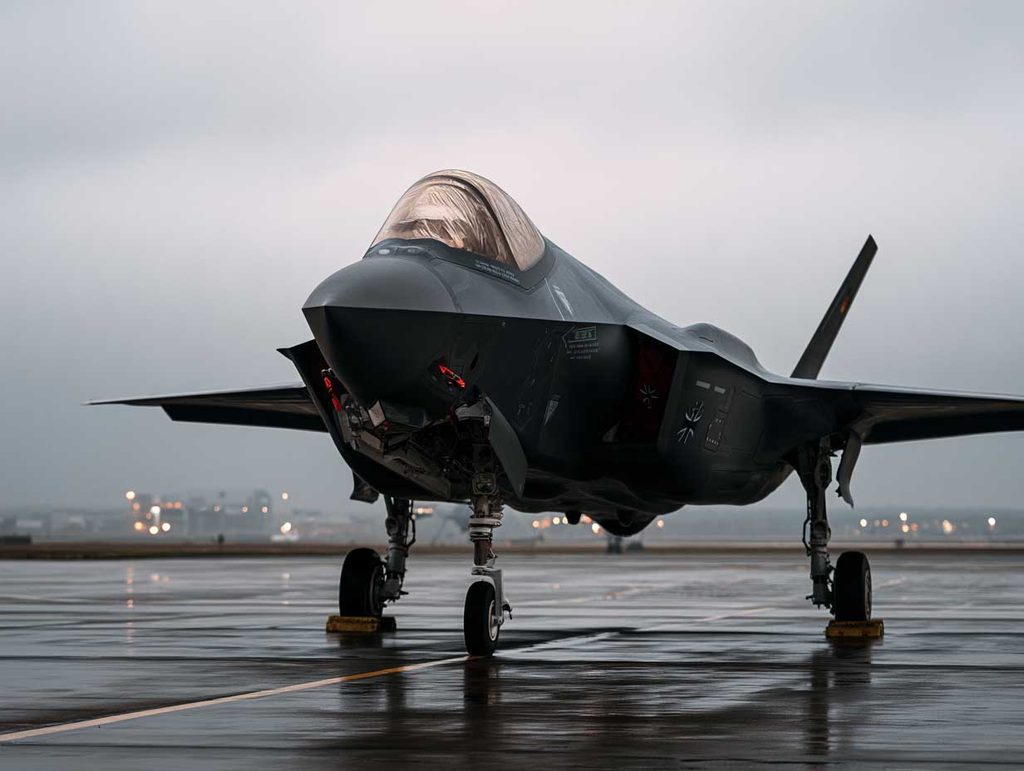
US stealth offers operational advantages, but at what cost?
The main appeal of the F-35 lies in its tactical data fusion.
The aircraft synthesizes inputs from its radar, infrared detectors, electronic warfare sensors, and allied networks. This provides the pilot with a consolidated picture of the battlespace.
This capability enhances threat identification and coordination with other aircraft, naval vessels, and ground systems.
The F-35 can also carry missiles and bombs in internal bays to preserve its low radar cross-section. Mounting external stores increases payload capacity, but compromises stealth.
These technical advantages come at a high financial price.
In June 2026, the Danish National Audit Office (Rigsrevisionen) revealed that the Ministry of Defence had underestimated acquisition and operating expenses for the first 27 F-35s by approximately 14 billion Danish kroner in 2017 baseline prices.
In the United States, the Government Accountability Office reported that the operational availability of the US fleet dropped from 67% in 2021 to 44% in 2025, with full mission-capable rates reaching only 25%.
While these US figures do not directly reflect European fleet readiness, they underscore ongoing program challenges regarding maintenance, supply chains, and technical support.
Switzerland highlights the budgetary limits of stealth rearmament
The Swiss case serves as a cautionary tale.
Having initially committed to acquiring 36 F-35As, the Federal Council announced on March 6, 2026, that it was stepping back from that fixed quantity due to cost overruns.
Bern intends to procure as many aircraft as fit within its approved budget ceiling while requesting a supplementary credit of 394 million Swiss francs to absorb cost increases.
This decision shows that purchasing stealth fighters involves far more than airframe costs.
Securing funding requires accounting for hardened infrastructure, maintenance equipment, personnel training, software updates, and armaments.
Dependence on US supply chains represents another constraint. Access to technical upgrades, industrial support, and operational data remains governed by the overarching F-35 program parameters.
While Washington cannot unilaterally disable European aircraft, national autonomy over maintenance and modernization remains distinctly limited.
Russia and China pursue contrasting industrial strategies
As F-35 deployments expand across Europe, Moscow is focusing on upgrading its Sukhoi Su-30SM2, Su-34, and Su-35S fleets alongside the development of the Su-57.
The Su-35S belongs to generation 4++, featuring powerful radar, high endurance, and extreme maneuverability, though it lacks true structural stealth.
China has taken a different path. After purchasing 24 Russian Su-35s, Beijing developed its own domestic platforms, notably the Chengdu J-20 and Shenyang J-16.
Modern fighter jet procurement highlights a fundamental distinction: Europe relies heavily on proven American technology, whereas China aims to control its entire aerospace supply chain.
However, Russia’s Su-57 and China’s J-20 differ significantly in industrial maturity and production scale. Grouping them broadly under the stealth umbrella obscures key operational differences.
Europe faces a choice between military power and sovereignty
The commercial success of the F-35 enhances NATO air force interoperability while intensifying pressure on European manufacturers like Dassault Aviation, Saab, and the Eurofighter consortium.
The Dassault Rafale, Saab Gripen E, and Eurofighter Typhoon retain clear strengths: national control over upgrades, weapons integration flexibility, and industrial autonomy.
However, they do not offer the same native combination of stealth and sensor fusion as the F-35.
Portugal, which continues to evaluate options to replace its F-16 fleet, illustrates this dilemma. As of October 8, 2026, no final selection has been announced.
The central issue extends beyond a simple competition between US and European platforms. It concerns whether nations can maintain an air force fleet that is numerically sufficient, highly available, and sustainable over decades.
A stealth aircraft grounded by maintenance issues cannot contribute to air defense. Conversely, an autonomous fleet incapable of surviving modern anti-access environments presents equally serious risks.
True air sovereignty will depend on balancing technological edge, operational readiness, and long-term cost management—far more than on the manufacturer’s country of origin.