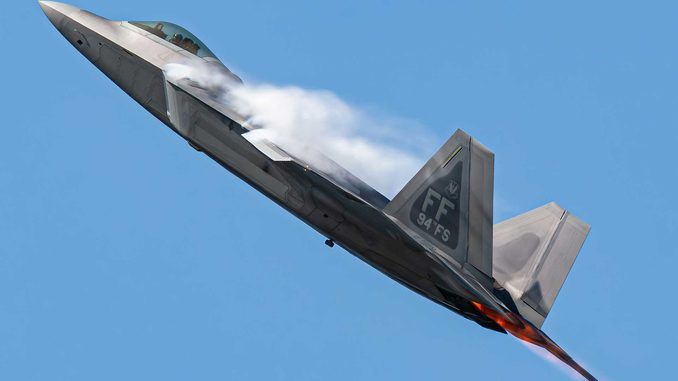
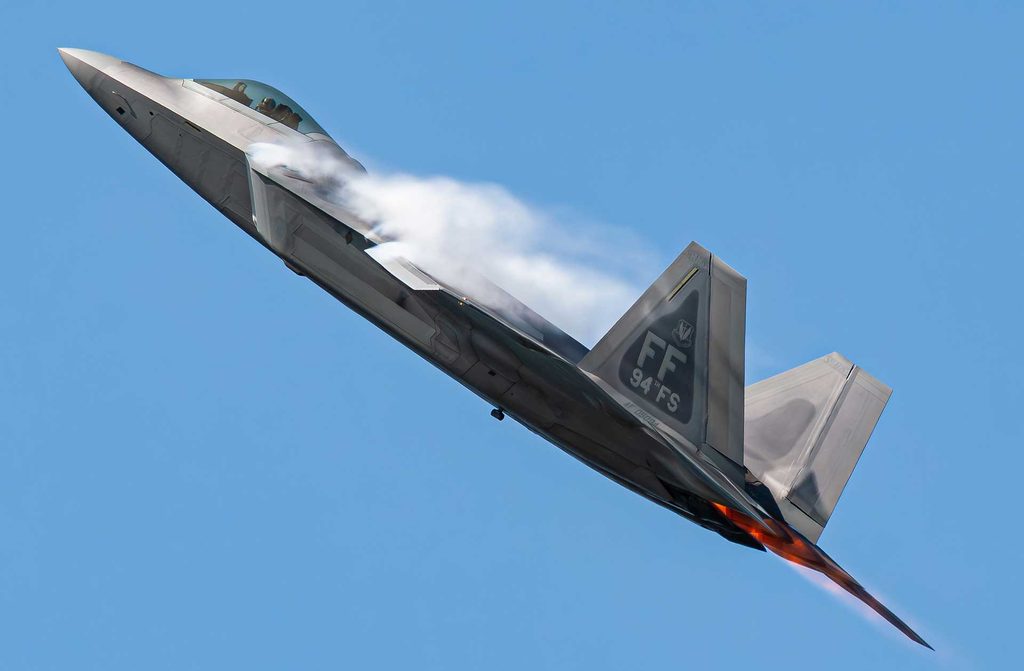
The F-22 is testing new stealth pods and infrared sensors at Edwards aimed at upgrading its detection and survivability.
Executive Summary
New photographs captured in September 2026 over California show a F-22A Raptor fitted with two low-observable external pods. These flights are part of a much broader campaign conducted out of Edwards Air Force Base to modernize the American stealth fighter. The stakes are high. While the F-22 still boasts an exceptional blend of stealth, speed, supercruise, and maneuverability, its sensor architecture dates back to the 1990s. The US Air Force now aims to equip it with long-range passive infrared detection, strengthen its electronic warfare capabilities, and modernize its missile warning system. The pods currently observed are primarily linked to an Advanced Sensor Pod IRST system. Their exact function remains classified, and they should not be confused with the Infrared Defensive System (IRDS), a separate suite of airframe-integrated infrared sensors.
New Pods Alter the F-22’s Silhouette
The F-22 Raptor was engineered around an almost uncompromising principle: nothing should protrude unnecessarily from its airframe. Missiles are stowed in internal bays and exterior surfaces are aligned to minimize radar reflections.
This is precisely why the images captured near Edwards Air Force Base are so compelling.
On September 19, 2026, an F-22 flying under the callsign “FEVER21” was photographed with two pods mounted on its underwing hardpoints. The aircraft was later spotted alongside an F-16 during aerial refueling conducted by the “GHOST81” NKC-135 test tanker. One of the pods features a forward section consistent with an optical or infrared window.
This is not an isolated appearance. Similar configurations have been undergoing testing for several years. In March 2026, an Edwards-based F-22 was photographed with these same pods alongside new low-drag, radar-reduced external fuel tanks.
Precision is necessary here: the US Air Force has not confirmed that these pods are electronic warfare pods. Public documentation links them primarily to the Sensor Enhancement program and an IRST capability. Electronic warfare upgrades are indeed part of the overall F-22 modernization, but the precise function of each pod remains classified.
The IRST Sensor Enables Searching Without Emitting
The operational utility of an Infrared Search and Track (IRST) system is fundamentally different from that of a radar.
The F-22’s AN/APG-77 AESA radar emits electromagnetic energy and analyzes the return signal. While its low probability of intercept modes make emissions difficult to detect, it remains an active transmission.
An IRST operates passively. It searches for an aircraft’s infrared signature: airframe friction heating, engines, hot exhaust plumes, and thermal contrast against the background. Consequently, it can detect and track an adversary without generating revealing radar emissions.
This capability is particularly vital when facing other stealth fighter jets. Radar stealth reduces radar cross-section, but it cannot eliminate engine heat or aerodynamic skin heating.
However, IRST is not a silver bullet. Its performance is heavily dependent on atmospheric conditions, humidity, cloud cover, altitude, target orientation, and background temperature. Furthermore, precise angular detection does not automatically yield instantaneous target range like a radar does. True tactical value comes from multi-sensor fusion.
US Air Force budget documents explicitly describe the Sensor Enhancement program as an effort to improve long-range target acquisition.
Pod Stealth Demands Aerodynamic and Electromagnetic Trade-offs
Attaching an external sensor pod to an F-22 presents an almost paradoxical engineering challenge.
A conventional pod creates edges, joins, cavities, and angles that readily reflect radar waves. Its mounting pylon can itself become a significant reflector. On a stealth aircraft, encasing electronics inside a streamlined fairing is simply not enough.
The geometry must also precisely control electromagnetic reflections.
The observed pods feature chiseled, angular shapes consistent with low-observable design principles. This does not imply they are invisible to radar; rather, it indicates their radar signature is carefully managed to minimize degradation of the aircraft’s overall stealth profile.
Dynamic flight tests at Edwards are critical in this context. Any new external store alters drag, wing loading, vibration characteristics, and localized airflow. Engineers must validate pod behavior across varying speeds, angles of attack, and g-load factors.
Flight testing focuses on identifying aeroelastic flutter, forced vibrations, aerodynamic interaction with the pylon, and structural stress. The faster and harder the aircraft maneuvers, the more severe these phenomena become.
The goal is not merely to determine whether the sensor “works,” but to prove it remains stable, cooled, powered, and fully operational across the entire authorized flight envelope.
The Boeing 757 “Catfish” Accelerates System Integration
The flight test campaign does not rely solely on F-22 airframes.
In June 2026, the Boeing 757 Flying Test Bed nicknamed “Catfish” was photographed at Edwards carrying a comparable pod mounted beneath its fuselage. This aircraft has served for decades as a flying laboratory for the Raptor program.
Its utility is immense.
The 757 carries representative F-22 avionics, allowing engineers to test sensors, processors, and software before integrating them onto an operational fighter. This risk-reduction approach enables rapid software and hardware adjustments between test sorties.
Edwards also features specialized facilities to evaluate radar and electronic warfare systems within controlled electromagnetic environments prior to flight trials. In these chambers, the F-22 can be exposed to simulated radar emitters, jamming, and complex threat scenarios.
The New IRDS Must Not Be Confused with the IRST Pod
The modernization initiative includes another major infrared capability: the Infrared Defensive System, or IRDS.
Lockheed Martin was awarded a $270 million contract to integrate this architecture into the F-22. It relies on a distributed array of Gen III TacIRST sensors embedded around the airframe. Its primary mission differs fundamentally from the long-range targeting pod: it is designed to enhance threat detection, particularly incoming air-to-air and surface-to-air missiles.
While the offensive IRST primarily hunts adversaries, the IRDS monitors immediate threats directed at the F-22 itself.
Combining both systems provides the Raptor with comprehensive passive infrared coverage: long-range targeting ahead of the aircraft, paired with distributed spherical situational awareness to boost survivability.
Distinguishing between these two programs is crucial, as they are frequently conflated in public commentary regarding the pod photos.
Stealth Fuel Tanks Address the Range Problem
The same test campaign encompasses Low Drag Tanks and Pylons (LDTP).
The F-22’s legacy external tanks hold 600 US gallons (approx. 2,270 liters) each. While they significantly extend range, they compromise stealth and aerodynamic performance, requiring pilots to jettison them before entering contested combat zones.
The next-generation tanks pursue a fundamentally different balance. Lockheed Martin states that the new design allows the F-22 to retain more of its maneuver performance without requiring mandatory jettison prior to engagement.
This evolution is especially critical in the Indo-Pacific theater, where vast distances separate air bases, aerial tankers, and combat zones.
It complements a hallmark capability of the F-22: supercruise flight, which enables sustained supersonic flight without continuous afterburner consumption.
The F-22 Becomes a Testbed for Next-Generation Air Warfare
The program is no longer focused merely on maintaining a aircraft designed thirty years ago. It aims to transform the Raptor into a platform capable of remaining dominant against advanced stealth fighters, ultra-long-range missiles, and highly sophisticated integrated air defense networks.
FY2026 budget documents explicitly outline several distinct upgrade vectors: Sensor Enhancement, IRDS, communications, anti-jam navigation, Low Drag Tanks and Pylons, and survivability enhancements. Concurrently, the test program executes rapid software update cycles; the FY2025 DOT&E report notes a sequence of operational capability releases extending through R10.
Opting for external pods is revealing. Deeply modifying the airframe of a stealth jet produced in a limited run of just 195 units would be prohibitively expensive and time-consuming. Modular external stores allow the service to deploy next-generation sensors without redesigning the nose cone, wing structures, or internal avionics bays.
However, this approach comes at a cost: any external store partially compromises both the radar signature and aerodynamic performance of the jet.
Quantifying that trade-off is the exact objective of the Edwards flight tests. The F-22’s operational future now hinges on this balance: preserving a stealth geometry designed in the 1990s while outfitting the jet with the eyes, networks, and survivability tools required for air combat in the 2030s.