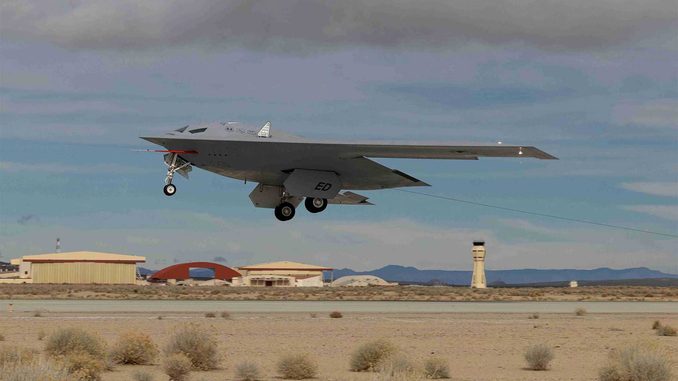
Washington is accelerating the production capacity of the B-21 Raider by 25% to face China, while the F-47 NGAD enters its development phase.
Executive summary
The US Air Force is accelerating the B-21 Raider, but the industrial mechanics are far more precise than a simple opening of a “new assembly line.” In February 2026, Washington and Northrop Grumman finalized an agreement funded by $4.5 billion to increase annual production capacity by 25%. In September, Northrop Grumman inaugurated East Gate 3 in Utah, a new manufacturing facility supporting this ramp-up. Final assembly remains at Palmdale, California. The objective is clear: deliver a long-range stealth bomber faster, capable of penetrating enemy defenses, particularly in the Pacific. However, the B-21 does not “replace” the NGAD. The sixth-generation fighter jet program, long vulnerable due to its cost, crossed a milestone in March 2025 with the award of the F-47 development contract to Boeing.
The 25% increase reflects an industrial scale change
The core announcement is now official. The US Air Force and Northrop Grumman agreed to increase the annual production capacity of the B-21 Raider by 25%. The agreement mobilizes $4.5 billion in additional funding. Northrop Grumman concurrently plans roughly $2.5 billion in multi-year investments to expand its industrial footprint.
However, a distinction must be made between production capacity and a new final assembly line. The B-21 continues to be assembled at Air Force Plant 42 in Palmdale, California. The East Gate 3 site, inaugurated on September 9, 2026 in Layton, Utah, is a new manufacturing facility designed to support the ramp-up. The East Gate campus is projected to reach approximately 78,500 m² (845,000 ft²) and will host up to 1,500 employees by 2032.
The US Air Force does not publish the exact number of aircraft produced each year. It would therefore be misleading to automatically convert the 25% into a specific number of additional bombers. The production rate remains largely classified.
The B-21 transitions from prototype to a credible military capability
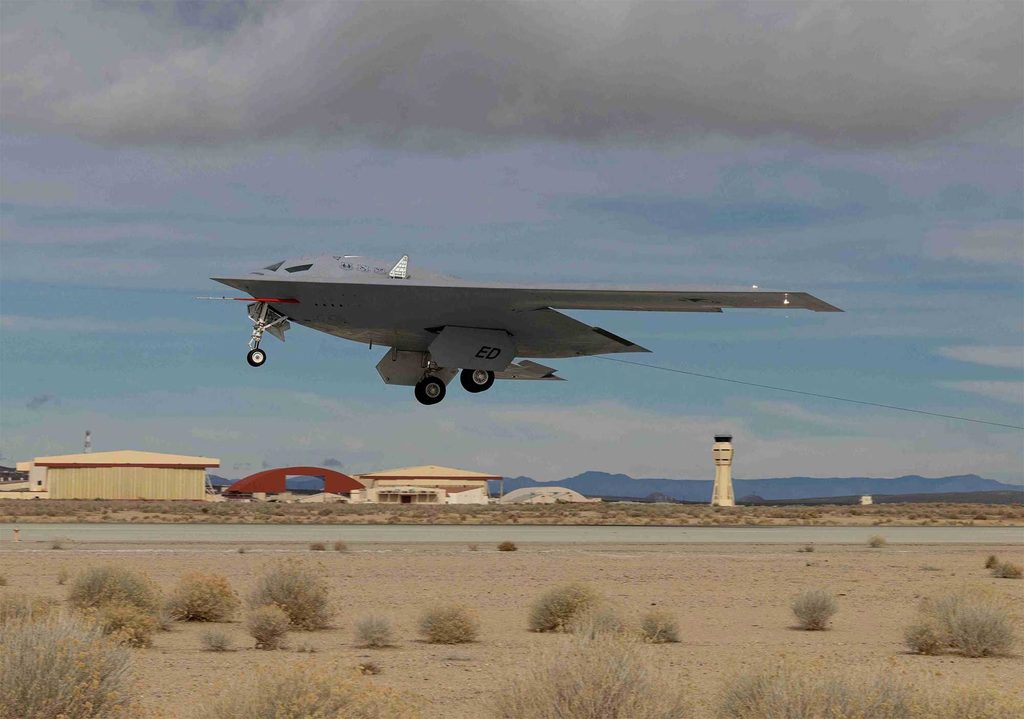
The first B-21 flew in November 2023. A second flight-test aircraft joined Edwards Air Force Base in September 2025, expanding testing to mission systems and weapons integration. In April 2026, the Raider also demonstrated aerial refueling with a KC-135.
The next phase is operational. The Air Force confirms that the first B-21s are scheduled to arrive at Ellsworth Air Force Base, South Dakota, in 2027. Whiteman Air Force Base in Missouri, followed by Dyess Air Force Base in Texas, will follow.
Washington still plans for a fleet of at least 100 B-21s. The official Average Procurement Unit Cost is $692 million in constant 2022 dollars. This figure does not represent the simple “flyaway” price. It includes acquisition costs distributed across the fleet, notably support equipment, spare parts, training, and certain engineering changes.
The Raider is meant to progressively replace the B-1B Lancer and B-2 Spirit, while the B-52 will remain in service. Its value lies in the combination of stealth, intercontinental range, open architecture, and the ability to carry conventional or nuclear payloads.
China turns bomber range into a strategic priority
The Pacific imposes distances that tactical fighters cannot overcome alone. China simultaneously maintains a dense network of ballistic and cruise missiles, anti-aircraft assets, and rapidly modernizing Chinese combat aircraft. The primary goal is to complicate American power projection around the first and second island chains.
The H-6K already provides the People’s Liberation Army Air Force with long-range strike capabilities using cruise missiles. The H-6N adds aerial refueling and contributes to the development of the airborne leg of China’s nuclear triad. Beijing is concurrently pursuing the development of the H-20 stealth bomber.
In this context, the B-21 is designed to reduce American reliance on vulnerable forward bases. It must be able to launch from long ranges, penetrate heavily defended airspace, and strike strategic targets. The geography of the Indo-Pacific places immense value on endurance, stealth, and aerial refueling.
NGAD is no longer stalled as it was in 2024
The link between the B-21 and NGAD requires a timeline correction. In 2024, the program was indeed paused. Frank Kendall, then Secretary of the Air Force, indicated that the projected concept could cost roughly three times the price of an F-35 Lightning II, potentially nearing $300 million per aircraft. At that level, extreme sophistication directly threatened the fleet capacity attainable by the US Air Force.
However, that phase has passed. On March 21, 2025, Boeing secured the Engineering and Manufacturing Development contract for the NGAD platform, now designated the F-47. The F-47 program is therefore currently in active development rather than awaiting a decision on its survival.
The US budget request for Fiscal Year 2027 allocates approximately $5 billion for the F-47, compared to about $3.5 billion in 2026. The first flight is targeted for 2028. The final unit cost of the F-47 remains unreleased; the widely cited $250 million to $300 million figures pertained to the original NGAD concept that prompted the 2024 review.
The B-21 and F-47 address two distinct requirements
The B-21 is therefore not a substitute for the F-47. Their missions are complementary. The Raider is a long-range penetrating strike platform capable of delivering conventional and nuclear weapons against heavily defended ground targets.
The F-47 operates under a different logic. It is built to gain and maintain air superiority in highly contested environments, operate alongside Collaborative Combat Aircraft, and eventually assume a portion of the missions currently assigned to the F-22.
This distinction is fundamental in the Pacific. Destroying strategic Chinese infrastructure thousands of miles from an American base and securing air superiority over a contested zone are distinct missions. The B-21 provides depth to American strike capacity, while the F-47 aims to protect and expand the operational freedom of the air force.
The American bet now rests on industrial speed
The most revealing change is ultimately industrial. Washington is now funding manufacturing plants, suppliers, and infrastructure before operational urgency becomes critical. East Gate 3 illustrates this logic: the industrial base must be capable of keeping pace when operational deliveries surge.
Risks remain. Accelerating production while flight testing continues can make late-stage engineering changes costly. However, the B-21 program was specifically structured around digital architecture, open systems, and test aircraft production using the same methods as operational airframes.
Facing China, time has become a strategic variable. Possessing a highly capable stealth bomber is insufficient if production items arrive too slowly. The American challenge is to field enough B-21s, early enough, while simultaneously developing the F-47 and CCA drones. The competition is no longer fought solely on technology, but on the ability to rapidly convert technology into usable military mass.