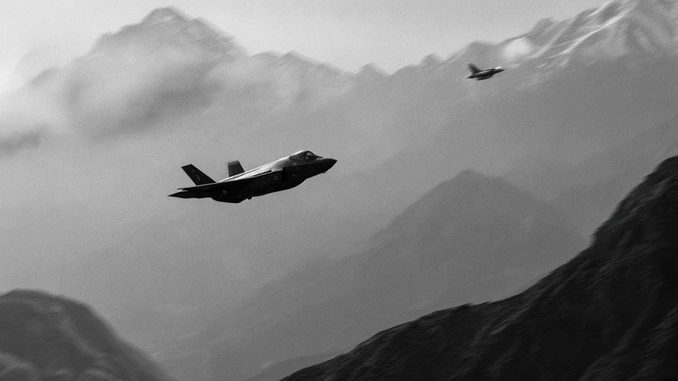
In Jodhpur, six American F-35As are participating in Tarang Shakti 2026. India is testing interoperability and asserting its regional strategic role.
In Summary
The Indian Air Force opens the second edition of Tarang Shakti 2026 in Jodhpur, its main multinational air exercise, taking place from September 26 to October 12. The event assumes a distinct dimension this year with the announced participation of six U.S. Air Force F-35A Lightning IIs, accompanied by KC-135 tankers. While the F-35 had previously landed in India for Aero India, it had never been engaged in a tactical exercise from an Indian base. More than 80 aircraft are set to take part in the maneuvers, including Indian Rafale, Su-30MKI, Tejas, Mirage 2000, Jaguar, and MiG-29 fighters, alongside French Rafales and Emirati F-16s. Beyond training, Tarang Shakti serves three main objectives: confronting doctrines, improving interoperability, and strengthening Indian defense diplomacy. The American presence also sends a regional signal, without transforming the exercise into a military alliance directed against China or Pakistan.
The F-35 Transitions from Airshow Display to Simulated Combat
The shift is significant. The F-35 Lightning II had previously been presented at Aero India in 2023 and 2025. Those appearances were essentially static displays and industrial diplomacy. At Tarang Shakti 2026, the platform enters a tactical environment.
According to information released to the Indian press, the United States is deploying six F-35As and two KC-135s. They will operate alongside or against the primary fighters of the Indian Air Force. Scenarios include within-visual-range combat, Beyond Visual Range (BVR) engagements, large force employments, dynamic targeting, aerial refueling, and combat search and rescue missions. Over 80 aircraft and approximately 1,500 personnel are participating in the exercise.
India is committing a large portion of its frontline inventory: Rafale, Su-30MKI, Tejas, Mirage 2000, Jaguar, and MiG-29 fighters, complemented by airborne early warning, transport, and aerial refueling aircraft. France is contributing notably with its Dassault Rafale and strategic projection and refueling assets. The United Arab Emirates is deploying F-16s.
The Exercise Converts Jodhpur into a Modern Air Combat Laboratory
The value of an exercise of this scale is not in determining which aircraft “wins.” Rules of engagement are controlled, weapons are simulated, and the most sensitive capabilities remain protected.
The military value lies elsewhere. Pilots must operate against unfamiliar aircraft and tactics. This is the core principle of dissimilar air combat training. A pilot accustomed to routinely facing friendly platforms eventually anticipates their reactions. A foreign participant introduces different signatures, performance profiles, and tactical methods.
The benefit is even greater at the force-wide level. Fighter aircraft, tankers, transports, detection platforms, and command chains must be synchronized. Crews need to share a common tactical picture, manage priorities, prevent airspace conflicts, and react rapidly as scenarios evolve.
The 2024 edition of Tarang Shakti previously allowed U.S. and Indian forces to conduct large-scale operations involving American F-16Cs, A-10s, KC-135s, and C-130Hs. The U.S. Air Force noted at the time that the objective was as much about tactical progress as it was about building shared procedures and mutual understanding.
The F-35 Provides Indian Pilots a Fifth-Generation Baseline
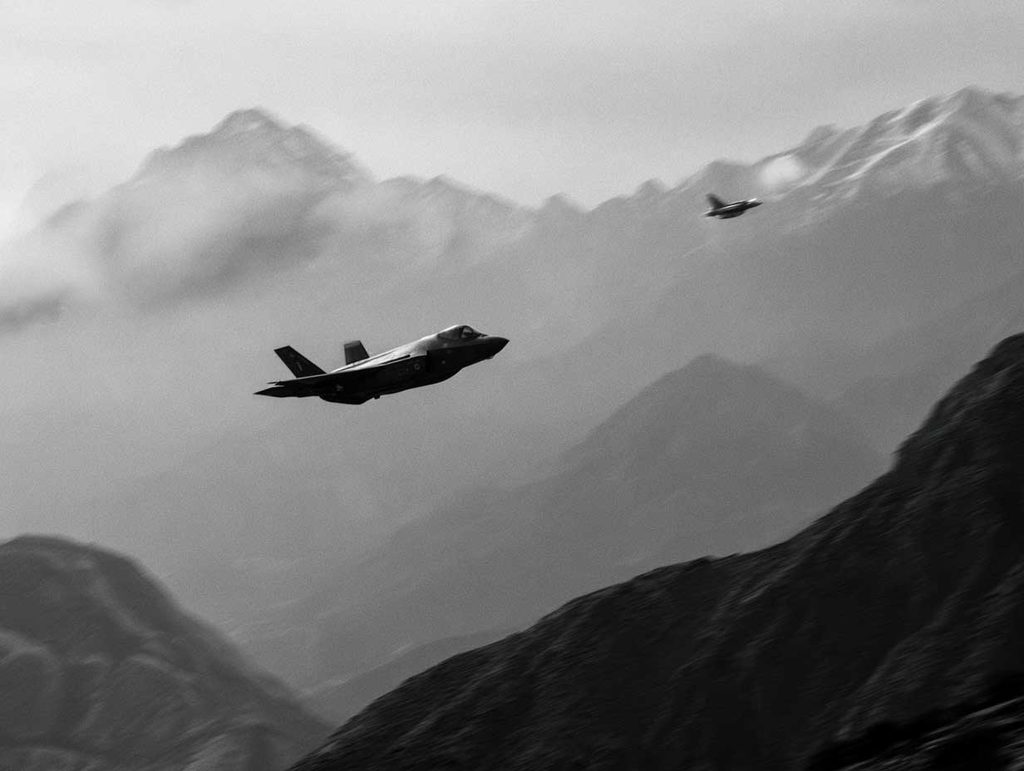
The presence of the F-35A is of particular interest. The American fighter combines low radar observability, sensor fusion, electronic warfare, and passive detection. Its advantage is therefore not based solely on aerodynamic performance.
For Indian crews, flying in the same scenario as an F-35 offers the opportunity to observe how a fifth-generation aircraft integrates into a formation and utilizes sensor-fused data to command the fight.
In BVR missions, the challenge extends beyond maneuvering alone. Crews must detect, classify, and engage before the adversary. The F-35’s low observability complicates this engagement sequence, while its sensor fusion enables the pilot to build situational awareness without relying on a single radar source.
However, it would be inaccurate to conclude that the IAF will be able to freely measure all F-35 capabilities. The United States strictly protects its signatures, radar modes, electronic warfare suites, and specific data-sharing functions. A multinational exercise is not an unrestricted comparative trial.
India Seeks to Learn while Demonstrating Organizational Capability
Tarang Shakti reflects a deliberate evolution by the Indian Air Force. For a long time, India primarily conducted bilateral exercises. It now seeks to plan and execute operations involving multiple foreign air forces.
The Vice Chief of the Air Staff, Air Marshal Ashutosh Dixit, summarized the objectives across three main pillars: operational learning, interoperability, and the strengthening of partnerships. The scenarios are also designed to integrate recent lessons learned by India in precision strike, integrated air defense, electronic warfare, counter-UAV ops, and multi-domain operations.
The exercise also serves as a showcase. Thirty-two countries are participating as observers. New Delhi can thus display the Tejas, its sensors, weapons, and more broadly the capabilities of its domestic aerospace industry. This is particularly relevant as the Indian Air Force pursues comprehensive modernization and looks to build more systems domestically.
The Geopolitical Signal Extends Beyond Washington Relations
The presence of six American F-35s is inevitably observed across the region, though its interpretation requires nuance.
For Washington, Tarang Shakti reflects a defense partnership that has steadily deepened. The U.S.-India defense framework signed in 2025 explicitly calls for increasing the frequency, complexity, and technological level of joint exercises. The deployment of the F-35 aligns directly with this strategy.
The broader context makes the picture even more noteworthy. Economic relations between Washington and New Delhi face current friction, particularly regarding Indian purchases of Russian oil and potential U.S. tariffs. Tarang Shakti demonstrates that military cooperation and political friction can proceed in parallel.
For China, the signal is not one of India joining a formal U.S. alliance. The exercise also brings together France, the United Arab Emirates, Australia, Germany, Bangladesh, Sri Lanka, and, according to the government program, Greece. New Delhi maintains a policy of multi-alignment. The message is rather that of an India capable of bringing together diverse air forces and accessing advanced Western air combat methodologies. Sino-Indian relations are concurrently experiencing a phase of cautious stabilization following years of heightened tension.
Pakistan will also monitor the exercise closely. Jodhpur is located approximately 200 km from the Pakistani border, and the IAF explicitly indicated its intent to incorporate lessons from Operation Sindoor. This gives Tarang Shakti a clear regional resonance. However, there is no indication that the exercise was designed as a direct threat toward Islamabad.
The primary demonstration is ultimately less about a simulated duel between the F-35 and the Rafale or Su-30MKI. India is demonstrating its ambition to act as an organizer of multinational air combat, capable of hosting fifth-generation U.S. aircraft while maintaining a fleet that integrates French, Russian, and domestic technologies. In the Indo-Pacific, this ability to operate alongside multiple partners without relying exclusively on any single one represents a strategic message in its own right.