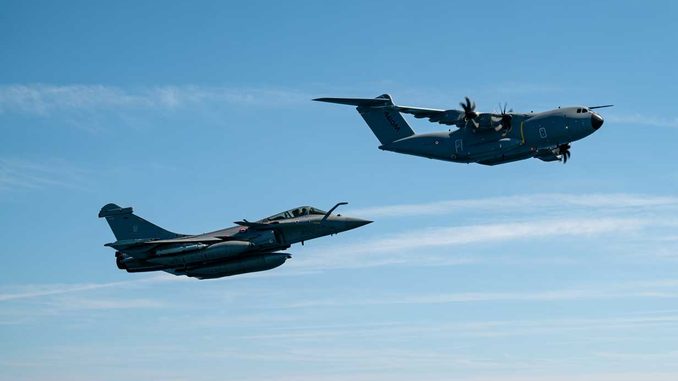
Rafale F4, MRTT, and A400M cover 40,000 km. Beyond the demonstration, PEGASE 26 tests France’s ability to act far and fast.
Executive Summary
With PEGASE 26, the French Air and Space Force deploys four Rafale F4 fighters, three A330 MRTT Phénix tankers, two A400M Atlas transports, and approximately 300 aviators across more than 40,000 km in 40 days. The mission crosses the Arctic, the Indo-Pacific, the Indian Ocean, and the Middle East. It allows France to test ultra-long-range air projection, as well as aerial refueling, logistics, command and control, and interoperability with partners such as the United States, Japan, South Korea, Indonesia, and India. However, its overall cost is not published. And four Rafales obviously do not constitute a force capable of conducting a major air campaign alone in the Pacific. The true utility of PEGASE lies elsewhere: preserving rare operational know-how, qualifying routes and bases, preparing for future crises, and maintaining strategic partnerships. The mission is also, quite clearly, a showcase for the French defense industry.
The PEGASE 26 Mission Far Exceeds 10,000 Kilometers
PEGASE 26 is not a simple round trip between mainland France and Réunion Island. The seventh edition of this air projection deployment, taking place from September 8 to October 15, 2026, covers over 40,000 km across nine stopovers.
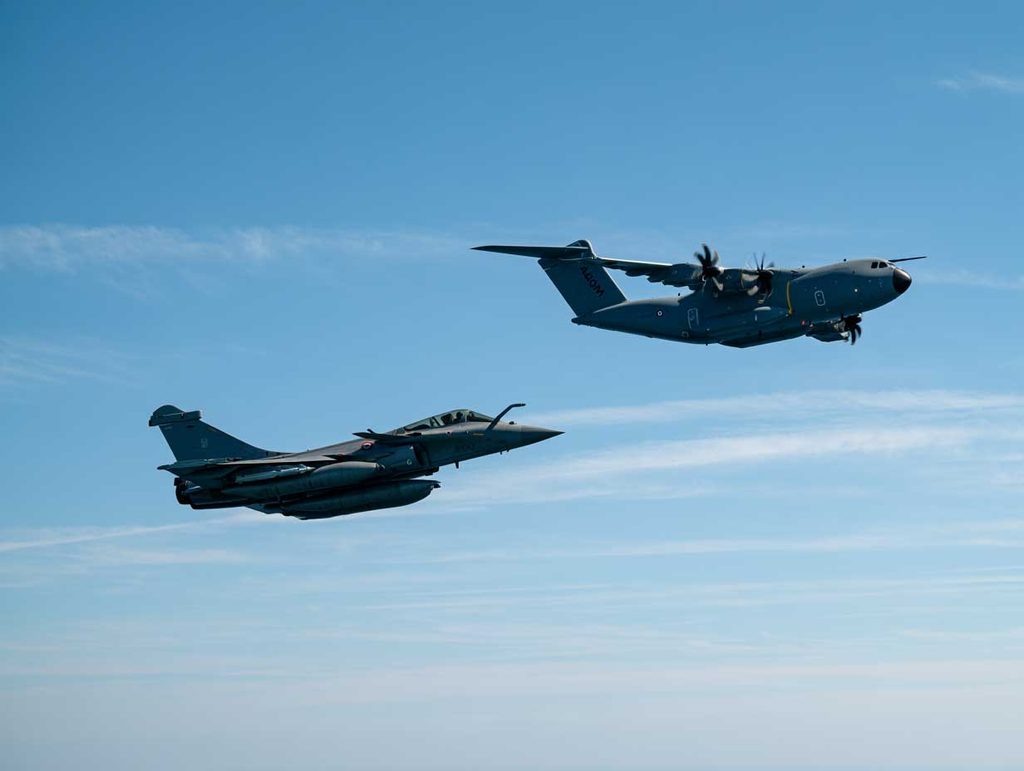
The primary detachment includes four Rafales conducting strategic power projection at the F4 standard, three A330 MRTT Phénix aircraft, two A400M Atlas transports, and about 300 airmen.
The first leg of the journey reveals a lot about the operational scope of the exercise. To reach Alaska from France via Greenland, the Rafales flew for eleven hours, requiring six aerial refuelings. An A400M opened the route ahead of them, staging through Kangerlussuaq and Pituffik Space Base.
This is not merely about proving that the Rafale can fly long distances—that capability has been demonstrated for a long time. The real test lies in simultaneously moving fighters, fuel, mechanics, spare parts, flight crews, and command elements together.
The Rafale-MRTT-A400M Triptych Forms the Core Strategic Capability
An isolated Rafale has limited range relative to the vast distances of the Pacific Ocean. Strategic capability emerges when three distinct aircraft types operate as a single unified system.
The A330 MRTT Phénix provides in-flight refueling while also carrying freight and personnel. The A400M Atlas transports technicians, ground support equipment, and spare parts packages required to generate fighter sorties once on the ground.
In Indonesia, the A400M and MRTT aircraft involved in PEGASE transported 37 tons of freight across the various legs of the deployment. Fifteen Rafale sorties, five MRTT sorties, and four A400M sorties were subsequently executed within four days.
This is what long-range air power projection truly entails. Flying four fighters across 10,000 km is relatively straightforward. Making them combat-ready upon arrival is significantly more complex.
French Autonomy Remains Relative
However, the term “autonomous” must be used with caution.
France retains complete control over its fighters, tankers, transport aircraft, personnel, and command structure. Commandement d’Appui et d’Opérations Aériennes (CAPCODA) at Lyon-Mont Verdun manages mission planning and execution monitoring directly from mainland France.
Yet autonomy does not mean self-sufficiency.
PEGASE depends on overflight rights, diplomatic clearances, foreign airfields, airport infrastructure, and partner support points. Greenland, Alaska, Japan, South Korea, Indonesia, and India are not merely coordinates on a map.
The deployment validates these operational access routes before a crisis occurs. This represents one of its most critical, yet least publicized, military benefits.
The True Cost of PEGASE 26 Remains Difficult to Quantify
At this stage, the French Ministry of the Armed Forces has not published a consolidated cost for PEGASE 26. Assigning an exact total figure would therefore be artificial.
However, budgetary reference points provide a sense of scale. A French Senate report estimates the operating and support cost of a Rafale at approximately €25,000 per flight hour. A parliamentary report previously placed A330 MRTT maintenance costs at around €11,500 per flight hour. An older parliamentary estimate placed the A400M at roughly €32,000 per hour, excluding procurement. These figures cannot be directly summed, as calculation methodologies and reference years differ.
Nonetheless, they demonstrate that PEGASE costs several million euros in flight activity alone.
For instance, 200 Rafale flight hours represent roughly €5 million using the €25,000 hourly reference rate. This calculation does not represent the full cost of PEGASE 26; it simply illustrates the financial scale. To this, one must add MRTT and A400M flight hours, fuel, maintenance, personnel allowances, accommodation, freight, infrastructure, and support.
The relevant question is not whether the mission is expensive—it is inherently costly. The core question is what capabilities and strategic returns France secures through this expenditure.
Exercises Turn Deployment Flying into Combat Training
The return on investment becomes clearer when PEGASE goes beyond ceremonial stopovers.
In Alaska, French Rafales trained in vast airspace alongside American F-22s and F-35 Lightning II fighters. In Japan, they conducted joint training with Japan Air Self-Defense Force F-2s. In South Korea, Rafales executed tactical exercises with South Korean F-35s for the first time.
In Indonesia, French and Indonesian Rafales and A400Ms completed their first combined flights. This cooperation is notable: Jakarta began receiving its first deliveries of Indonesian Rafale fighters in 2026.
Exercise Tarang Shakti, hosted by the Indian Air Force, takes integration even further. It brings together F-35s, Rafales, F-16s, A400Ms, and tankers from multiple nations in scenarios involving dozens of aircraft simultaneously.
This level of operational training is difficult to replicate in Europe. It exposes crews to foreign airframes, tactical procedures, and operational environments they would encounter within a real coalition.
France Defends Concrete Interests in the Indo-Pacific
Portraying PEGASE as a distant expedition for prestige would be misleading.
France counts roughly 1.6 million citizens in the Indo-Pacific, manages nearly 9 million km² of Exclusive Economic Zone (EEZ) in the region, and permanently deploys around 7,000 military personnel there. Réunion, Mayotte, New Caledonia, and French Polynesia transform major regional security developments into direct national security considerations for Paris.
Events in May 2024 demonstrated that this deployment capability is far from theoretical. During the crisis in New Caledonia, seven A400Ms participated in the rapid airlift of security personnel and equipment directly from mainland France.
Rapid long-range deployment serves combat missions, non-combatant evacuations, natural disaster responses, and military reinforcements alike.
The Commercial Objective Is Explicit
PEGASE doubles as an industrial showcase. Denying this aspect would be artificial.
General Julien Sabéné explicitly described the participating crews as ambassadors for the French defense industry. The choice of stopovers is telling: India and Indonesia operate the Rafale, Indonesia has ordered the A400M, and several mission partners are evaluating European defense systems.
Military diplomacy and defense exports reinforce each other.
An aircraft demonstrated in Alaska, refueled over the Pacific, integrated with F-35s in Korea, and maintained operationally for weeks in Asia offers a commercial argument no sales brochure can replicate.
This directly benefits Dassault Aviation, Airbus, Safran, Thales, and their supporting industrial base. However, industrial advantages alone do not justify a major military deployment.
Europe Benefits from PEGASE Without Becoming Automatically Stronger
PEGASE 26 remains a French sovereign operation, not a European Union military operation.
European benefits exist nonetheless. The A400M and A330 MRTT are European platforms. European allies participate in Tarang Shakti. The Arctic routing strengthens defense ties with Denmark and North America. Furthermore, the European Union has maintained an Indo-Pacific strategy since 2021, with security and defense highlighted as one of seven key pillars.
Yet a clear limitation remains. As long as lessons learned, operational procedures, and validated basing access remain primarily French, the military benefit to broader European defense remains indirect.
A true European long-range projection capability would require shared tanker fleets, common airbase access agreements, prepositioned stocks, interoperable command structures, and regular large-scale exercises.
The Primary Constraint of PEGASE Is Its Scale
Four Rafales provide a credible demonstration of strategic reach. They do not constitute an air campaign.
In a high-intensity Indo-Pacific conflict, a handful of fighters would be rapidly absorbed by air defense, escort, strike, and high-value asset protection requirements.
This is the main constraint revealed by the exercise. PEGASE proves that France can open a route, deploy a detachment, sustain it, and operate alongside allies. It does not prove that France could independently sustain dozens of fighters for extended weeks at a distance of 15,000 km.
However, that is not its primary goal.
The true strategic value lies in maintaining first-echelon capability: arriving quickly, securing operational access, establishing support logistics, integrating follow-on forces, and transitioning into a broader coalition effort.
This is where the cost-benefit ratio of PEGASE proves defensible. A military force cannot wait for a crisis to learn how to refuel fighters six times in eleven hours, move 37 tons of spare parts across the globe, or verify which foreign bases will accommodate its aircraft.
Without regular operational deployments, strategic projection capabilities exist mainly on paper. PEGASE transforms theoretical doctrine into real-world operational execution. The challenge for Paris moving forward will be demonstrating that it can scale up from four projected Rafales to a force large enough to carry decisive strategic weight if a crisis demands it.