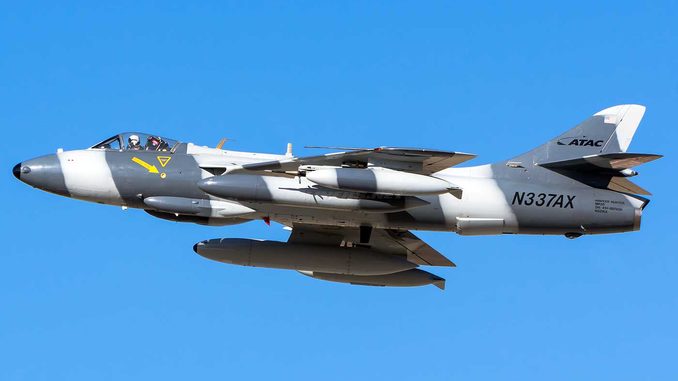
An ATAC Hawker Hunter crashed off the coast of California following a loss of thrust. Past incidents raise questions regarding engine performance and maintenance.
Executive Summary
On September 22, 2026, a Hawker Hunter Mk 58 operated by the Airborne Tactical Advantage Company, or ATAC, crashed into the Pacific Ocean off Morro Bay, California, during an exercise supporting the U.S. Navy and U.S. Marine Corps. The pilot of aircraft N345AX reported a loss of engine thrust, issued a Mayday, and ejected. He was recovered by a U.S. Navy helicopter. No specific defect has been identified yet, making caution essential. However, this accident is not an isolated event. Since 2018, several ATAC Hawker Hunters have been lost following partial or total power losses. Notably, a 2022 investigation identified a bearing failure in the high-pressure fuel pump governor. Other accidents have remained unexplained. This history justifies the preventive grounding of the fleet, though it does not yet support a definitive conclusion of a systemic defect or poor maintenance.
Hawker Hunter N345AX Lost Thrust Off Morro Bay
The accident occurred on September 22 at approximately 6:50 p.m. local time. The Hawker Hunter Mk 58, registered as N345AX, was participating in a military training mission off the central coast of California.
The aircraft was operated by ATAC, an American company specializing in providing adversary aircraft for armed forces. Its pilots simulate enemy fighters during interception exercises, air defense drills, and carrier strike group training.
The pilot declared a clear emergency over the radio, stating he had “lost thrust.” Controllers considered diverting the aircraft to Paso Robles, but the Hunter was over the Pacific. The pilot ultimately ejected before the aircraft crashed into the sea, approximately 10 km northwest of Morro Bay.
He was rescued alive by a U.S. Navy helicopter and transported to a hospital. ATAC confirmed he did not suffer serious injuries.
The U.S. Navy subsequently grounded the 22 Hawker Hunters operated by ATAC pending initial findings from the investigation.
This measure is significant, but it does not constitute proof of a widespread flaw. A safety stand-down is a standard precautionary procedure when an accident could potentially involve an element common to multiple aircraft.
The Rolls-Royce Avon Naturally Becomes a Central Focus
The Hawker Hunter is a British fighter jet designed in the early 1950s. The Mk 58 variant was originally intended for the Swiss Air Force.
According to Federal Aviation Administration records, N345AX is a single-engine jet equipped with a Rolls-Royce Avon Mk 207. The Avon belongs to the first generation of British axial-flow turbojets. Variants installed on the Hunter produce approximately 45 kN of thrust, or roughly 10,150 lbf.
The critical factor lies elsewhere: the Hunter has only one engine.
On a modern twin-engine aircraft, losing one engine theoretically leaves an opportunity to continue flight. On a Hunter, a total and sustained loss of thrust instantly converts the fighter into a glider. The pilot must retain enough energy to reach a runway or elect to eject.
Loss of Thrust Does Not Yet Reveal the Cause
Above all, premature assumptions must be avoided. A loss of thrust is a symptom, not a diagnosis.
It can result from a fuel supply issue, a high-pressure pump, a governor, an engine-driven accessory, a lubrication problem, a compressor or turbine failure, or even a control system anomaly.
As of September 27, none of these hypotheses have been confirmed for N345AX.
The investigation will examine maintenance logs, engine components, recent work performed, fuel quality, available flight parameters, and radio communications. The recovery of the wreckage will be decisive if technically feasible.
Blaming maintenance at this stage would be premature.
Past Incidents Reveal Several Worrying Power Losses
However, the accident becomes more significant when placed in the context of recent ATAC Hawker Hunter history.
In December 2018, aircraft N323AX suffered a total loss of power after takeoff from Honolulu. The pilot attempted an engine reignition before ejecting at less than 150 m (approx. 500 ft) above the ground.
The NTSB recovered part of the engine and tested several components. The high-pressure pumps, fuel filter, and various other elements operated normally. The agency ultimately concluded a total loss of power for undetermined causes.
The June 2022 incident is far more revealing.
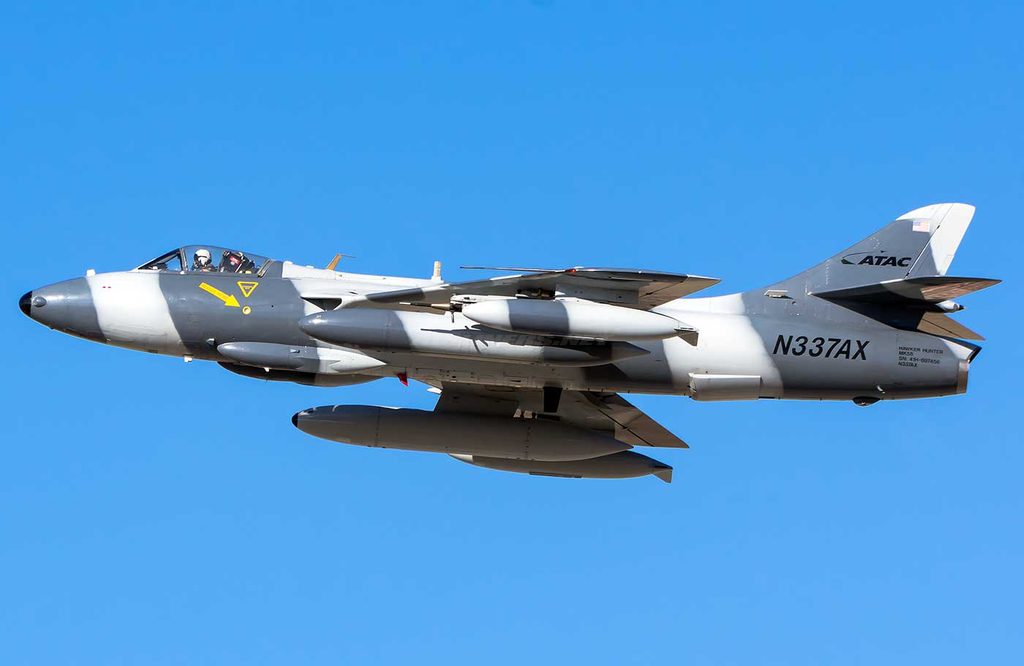
Aircraft N337AX was cruising at approximately 7,300 m (24,000 ft) off the coast of North Carolina when it suffered a partial power loss. Engine speed stabilized around 5,000 rpm, whereas between 6,800 and 7,200 rpm is required to maintain altitude and return to an airfield.
The pilot ejected at approximately 910 m (3,000 ft).
This time, the wreckage was recovered.
The NTSB discovered a failed bearing in the high-pressure fuel pump. Output pressure dropped to no more than 5.9 MPa (850 psi), compared to a normal operating range of 13.1 to 15.2 MPa (1,900 to 2,200 psi).
The pump defect was officially cited as the probable cause of the power loss.
A third accident occurred on October 15, 2025, off Big Sur. Aircraft N335AX was flying at roughly 6,700 m (22,000 ft). Following a power reduction intended to conserve fuel, the engine flamed out completely. Multiple reignition attempts failed.
The aircraft was never recovered. The NTSB concluded a total loss of power due to undetermined causes.
Including the Morro Bay crash, at least four ATAC Hunters have been lost since 2018 in events involving partial or total power loss.
This frequency is unusual enough to warrant thorough analysis.
Hunter Accidents Do Not Point to a Single Defect
It would be equally misleading to attribute all Hawker Hunter accidents to engine failures.
In 2012, ATAC’s N329AX crashed at Point Mugu. The primary issue was a severe fuel imbalance that ultimately rendered the aircraft uncontrollable. The investigation identified an improperly assembled transfer valve and motor.
At the time, the NTSB highlighted specific shortcomings: insufficiently documented maintenance procedures and a lack of Hunter-specific technical training. ATAC and the U.S. Navy subsequently revised several operational procedures.
In 2014, N332AX was lost following a loss of control at low speed during final approach. Examination revealed no decisive engine defects.
In 2017, N338AX crashed into the Pacific following a loss of control during an exercise, likely caused by crossing another aircraft’s wake turbulence. Again, the engine was not identified as the cause.
The operational record demonstrates several distinct categories of accidents: human factors, fuel systems, loss of control, and propulsion failures.
This is precisely why analyzing a retired military aircraft operated in civil aviation cannot be limited to the age of its airframe.
Maintenance Is a Legitimate Question, But Not Yet an Answer
The case of N345AX illustrates the complexity of the matter.
The FAA registered it as a 1973 Hawker Hunter. Its history actually goes back further. The aircraft originally flew for the Royal Air Force under serial XF947 starting in 1956, before being converted and transferred to Switzerland. It later enjoyed a second civil career in Great Britain under registration G-PSST and the nickname “Miss Demeanour.”
An aircraft of this generation can remain safe if it receives appropriate maintenance. However, that maintenance becomes exceptionally demanding.
Operators must monitor structural fatigue, corrosion, fuel and oil systems, engine accessories, and life-limited parts. They must also have access to traceable spare parts and procedures suited to an aircraft designed over 70 years ago.
ATAC does not use these aircraft for simple airshows. These planes carry out tactical missions and high-performance flights on historic military jets within a demanding operational environment: tactical profiles, rapid power changes, military exercises, and a utilization rate higher than that of many private warbirds.
This does not prove negligence. It simply highlights the necessity of rigorous technical oversight.
The 2022 precedent proves that a genuine mechanical failure in a fuel system component can disable the Rolls-Royce Avon. The 2012 precedent also proves that maintenance errors have previously played a role in an ATAC Hunter crash. However, no public evidence currently connects those past events to N345AX.
Repeated Failures Now Demand a Technical Response
A total loss of thrust is not a common occurrence in modern jet aviation. For ATAC’s Hunter fleet, the recent repetition of such incidents deserves serious attention.
Crucially, one key metric is missing to accurately evaluate the risk: the exact number of flight hours accumulated specifically by ATAC’s Hawker Hunters during this timeframe. Without this denominator, calculating a precise accident rate is impossible.
ATAC states it has logged over 125,000 flight hours across its entire fleet since its inception, but that figure encompasses several aircraft types. It does not isolate the reliability of the Hunter alone.
The Morro Bay investigation must answer a specific question: does the failure of N345AX share a common mechanism with previous accidents?
If investigators discover another failure in the fuel system, high-pressure pump, or engine accessories, the hypothesis of a recurring defect will gain significant weight. If the cause is entirely different, the broader picture will be more nuanced.
Grounding the 22 aircraft now offers technicians the opportunity to compare engines, pumps, oil systems, maintenance records, and operational hours across the entire fleet.
That is likely where the most critical information resides. The debate is not whether a vintage aircraft can still fly safely—thousands do. The question is whether a single technical flaw is repeating itself across a fleet used intensively to prepare U.S. Navy pilots for combat.