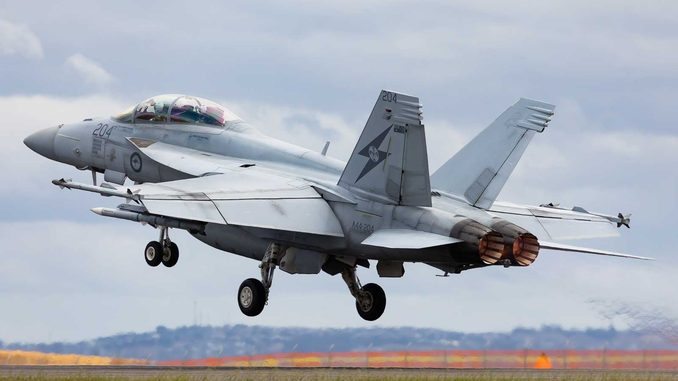
The US Navy is transforming its Carrier Air Wings: F-35C, F/A-XX, drones, and Super Hornet Block III are reshaping American naval aviation power.
Executive Summary
The US Navy has undertaken a profound transformation of its carrier air wings. However, calling an imminent retirement of the F/A-18E/F Super Hornet would be inaccurate. Boeing’s fighter will remain a major element of Carrier Air Wings throughout the 2030s and will retain operational capability well into the 2040s. The shift is happening elsewhere. The Navy is gradually reducing its reliance on a single aircraft that performed air defense, strike missions, and even a portion of aerial refueling all on its own. The F-35C brings stealth and data fusion. The MQ-25A Stingray is set to take over tanking duties. And Boeing has just been selected to develop the F/A-XX, the future sixth-generation carrier-based fighter. The objective is therefore not simply to replace the Super Hornet. It is about rebuilding the Carrier Air Wing around a system of systems, blending crewed aircraft, distributed sensors, and uncrewed platforms.
The Super Hornet Remains at the Core of Carrier Air Wings
The F/A-18 Super Hornet is not yet an aircraft at the end of its operational career. Having entered service with the US Navy in 1999 and deployed for the first time aboard USS Abraham Lincoln in 2002, it still forms the backbone of American carrier aviation.
The current structure of a Carrier Air Wing illustrates this. The baseline template published by Naval Air Forces Pacific plans for roughly 44 strike fighters split across four squadrons. Depending on the configuration, one 12-aircraft squadron may be equipped with F-35Cs, while the other three remain primarily outfitted with F/A-18E/Fs. Added to this are typically five EA-18G Growlers, four E-2D Advanced Hawkeyes, MH-60s, and logistics aircraft.
This is already the model observed across several air wings. Carrier Air Wing 9 deployed aboard USS Abraham Lincoln paired a single F-35C squadron with three Super Hornet squadrons. Carrier Air Wing 5, forward-deployed to Japan aboard USS George Washington, likewise combines F-35C, F/A-18E/F, and EA-18G aircraft.
The shift is thus gradual. The F-35C is not displacing the Super Hornet from the flight deck immediately. It is first arriving to operate alongside it.
The F-35C Gradually Replaces F/A-18E/F Squadrons
This coexistence will nevertheless evolve. The Navy is now preparing a new phase of conversion toward the F-35 Lightning II.
Its stationing plan outlines the transition of seven existing F/A-18E/F squadrons into F-35C squadrons, representing 70 aircraft at a rate of ten per unit, over a period of roughly ten years. The final basing decision must notably resolve between NAS Lemoore in California and NAS Oceana in Virginia.
The process is already underway. VFA-147 operates the F-35C within Carrier Air Wing 5. VFA-97 has also transitioned to the F-35C within Carrier Air Wing 2. In February 2026, VFA-115 completed its own transition to the stealth aircraft.
This replacement follows operational logic. The F-35C can penetrate heavily defended airspace with a reduced radar signature. Most importantly, its sensor suite and data fusion allow it to detect, classify, and transmit information to other aircraft or ships within the Carrier Strike Group.
For its part, the Super Hornet retains very concrete advantages: payload capacity, availability, versatility, and logistical maturity. The two aircraft therefore fulfill complementary rather than interchangeable roles.
Block III Pushes Back the Super Hornet’s Retirement
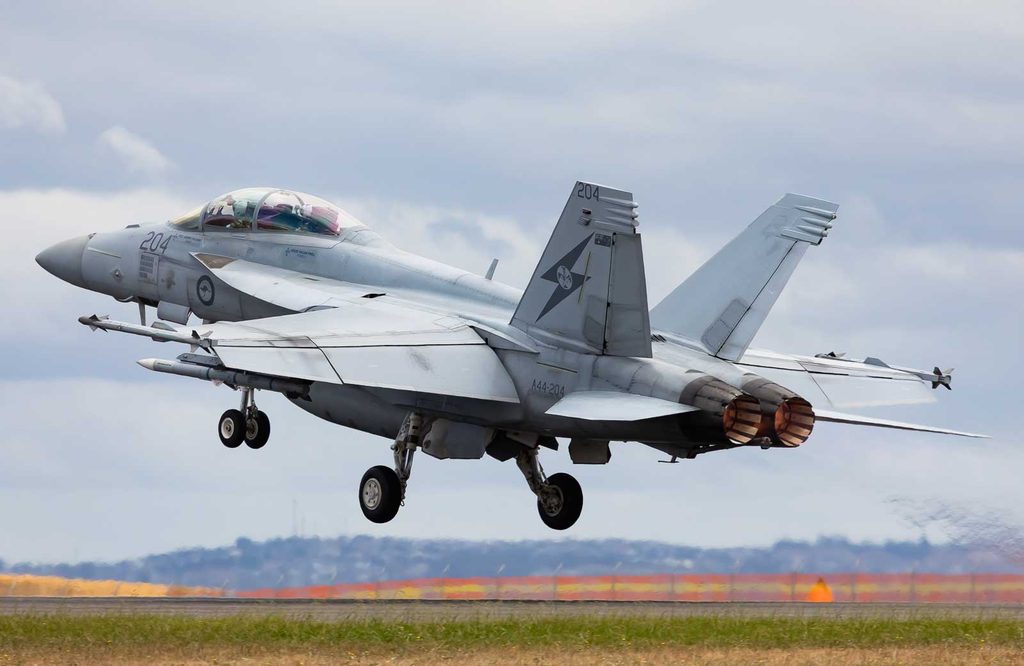
The term “phase-out” should indeed be handled with caution. In March 2024, the US Navy ordered another 17 F/A-18E/F Block III aircraft for $1.3 billion. Deliveries are set to begin in the winter of 2026 and wrap up by spring 2027 at the latest. This marks the last known US order for newly built aircraft.
However, the end of production does not mean the end of service.
The Service Life Modification program is transforming airframes originally rated for approximately 6,000 flight hours to extend their potential up to 10,000 hours. Upgraded airframes are also progressively receiving Block III standard features: a widescreen cockpit display, modernized computing architecture, enhanced networking capabilities, and reduced radar signatures. In April 2026, Fleet Readiness Center Southwest completed its first fully in-house Block III transformation.
The Navy now indicates that the Super Hornet will remain a key asset for Carrier Air Wings into the 2030s and will maintain significant combat capability into the 2040s.
The platform even continues to receive new ordnance. In February 2026, the US Navy declared the GBU-53/B StormBreaker—or Small Diameter Bomb II—operational on the F/A-18E/F, enabling it to engage moving or stationary targets in adverse weather.
The MQ-25 Relieves the Super Hornet of One of Its Most Costly Missions
The transformation of the Carrier Air Wing involves more than just replacing fighters. It also alters how they are used.
For years, Super Hornets performed aerial refueling for their own formations via the “buddy tanker” configuration. While effective, it was costly. Every F/A-18 tasked with tanking was unavailable for combat missions and accumulated flight hours rapidly.
The MQ-25A Stingray is set to gradually assume this responsibility. The Navy achieved Milestone C in May 2026 before ordering the first three low-rate initial production aircraft in September. First deliveries from this batch are now planned for 2029. The overall program currently encompasses 76 aircraft, including prototypes and test assets.
The stakes extend beyond the drone itself. By taking tanking duties off the Super Hornet’s shoulders, the MQ-25 frees up more fighters for strike operations, preserves airframe life, and extends the Carrier Air Wing’s operational reach.
This represents one of the most critical transformations in American naval aviation: each platform becomes more specialized, yet the air wing as a whole becomes more integrated.
The F/A-XX Now Emerges as the True Successor
The final piece of the puzzle has just fallen into place.
On September 29, 2026, the US Navy selected Boeing to develop the F/A-XX, its future sixth-generation carrier-based fighter. The development contract is valued at roughly $20 billion and includes several test aircraft dedicated to qualification, systems integration, and weapons testing campaigns.
This decision brings significant clarity to the Super Hornet’s succession. While the F-35C increases the proportion of stealth aircraft in Carrier Air Wings, the F/A-XX stands as the direct long-term successor to the F/A-18E/F.
Few detailed specs have been made public. However, the Navy emphasizes greater range, an open architecture, new mission systems, and the ability to operate alongside crewed and uncrewed platforms. The program is slated to begin replacing Super Hornets during the 2030s.
The future air wing will likely no longer rely on a single dominant multirole fighter like the Super Hornet. Instead, it will combine several tiers of capability: F-35C for stealth penetration and intelligence gathering, F/A-XX for next-generation air dominance, EA-18G or its successor for electronic warfare, E-2D for airborne command, and uncrewed platforms for refueling and, eventually, additional missions.
An End to Dominance Rather Than the Vanishing of an Aircraft
The transition undertaken by the US Navy runs deeper than a routine airframe replacement.
For nearly two decades, the F/A-18E/F handled nearly every combat mission launched from an aircraft carrier: interception, air superiority, strike, anti-ship warfare, reconnaissance, and aerial refueling. This concentration was remarkably efficient, but it relied heavily on a single aircraft family.
Future American carrier aviation follows a different logic. Stealth falls to the F-35C. Refueling transitions to the MQ-25. Electronic warfare remains with the EA-18G. The F/A-XX is expected to deliver range and air superiority against upcoming threats over the coming decades.
A look at the modern fighter jets catalog demonstrates how much this evolution mirrors a broader trend: the isolated performance of a single aircraft matters less than it once did. Decisive capability now resides in the networking between sensors, weapons, aircraft, and uncrewed systems.
The Super Hornet is not disappearing. It is gradually relinquishing its status as the central node around which the entire Carrier Air Wing was built. And that shift—far more than the impending closure of its American production line—truly marks the end of an era.